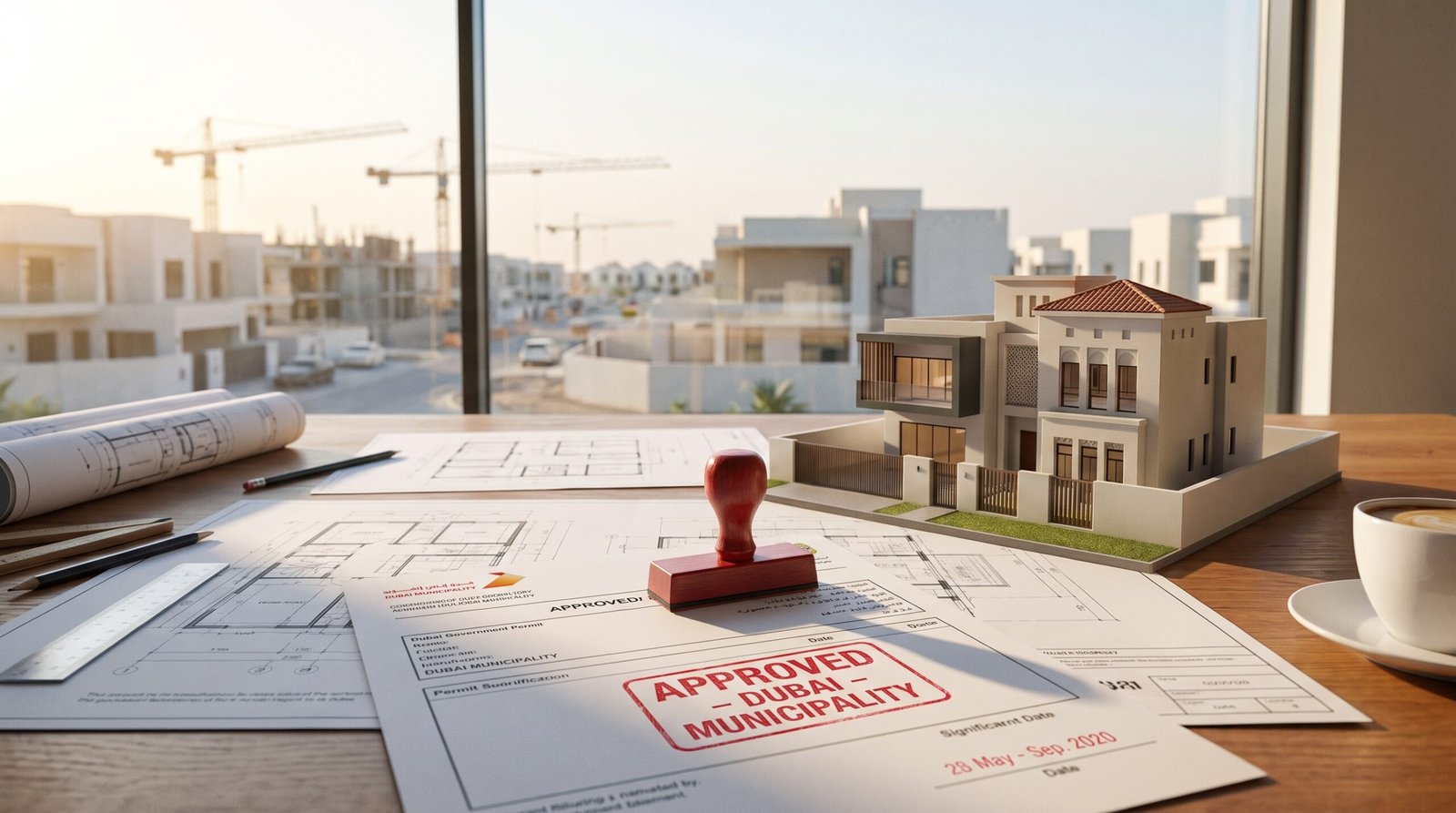
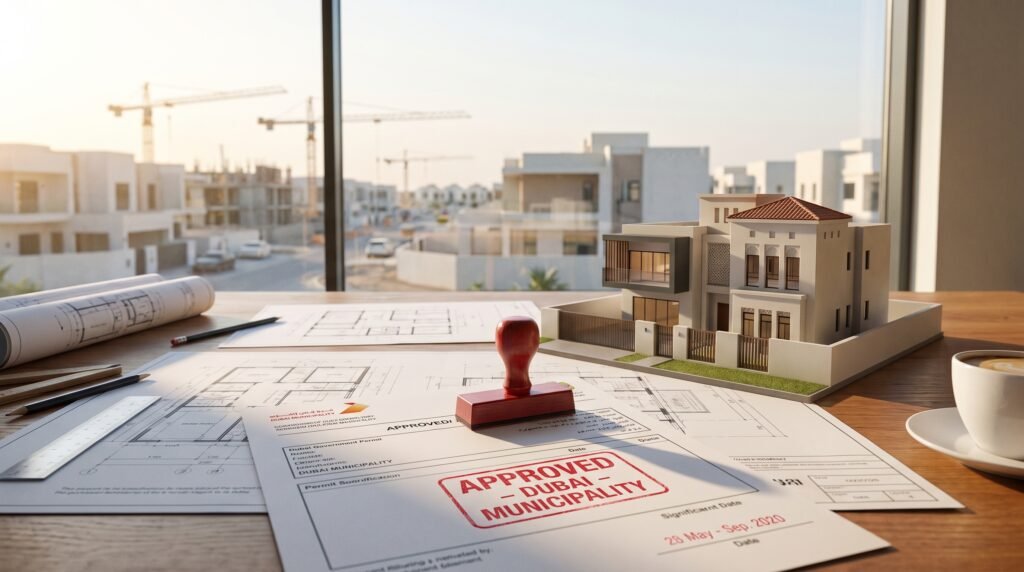
Renovation delays in Dubai often begin before the first wall comes down. A developer NOC, Dubai Municipality permit, DDA approval, Trakhees process, or building management clearance can affect the real start date. The exact route depends on the property, renovation scope, jurisdiction, and whether structural or shared building elements are involved.
That is why the Dubai renovation permits timeline is rarely a single number. A published authority review period covers only one stage. It does not include design revisions, contractor documents, access approvals, procurement, construction, snagging, or final handover.
The scale of Dubai’s construction activity adds useful context. Dubai Municipality issued 10,776 building permits in Q1 2026, up 12% from Q1 2025, while the permitted built-up area reached almost 3.9 million square meters.
This guide explains which approvals apply, how long each stage can take, what changes require permission, realistic timelines for kitchens, bathrooms, apartments, and villa extensions, and how delays affect storage, temporary relocation, and total renovation cost.
What approvals does a Dubai renovation need?
A Dubai renovation can involve three distinct approval layers: developer approval, authority approval, and building-management approval. The required combination changes with property type, jurisdiction, lease status, and renovation scope.
Start by identifying the authority governing the property. Dubai Municipality lists modification and addition permits for buildings under its system, while DDA and Trakhees operate their own modification and fit-out processes.
- Developer NOC
A developer No Objection Certificate (NOC) records the master developer’s consent for the proposed renovation. You usually encounter this layer inside a managed residential community.
You require a developer NOC when community rules control alterations, exterior appearance, additions, landscaping, or structural changes. Requirements differ by master community.
Emaar Community Management, for example, requires homeowners to submit home modification requests through its community portal. Its guidance also requires contractors to comply with local laws and obtain relevant engineering certifications before work affects structural integrity.
The practical route is straightforward:
- Prepare the proposed scope and drawings.
- Check the community’s modification guidelines.
- Submit the home modification request.
- Provide contractor and technical documents requested by the developer.
- Receive the NOC before controlled work starts.
Skipping this stage can block contractor access or trigger a violation. Emaar’s published guidelines allow a Notice of Violation and recovery of rectification costs when unauthorized work damages common areas.
- Dubai Municipality permit
A Dubai Municipality renovation permit authorizes regulated modification or addition works under the Municipality’s building-control system.
Your contractor or consultant uses this route when the property falls under Dubai Municipality, and the proposed work exceeds simple maintenance or decoration. Dubai Municipality lists a dedicated Permit to Make Modifications or Additions to Buildings for existing and under-construction buildings.
Decoration has a separate rule. Dubai Legislation Portal records Administrative Resolution No. 85 of 2019. It requires a permit for qualifying commercial structural units above 100 m². The application goes through an approved contractor using the Dubai Building Permit System.
Dubai Municipality currently also lists an instant self-permit for qualifying decorative works in units above 100 m². That route does not convert structural work into decorative work.
Where the Dubai Development Authority controls the location, the process changes. The Dubai Development Authority publishes a 5-working-day estimate for building modification design review. The subsequent building modification permit has a published service time of 2 working days.
Skipping the correct authority permit creates a compliance problem. The authority can require corrections, updated drawings, inspection, or regularization before completion.
- Building management approval
Building management approval governs contractor activity inside a jointly owned building and protects shared facilities and common parts. Dubai Land Department defines a management company as an RERA-approved entity responsible for managing shared facilities, shared properties, and common parts.
That layer matters most in apartment buildings because the contractor reaches the unit through common property. The building manager controls those common facilities under the jointly owned property framework.
Dubai’s Law No. 6 of 2019 classifies foundations, columns, structural walls, façades, roofs, elevators, tanks, shared pipes, ventilation systems, and shared utility infrastructure as common parts.
A building manager can therefore require documents linked to access and common-area protection under the property’s management rules. Exact contractor-document and deposit requirements remain building-specific, not Dubai-wide.
Building management approval does not replace a government modification permit or developer NOC. Each approval controls a different part of the project.
How long does each stage take?
There is no single Dubai renovation permit timeline because Dubai Municipality, DDA, Trakhees, developers, and building managers operate different approval routes.
The table separates official authority service times from stages without a Dubai-wide published turnaround.
| Approval stage | Practical timing | Fee or condition |
|---|---|---|
| DDA building modification design | 5 working days | AED 1,500 + AED 20 levies |
| DDA building modification permit | 2 working days | AED 1/ft² + AED 20 levies |
| DDA fit-out permit | 2 working days | AED 0.90/ft², AED 200 minimum, AED 10,000 maximum + AED 20 levies |
| DDA fit-out completion | 2 working days | No service fee listed |
| DDA modification completion | 3 working days | Normal submission has no fee |
| Dubai Municipality modifications/additions | No single duration is published on the service catalogue | Scope-specific service |
| Developer NOC | Community-specific | Developer rules apply |
| Building-management approval | Property-specific | Management rules apply |
For a DDA building modification, the published design and permit stages total 7 working days, excluding resubmissions, developer approval, owner documents, or other authority input.
The process does not necessarily end when construction finishes. DDA publishes another 3-working-day period for a building-modification completion certificate.
That makes 10 published DDA working days across design review, modification permit, and completion review when the three stated service periods apply without resubmission.
What you cannot change without approval
Substantial structural changes, external alterations, and changes involving common parts require formal approval under Dubai’s jointly owned property framework. The Dubai Legislation Portal states this directly in Law No. 6 of 2019.
Article 7 lists structural supports, foundations, columns, structural walls, façades, roofs, shared utility equipment, ventilation systems, pipes, and electrical infrastructure among common parts.
Article 39 states that an occupant can make substantial structural or external alterations only after approval from the Master Developer, Dubai Land Department, and Competent Authority.
For tenants, Dubai Law No. 26 of 2007 adds another restriction. Article 19 prevents a tenant from changing or restoring the property without landlord permission and the licences required by competent authorities.
Article 18 also requires the landlord to provide approvals requested for permitted decoration work when the work does not affect the property’s structure.
Check approval status before altering structural walls, common ventilation, shared services, façades, external openings, or substantial building geometry. Those elements appear directly within the legal approval framework.
Realistic project timelines by scope
Renovation duration includes more than authority processing. Current Dubai contractor and project-management benchmarks separate design, approvals, procurement, site construction, snagging, and handover.
These figures are market planning ranges, not Dubai government service standards.
| Scope | Current Dubai planning range | Evidence |
|---|---|---|
| Kitchen only | About 5 to 8 weeks for a typical full project | Current Dubai sources report 4.5 to 8 weeks depending on size and scope. |
| Bathroom only | About 4 to 9 weeks, including front-end preparation | Current project-management benchmarks place single-room projects around 4 to 7 weeks, while turnkey estimates reach 6 to 9 weeks. |
| Full 1- to 2-bedroom apartment | About 9 to 15 weeks | Two current Dubai sources report 9 to 15 weeks and 9 to 14 weeks. |
| Full 2- to 3-bedroom rebuild | About 14 to 20 weeks | Current turnkey estimates place a full gut renovation at 14 to 20 weeks. |
| Villa with structural changes | About 24 to 42 weeks | Current market estimates span 24 to 40 weeks and 28 to 42 weeks. |
Kitchen only
A kitchen-only renovation commonly occupies about 5 to 8 weeks across design, procurement, approvals, site work, and handover for a standard non-structural project. Two current Dubai renovation sources place standard complete programmes within roughly this range.
Current Dubai kitchen data places custom cabinet manufacturing around 7 to 14 days in one published schedule.
The same source places stone worktop fabrication after templating at roughly 3 to 5 days.
Lock cabinetry dimensions, appliance specifications, sink positions, and worktop selections early because those items control later fabrication stages.
- Bathroom only
A bathroom-only renovation commonly sits within a 4 to 9-week door-to-door planning range, depending on the amount of plumbing, waterproofing, tiling, approvals, and custom work.
A current Dubai bathroom schedule places a full renovation with a new layout and plumbing changes at 3 to 5 on-site weeks. A custom master bathroom can reach 5 to 7 on-site weeks.
The same schedule allocates 24 to 48 hours to a waterproofing flood test before tiling.
Confirm drain positions, sanitaryware dimensions, concealed fittings, and tile quantities before first-fix plumbing. Changing those items later can reopen finished surfaces.
- Full apartment
A full 1 to 2-bedroom Dubai apartment renovation has a current planning range of about 9 to 15 weeks from design and approvals through construction and handover.
A deeper 2- to 3-bedroom strip-out and rebuild can reach 14 to 20 weeks in current Dubai turnkey estimates.
This is the point where renovation duration determines the storage term.
A full apartment renovation runs about 9 to 15 weeks, including approvals and construction. Furniture stored for three to four monthly billing periods costs about AED 5,400 to AED 7,200 at a current AED 1,800 monthly 100-square-foot Dubai storage rate.
That 100-square-foot unit is advertised for full-apartment contents on a monthly rolling basis.
A four-week renovation extension can therefore add another AED 1,800 at that specific published rate, before collection, redelivery, or optional services.
Storage prices vary materially by operator and specification. Another current Dubai price list places 100-square-foot climate-controlled storage at AED 1,800 to AED 2,800 per month including VAT.
- Villa extension
A villa extension sits at the longest end of the renovation programme because structural design and authority approvals enter the schedule before physical construction. Current Dubai structural-villa estimates span roughly 24 to 42 weeks.
One current project-management benchmark divides a structural villa project into 10 to 14 weeks for design and permits plus 18 to 28 weeks for construction.
Dubai Municipality lists a specific modification-and-addition permit route for existing buildings.
Trakhees requires completed facilities in its jurisdiction to obtain a Modification Permit before modification or fit-out work starts.
Where a master community controls the villa, developer approval can form another pre-start stage. Emaar, for example, requires approval for villa alterations in its published community guidance.
Why renovations overrun and what that costs
Renovations overrun when drawings change, decisions arrive late, approvals require resubmission, materials arrive after their installation window, or one trade blocks the next.
UAE research supports that pattern. A peer-reviewed UAE construction study identified design variation, unrealistic schedules, permit delays, inaccurate time estimates, and client change orders among the leading causes of time overruns.
Procurement also deserves its own line in the programme. Turner & Townsend’s 2026 Middle East market intelligence reports that lead times for critical components such as transformers, escalators, lifts, and generators can exceed 12 weeks. It also places Dubai construction inflation at 5% for 2026.
Those figures describe the wider construction market rather than a kitchen quote. The implication still matters. Late specification creates exposure to longer procurement and changing prices.
For a residential renovation, calculate delay cost as:
- extra contractor time + storage extension + temporary accommodation + revised material orders + additional access or permit charges
A one-month delay also means one more month of furniture storage when the property remains cleared for construction.
Living in the property versus moving out
Living in the property fits partial renovations better than whole-property strip-outs because occupied projects require room-by-room sequencing and protected liveable zones. Current Dubai renovation guidance recommends retaining access to essential rooms during phased occupied work.
A partial project can keep one bathroom or one living zone operational while another area is under construction.
Full renovations create a different problem. Demolition, mechanical and electrical work, tile removal, dust, and simultaneous loss of essential rooms make continued occupation harder.
Occupied projects also require phased sequencing rather than opening several rooms simultaneously, which can produce a longer programme.
Compare the cost of temporary accommodation and storage against the added programme created by occupied phasing. For a 9- to 15-week full apartment programme, that calculation covers roughly two to four months of temporary arrangements.
FAQs
How long does a Dubai renovation permit take?
There is no single Dubai-wide permit duration. DDA publishes 2 working days for a modification permit and 5 working days for modification-design review.
Does every apartment renovation need Dubai Municipality approval?
No. The applicable route depends on jurisdiction and scope, while structural changes and common-part alterations require the relevant competent approvals.
Can you remove a structural wall in a Dubai apartment without approval?
No. Dubai Law No. 6 of 2019 classifies structural walls as common parts and requires approval for substantial structural alterations.
Does a tenant need landlord approval for renovation work?
Yes. Article 19 of Dubai Law No. 26 of 2007 requires landlord permission and applicable official licences before a tenant makes changes or restoration works.
How long does a kitchen renovation take in Dubai?
A standard complete kitchen project commonly falls around 5 to 8 weeks, while structural or heavily customized kitchens can run longer.
How long does a full apartment renovation take in Dubai?
Current Dubai planning benchmarks place a 1- to 2-bedroom full apartment at about 9 to 15 weeks and deeper, larger-apartment projects around 14 to 20 weeks.
How long does a structural villa renovation take?
Current Dubai market benchmarks span roughly 24 to 42 weeks for villas involving structural changes, depending on design, approvals, procurement, and construction scope.
What causes renovation delays in the UAE?
A peer-reviewed UAE study identifies design variation, unrealistic schedules, permit delays, inaccurate time estimates, and client change orders as its top five time-overrun causes.
Why does the renovation timeline matter for furniture storage?
Storage is usually billed by time and unit size, so extending a renovation can add another monthly storage charge.
Rakan Al-Juraid is a logistics specialist with a focus on commercial storage systems and high-security asset management. With extensive experience in industrial warehousing, he specializes in inventory tracking technology and transit safety. Rakan’s expertise lies in streamlining the storage process for both businesses and homeowners through strategic planning. His writing offers data-driven advice on insurance for stored goods, fire-safe environments, and heavy-duty logistics. He is committed to ensuring that every square foot of storage is utilized with maximum security and efficiency. Rakan aims to provide professional-grade storage standards to every reader navigating the moving process.
- Rakan Al-Juraid
- Rakan Al-Juraid
- Rakan Al-Juraid
- Rakan Al-Juraid