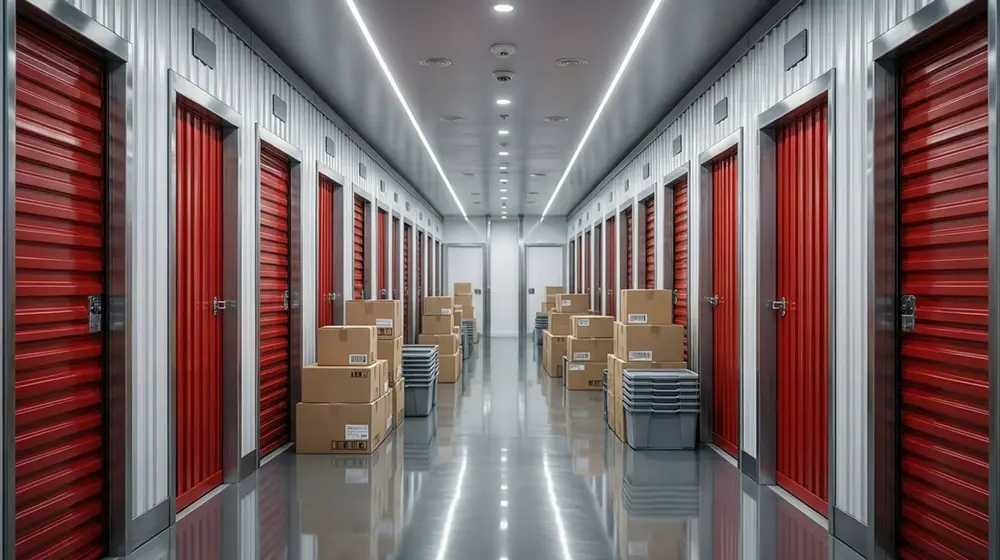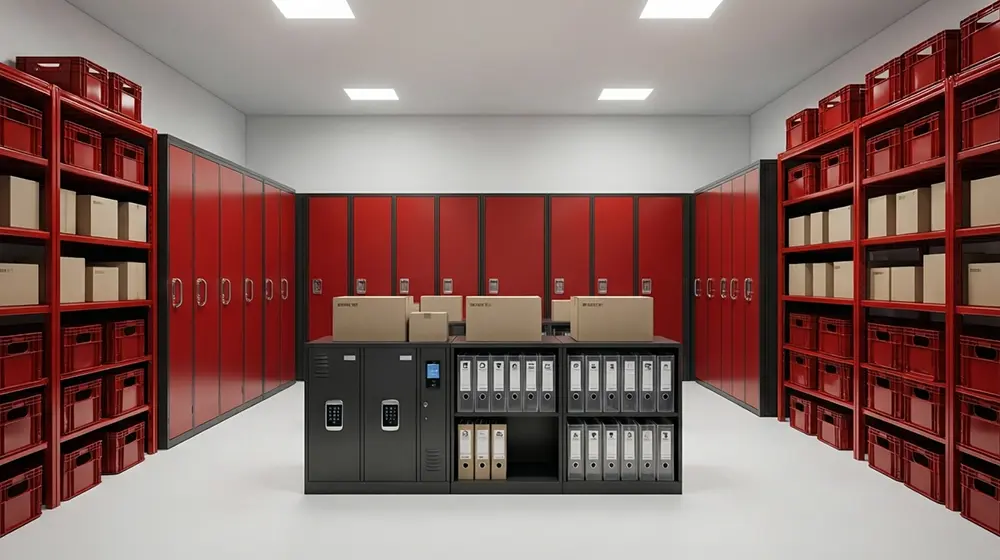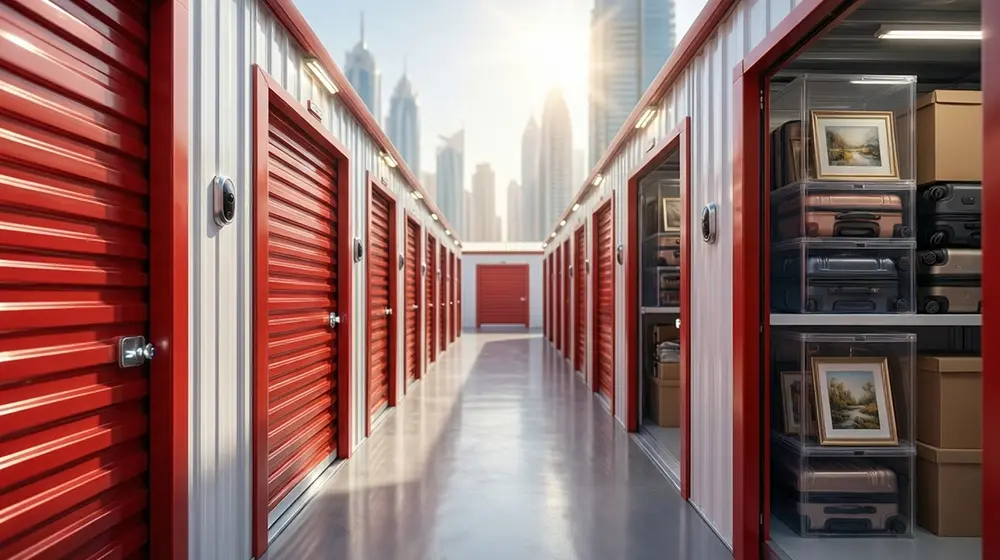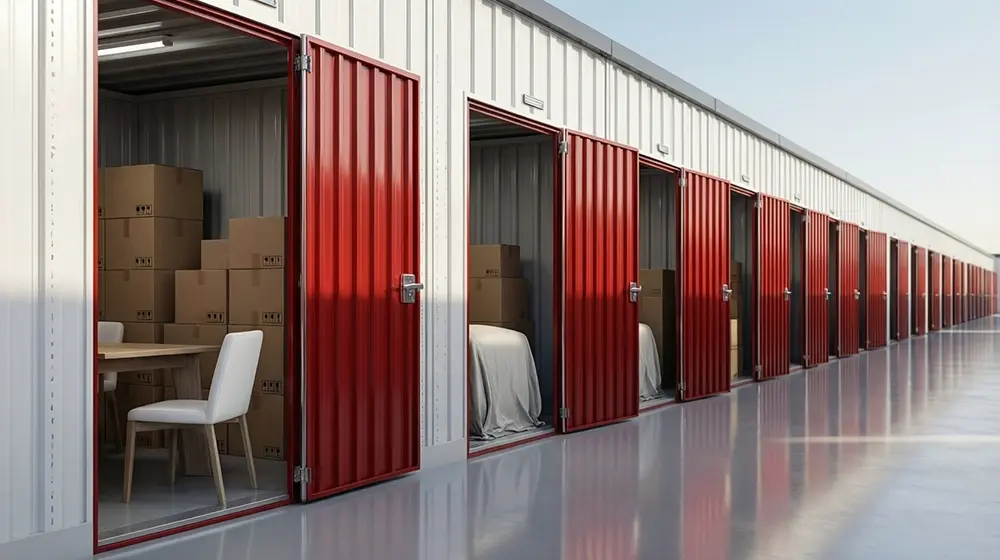

Dubai residents are running out of spare cupboards. Dubai’s population is on the brink of crossing the 4.0 million mark. The population stood at 3,999,247 as of August 25, an increase of 3.5 per cent, or more than 134,000 people, since the start of the year. More tenants and SMEs are turning to self-storage instead of upsizing their homes or offices. At the same time, the UAE self-storage market already generates about USD 602.5 million in annual revenue and is forecast to reach roughly USD 859.2 million by 2030, which means more units, more moves, and more chances for things to go wrong if packing is rushed.
Dubai’s climate adds another layer of pressure. August highs around 106°F to 112°F and humid days that often sit near or above 60 % turn ordinary cardboard, textiles, and electronics into high-risk items when stored carelessly. In this setting, the difference between random boxes and a properly planned packing kit is the difference between smooth move-in days and avoidable damage, mold, or lost documents.
This guide walks through eight specific packing and organization items, shows why each one matters in Dubai conditions, and explains the surprisingly large financial and practical impact behind what looks like simple preparation.
What are the top 8 must-have packing and organization items before moving into your Dubai self-storage unit?
The top 8 must-have packing and organization items before moving into your Dubai self-storage unit are standardized double-walled boxes, clear plastic bins with lids, protective wraps and quality tape, pallets and metal shelving, moisture absorbers, a structured labeling and inventory system, textile and mattress protection, and a first access plus document container pair.
Below, each section answers one question, presents quantified evidence, and explains the surprising reason that connects each item to Dubai conditions.
1. Why are standardized double-walled boxes a priority before moving into your Dubai self-storage unit?
Standardized double-walled boxes are a priority because they reduce crush damage and unlock more usable cubic volume inside a Dubai self-storage unit.
Key facts about packaging failure
- Almost 11 % of goods are damaged during shipping due to inadequate packaging.
- Unsuitable packaging and poor preparation, plus human failure, accounted for losses and damage claims.
- Around 20 % of consumers return items due to transit damage, which erodes revenue and trust.
These figures show that packaging design, not only transport events, often drives damage.
Why does this matter in a Dubai self-storage unit?
- Double-walled boxes tolerate higher stacking loads, which is important in units where tenants stack cartons four to six levels high.
- Standardized footprints reduce irregular gaps and increase the share of volume used for contents rather than voids.
- High temperature corridors in Dubai self-storage facilities make repeated rearrangement tiring, so stable towers reduce the number of moves per box.
How to use double-walled boxes effectively?
- Limit the weight per box to a value one person can lift safely in 30–40°C corridors, often 15–20 kilograms for many adults.
- Reserve double-walled cartons for books, tableware, tools, and dense household items.
- Use small or medium sizes for heavy items and keep large boxes only for light items such as bedding.
2. Which surprising advantage do clear plastic bins give inside a Dubai self-storage unit?

Clear plastic bins give the surprising advantage of combining humidity resistance with visual inventory control in a Dubai self-storage unit.
Dubai humidity and material risk
- Climate data indicates that Dubai’s coastal humidity frequently sits between 50 and 60 % on average.
- Indoor humidity above 60 % supports mold growth and dust mite activity on fabrics and paper.
Cardboard absorbs moisture, which reduces stacking strength and encourages mold on internal surfaces. Clear polycarbonate or polypropylene bins with locking lids respond differently.
Benefits of clear plastic bins in a Dubai self-storage unit
- Rigid plastic bodies resist moisture absorption better than cardboard under fluctuating humidity.
- Gasket or clip lids limit insect access to textiles, paper, and accessories.
- Transparent walls allow content identification without opening bins, which reduces handling impacts in the unit.
Recommended uses and configuration
- Place documents, photographs, and small electronics in clear bins with silica gel desiccant packs.
- Use smaller bins for photographic equipment, cables, and external drives.
- Stack bins on pallets or metal shelves, not directly on the floor, to avoid any contact with cleaning water or accidental spills.
3. How do stretch wrap, bubble wrap, and high-grade tape change the risk profile in your Dubai self-storage unit?
Stretch wrap, bubble wrap, and high-grade tape change the risk profile by reducing vibration damage and seam failure when items move into and inside a Dubai self-storage unit.
Evidence from loss and damage research
- A logistics study on damage costs in supply chains concludes that shocks, vibrations, and handling create many losses, but suitable packaging and preparation prevent a large share of that damage.
- Consumer behavior research notes that about 20 % of buyers return products due to transit damage, which highlights how sensitive goods are to moderate handling failures.
In Dubai, move-in days often involve two or more legs of transportation through high-temperature loading bays.
Reasons to prioritize quality wraps and tape
- August daytime temperatures near 41–43°C and high humidity can soften low-quality tape adhesives, which leads to box seams opening during handling.
- Stretch wrap stabilizes multi-item bundles, which reduces the risk of stack collapse when trolleys encounter floor thresholds in Dubai self-storage facilities.
- Bubble wrap introduces an energy-absorbing layer between glass, ceramics, and furniture edges and hard impacts.
Application sequence before entering a Dubai self-storage unit
- Wrap glass, mirrors, and framed artwork in acid-free paper, then bubble wrap, then corner protectors.
- Use cross-pattern tape on the bottom of heavy boxes, with at least three strips under each main seam.
- Apply stretch wrap around stacked cartons to form unified loads for corridor movement.
- Label wrapped bundles clearly to avoid cutting into protective layers later.
4. Why do pallets and metal shelving deliver more than simple neatness inside a Dubai self-storage unit?
Pallets and metal shelving deliver protection from ground moisture and better use of vertical space in a Dubai self storage unit.
Structural and damp-related evidence
- Direct contact between absorbent materials and damp floors increases mold growth and structural degradation over time.
- Warehouse layout articles highlight that poor use of vertical space often wastes 10–20 % of potential capacity, while cluttered floors raise trip and impact risks.
In Dubai, many self-storage units sit in converted warehouses or multi-level facilities where cleaning water, occasional condensation, or minor leaks are non-zero risks.
Surprising benefits of pallets and shelving in a Dubai self-storage unit
- Wooden or plastic pallets introduce a clear air gap between stored items and the floor, which reduces exposure to any standing water and fosters airflow.
- Boltless metal shelving uses the full height of the Dubai self storage unit, which is relevant because average Dubai apartments already compress floor area to about 800–950 square feet for 1-bedroom units and 1,200–1,500 square feet for 2-bedroom units.
- Shelving supports easier access to boxes containing documents or business inventory, which limits repeated lifting of heavy stacks.
Layout suggestions for pallets and shelving
- Position pallets along the back and one side wall to support heavy box stacks.
- Install metal shelving units near the front for frequently accessed boxes and plastic bins.
- Maintain a central aisle of at least 50–60 centimeters for safe movement and box retrieval.
5. What measurable role do moisture absorbers and desiccants play inside your Dubai self-storage unit?
Moisture absorbers and desiccants measurably reduce mold, rust, and odor formation risk inside a Dubai self storage unit by lowering local humidity around sensitive items.
Humidity thresholds and damage risk
- Building and health references state that relative humidity above 60 % supports mold and mite activity, and prolonged exposure often damages fabrics, wood, and paper.
- Electronics corrosion notes show that moisture and salts on printed circuit boards accelerate corrosion, leakage currents, and failure rates, particularly in warm climates.
Dubai’s summer climate crosses these thresholds regularly. Moisture management, therefore, becomes a core part of packing, not an optional step.
Types of moisture control used in a Dubai self-storage unit
- Silica gel or molecular sieve desiccant packets inside sealed containers.
- Calcium chloride-based absorber tubs are placed openly on shelves.
- Humidity indicator cards in boxes containing highly sensitive electronics or documents.
Placement rules inside the Dubai self-storage unit
- Place desiccant packs in every bin or carton that stores cameras, lenses, laptops, or external drives.
- Put absorber tubs on different shelves and corners of the Dubai self storage unit to spread coverage.
- Inspect and replace saturated absorbers at each visit, using color changes or fill levels as simple indicators.
6. How does a structured labeling and digital inventory system change daily reality in a Dubai self-storage unit?
A structured labeling and digital inventory system changes daily reality by cutting search time and preventing unnecessary handling inside a Dubai self-storage unit.
Why inventory discipline matters in Dubai?
- As of October 2025, Dubai’s population has reached 4,036,863, marking a 5.43% annual increase, in addition to over 208,030 new residents in just one year. And rent rises of 11–21 % have increased relocation frequency and storage usage across income segments.
- Moving and storage providers in the UAE consistently advise tenants to label every box and keep an itemized list to support both convenience and insurance documentation.
In practical terms, this means that the Dubai self storage unit often holds items that households will access several times during the year, not only at move-out.
Components of an effective labeling system for a Dubai self-storage unit
- A room code such as K for kitchen, B for bedroom, and L for living room.
- A sequence number such as K01, K02, K03.
- Simple priority markers such as F for fragile, H for heavy, and C for climate sensitive.
- A digital spreadsheet or note application that lists each code plus short content descriptions and approximate replacement values.
Benefits observed over time
- Lower probability of stack collapse, because tenants open fewer boxes and reorganize less frequently.
- Faster retrieval of work equipment or seasonal items from the Dubai self-storage unit.
- Better evidence portfolios for any future insurance queries.
7. Why do mattress covers, sofa covers, and moving blankets have a direct financial impact in a Dubai self-storage unit?
Mattress covers, sofa covers, and moving blankets have a direct financial impact because they extend the lifespan of high-ticket textiles and wood surfaces inside a Dubai self-storage unit.
Evidence on textiles and damp storage
- Housing and environmental health guidance notes that damp, poorly ventilated spaces create conditions for mold on mattresses, upholstery, carpets, and curtains, with both health and financial consequences.
- Articles on improper storage environments in hot climates describe faster degradation of fabrics, foam, and adhesives under combined heat and humidity exposures.
In Dubai, these conditions intersect with high replacement costs. Rental market data shows 1-bedroom apartments in many districts with annual rents in the 70,000–90,000 AED range and larger units with higher figures, which pushes tenants to preserve existing furniture longer.
Functions of textile and surface protection in a Dubai self-storage unit
- Mattress covers block dust and discourage pests from nesting in foam layers.
- Fabric or breathable plastic sofa covers reduce sunlight and dust exposure from corridor openings.
- Moving blankets protect varnished wood and glass during loading and stacking.
Implementation notes
- Use breathable covers for mattresses and sofas rather than sealed plastic films that trap moisture.
- Drape dust sheets over polished tables, pianos, and sideboards and secure with minimal tape around legs.
- Deploy moving blankets between furniture surfaces that contact each other during stacking.
8. What is the role of a first access box and a secure document container in a Dubai self-storage unit?
A first access box and a secure document container reduce disruption and protect critical records during the full period a Dubai self-storage unit remains in use.
Evidence from storage practice and risk management
- Self-storage guides from operators in the UAE and abroad repeatedly recommend a “first box in, first box out” containing essentials for early visits after move-in.
- Risk management standards on records highlight that centralizing key documents and digital backups simplifies response to fire, water, or insurance events.
Dubai’s high residential churn and multi-income household structure make fragmented document storage especially risky.
Contents of a first-access box for a Dubai self-storage unit
- Printed copy of the label and inventory list.
- Basic tools such as a cutter, spare labels, markers, and tape.
- Gloves and a simple dust mask for occasional dusty surfaces.
- A compact cleaning kit, such as microfiber cloths and mild cleaner.
Contents of a document and a valuables container
- Identification documents, property title papers, insurance policies, and key contracts are not kept in a bank box.
- External drives or encrypted devices containing backups are packed with anti-static bags and desiccants.
- A simple index stored in a separate physical location or secure digital account.
Summary table: Eight items and the surprising reason behind each one
| Item number | Packing or organizational item | Primary function in a Dubai self-storage unit | Surprising reason linked to Dubai conditions |
| 1 | Standardized double-walled boxes | Safer stacking and predictable load paths | Converts limited floor space into a higher usable cubic storage volume |
| 2 | Clear plastic bins with lids | Moisture-resistant and visually searchable containers | Reduce unnecessary box opening in hot, humid corridors |
| 3 | Stretch wrap, bubble wrap, high-grade tape | Stabilize loads and protect fragile surfaces | Maintain seam integrity and bundle stability in 40–43°C heat |
| 4 | Pallets and metal shelving | Elevate items and use vertical space | Protect from floor damp while offsetting Dubai’s high rent per square foot |
| 5 | Moisture absorbers and desiccants | Lower local humidity and condensation risk | Provide microclimate control in units that share a wider humid climate |
| 6 | Labeling and digital inventory system | Support fast retrieval and reduce box handling | Enable structured access in a city with frequent moves and high churn |
| 7 | Mattress covers, sofa covers, moving blankets | Shield textiles and wood from dust, abrasion, and mold | Extend the lifespan of costly furniture in a rising rent environment |
| 8 | First access box plus document and valuables container | Support early visits and protect critical information | Prevent repeated deep unpacking while centralizing high-value records |
How ready are you for moving into your Dubai self-storage unit? A short checklist
- All heavy contents are packed in double-walled boxes in two or three standard sizes.
- Humidity-sensitive items are stored in clear plastic bins with gasket or clip lids.
- At least two pallets or one shelving bay are planned inside the Dubai self-storage unit.
- At least two moisture absorber tubs plus desiccant sachets are ready for sealed containers.
- Every box is labelled with a code and content summary, and an inventory is saved digitally.
- Mattresses, sofas, and wood furniture are covered with breathable covers and dust sheets.
- One first access box is prepared and positioned near the unit door.
- One document and a valuables container assembled, with a separate backup for the index.
Conclusion: Are You Really Ready To Move Into Your Dubai Self Storage Unit?
No packing list feels exciting when you are already tired from viewings, rent negotiations, and paperwork. Yet in Dubai, where August heat sits above 40 degrees and humidity regularly pushes past comfort levels, the eight items in this guide quietly decide whether your storage unit becomes a clean extension of your home or a slow damage zone you dread visiting. The difference is rarely dramatic on day one. It shows up six months later in sagging boxes, musty mattresses, loose paperwork, and the sinking feeling that replacing “cheaply stored” furniture now competes with a rising rent bill.
Standardized boxes, clear bins, pallets, moisture control, and textile covers may look like simple accessories, but they work together as a small risk management system built for Dubai conditions. When you add structured labels and a first access plus document pair, every visit becomes faster, safer, and less stressful. You can find seasonal clothes, business records, or kids’ school items without dismantling half the unit in a hot corridor.
Before you sign another storage contract or call the movers, walk through the checklist again. If you can honestly tick seven or eight boxes, you are not just renting space. You are protecting the years of work, saving, and decision-making already locked into your furniture, electronics, and documents.
FAQs
Do I really need double-walled boxes if I am only storing items for a few months?
Yes, because even short-term storage often involves tall stacks and multiple moves, and single-wall cartons crush and split much faster.
Are clear plastic bins worth the higher cost compared with cardboard boxes?
They usually pay off when you factor in better humidity resistance, easier searching, and less handling damage over time.
Can I skip bubble wrap if I use plenty of towels and clothes around fragile items?
Towels help, but purpose-made wraps absorb shock more predictably and reduce the risk of hidden cracks in glass and ceramics.
Why should I bother with pallets if the storage floor looks dry and clean?
Floors can still collect cleaning water, condensation, or minor leaks, and a small air gap often decides whether boxes stay dry.
How many moisture absorbers do I need for a standard Dubai self-storage unit?
Most tenants start with at least two tubs plus desiccant sachets in sealed containers, then adjust based on how quickly they fill.
Is a digital inventory really necessary if I already label every box?
A simple spreadsheet or note lets you search by item and value, which is much faster than scanning labels during a hot visit.
Can I store mattresses and sofas without covers if the unit is climate-controlled?
You can, but dust, scuffs, and accidental spills still happen, and covers cost far less than deep cleaning or replacement.
What should I put in my first access box on move-in day?
Keep tools, labels, tape, copies of your inventory, basic cleaning items, and any essentials you expect to need on early visits.
Where is the safest place to keep my document and valuables container inside the unit?
Place it off the floor on a stable shelf, away from doors and vents, and note its position clearly in your inventory.
How often should I visit my Dubai self-storage unit to check on everything?
A quick visit every one to three months is enough for most people to inspect absorbers, look for early issues, and adjust their layout.
Rakan Al-Juraid is a logistics specialist with a focus on commercial storage systems and high-security asset management. With extensive experience in industrial warehousing, he specializes in inventory tracking technology and transit safety. Rakan’s expertise lies in streamlining the storage process for both businesses and homeowners through strategic planning. His writing offers data-driven advice on insurance for stored goods, fire-safe environments, and heavy-duty logistics. He is committed to ensuring that every square foot of storage is utilized with maximum security and efficiency. Rakan aims to provide professional-grade storage standards to every reader navigating the moving process.
Layali Al-Samer is a seasoned storage and organization expert with over 12 years of experience in the logistics industry. She holds a degree in Spatial Design, specializing in high-density residential storage and climate-control solutions. Layali focuses on inventory management for luxury goods and long-term preservation techniques for sensitive heirlooms. Her articles provide expert guidance on maximizing unit efficiency and protecting valuables from environmental damage. She is dedicated to helping readers declutter their lives through strategic and organized spatial planning. Layali’s goal is to ensure every possession is stored with the highest level of care and precision.