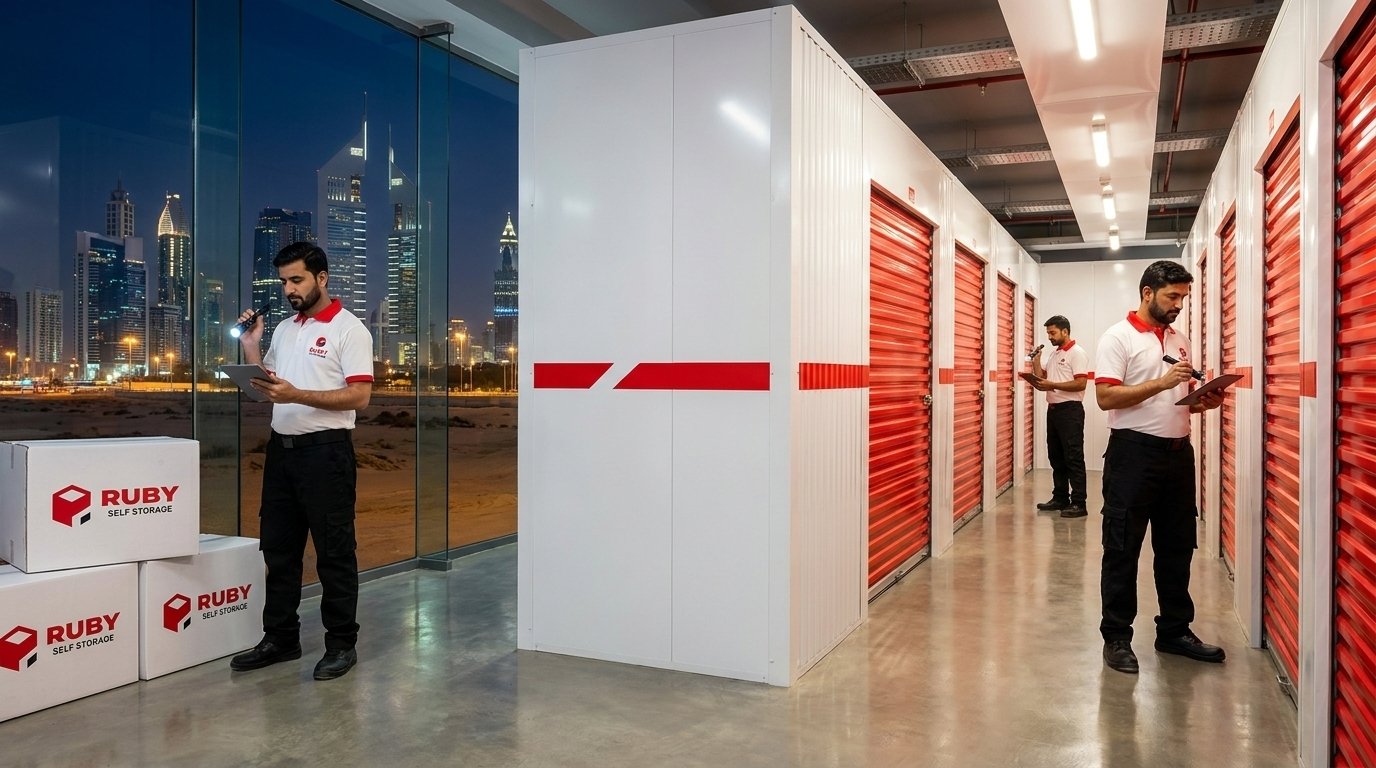
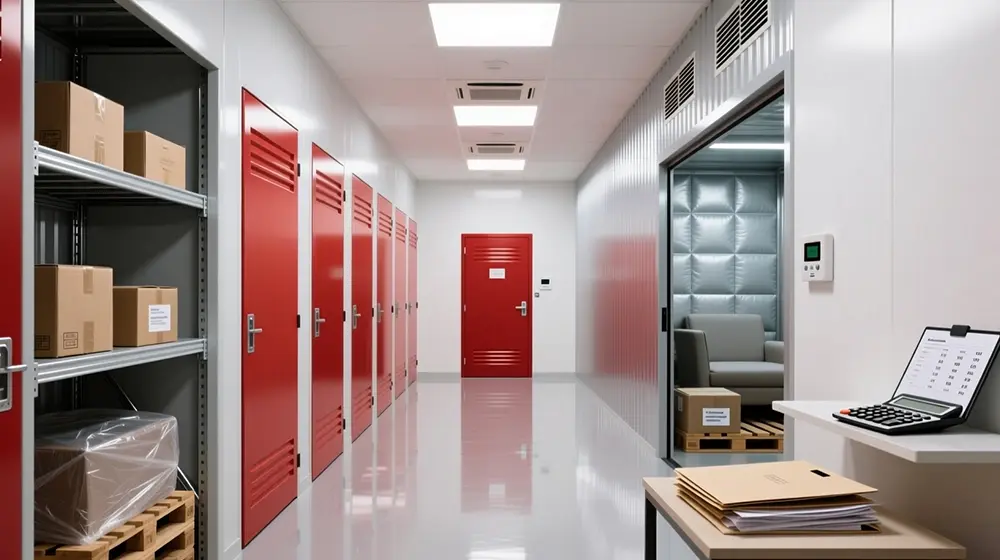
Dubai’s furniture self-storage market now grows at the same speed as the city itself. This guide explains how furniture self storage in Dubai really works by comparing the total monthly cost of standard and climate controlled units. It walks through typical price bands by size, shows how deposits, transport, insurance, and tax change the effective monthly bill, and then sets out a simple calculator so tenants can see when paying more for climate control actually reduces long-term costs.
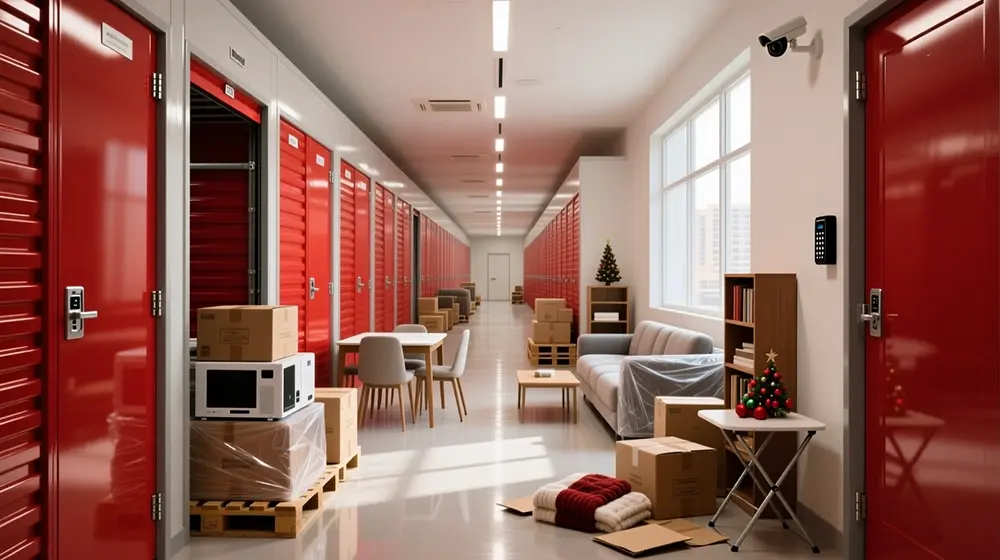
What drives demand for furniture self-storage in Dubai today?
Furniture self-storage in Dubai expands because fast population growth, strong rent inflation, and compact housing converge.
Key population facts:
- As of June 2025, Dubai’s population stands at approximately 3.95 million. This marks an increase from 3.84 million in January 2025, indicating a growth of about 110,000 residents in the first six months of the year.
- As of October 2025, Dubai’s population has reached 4,036,863, marking a 5.43% annual increase, with the addition of over 208,030 new residents in just one year.
- Since 2011, Dubai’s population has doubled in size, growing from 1.93 million to 4.0 million in just 14 years.
Rent and housing signals:
- Average Dubai residential prices increased by about 21.3 %, with apartment prices up 20.7 % and villa prices up 24.3 %.
- Average residential rents increased by 21.1 % between January and May 2024 compared with the same period a year earlier.
- Apartment prices up 19.1 % year on year and villa prices up 28.7 % in mid-2025.
Self storage market metrics:
- The UAE self-storage market is estimated at about USD 602.5 million in 2024 and is forecast to reach around USD 859.2 million by 2030, with an expected compound annual growth rate of 6.3 % from 2025 to 2030.
- Global self-storage is estimated at about USD 56.81 billion in 2023 and projected to reach about USD 83.20 billion by 2030.
This means more households choose furniture self storage in Dubai instead of moving to larger units.
For tenants:
- More frequent moves as leases renew in a rising rent environment
- Less spare room in apartments and townhouses
- Greater reliance on furniture self storage in Dubai during relocations, renovations, and downsizing
Short leases, frequent relocations, and a large expatriate share increase the number of furniture moves per household. Many tenants relocate every one to three years, which multiplies the number of occasions where furniture storage units in Dubai become relevant.
How does furniture self storage in Dubai separate standard and climate-controlled units?
Furniture self storage in Dubai separates standard and climate-controlled units mainly by interior conditions, building insulation, and total cost per month.
- Climate Data records an average August temperature of about 35.7 °C in Dubai, which is the warmest month of the year.
- WeatherSpark data for August describes daily high temperatures around 106 °F with most days above 100 °F.
- Holiday Weather notes August relative humidity in Dubai often ranges between about 30 % and 89 %, with many days above 76 % toward the end of the month.
- Reuters coverage of recent summers in the UAE reports inland highs near 51.8 °C and regular mid-40 °C days in coastal cities such as Dubai.
Standard units:
- Use warehouse spaces with basic ventilation and limited insulation
- Track external heat and humidity more closely
- Offer lower base rents per month
- Suit robust items such as metal frames, some plastic items, and low-value furniture
Climate-controlled units:
- Operate within fully air-conditioned or climate-regulated buildings
- Maintain moderate temperature and more stable humidity
- Carry higher base rents per month
- Target sensitive goods such as wooden furniture, leather sofas, mattresses, and electronics
Climate-controlled self-storage costs more than non-climate space because of cooling systems, power consumption, and building design, although exact premiums differ by market.
What do the current Dubai storage price bands show for standard furniture units per month?
Current Dubai storage price bands show that small units for furniture and boxes often start around 300 AED per month, while medium rooms, near 50 square feet, usually sit between about 895 and 1,400 AED per month, depending on location and operator.
- A 25 square foot self-storage unit in Dubai typically costs 300 to 400 AED per month and fits up to six regular boxes.
- 50 square foot rooms often list 900 to 1,400 AED per month.
- 25 square foot units at 300 to 400 AED per month, 50 square foot units at about 895 to 1,400 AED per month, and 100 square foot units at about 1,700 to 2,600 AED per month.
Standard furniture storage price table
| Unit size | Furniture self storage in Dubai | Monthly rent for standard unit (AED) |
| 15 to 20 sq ft | Boxes, side tables, small shelves, chairs | 250 to 350 |
| 25 sq ft | Small furniture set, boxes, seasonal items | 300 to 400 |
| 50 sq ft | Contents of a studio or lightly furnished 1-bedroom apartment | 895 to 1,400 |
| 75 sq ft | Contents of a full 1-bedroom or compact 2-bedroom apartment | 1,300 to 1,800 |
| 100 | Contents of a larger 2-bedroom apartment or part of a villa | 1,700 to 2,600 |
These ranges form the baseline for comparing furniture self storage in Dubai between standard and climate-controlled units.
How much does climate-controlled furniture self storage in Dubai cost each month?
Climate-controlled furniture self-storage in Dubai usually costs between about 20 % and 40 % more per month than standard units of the same size, although some facilities only offer climate-controlled units, so the premium is embedded within the base rate.
Climate-controlled cost differentials:
- Climate-controlled units command higher rents than non-climate units because of air conditioning and building performance requirements.
- Temperature-controlled warehouses often rent at substantial premiums compared with ambient high bay storage, particularly in hot regions.
- Climate control often sits in the upper half of the ranges quoted earlier for each size band.
Estimated climate-controlled furniture storage price bands
Taking the midpoints of the standard ranges and applying a 25 to 35 % premium produces the following illustrative climate-controlled price bands for Dubai:
| Unit size (sq ft) | Midpoint standard rent (AED) | Assumed climate premium range | Estimated climate-controlled rent (AED) |
|---|---|---|---|
| 25 | 350 | 25 to 35 % | 440 to 475 |
| 50 | 1,150 | 25 to 35 % | 1,440 to 1,550 |
| 75 | 1,550 | 25 to 35 % | 1,940 to 2,090 |
| 100 | 2,150 | 25 to 35 % | 2,690 to 2,900 |
Tenants should always request written quotes from several climate-controlled storage providers in Dubai before final decisions.
Which cost factors change total monthly bills for furniture self-storage in Dubai?
Total monthly bills for furniture self-storage in Dubai change when additional fees, taxes, and service charges accumulate around the base rent. Main cost components:
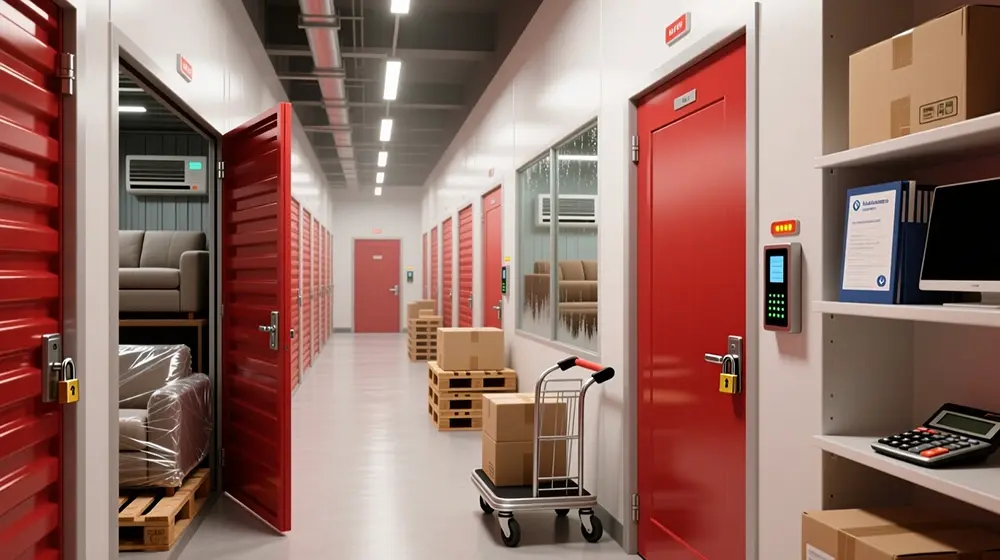
- Security deposit: Some providers require one month’s equivalent as a refundable deposit, which ties up cash and increases effective cost for short stays.
- Administration or setup fees: Documents or account setup fees add a one-off cost that becomes significant for very short rentals.
- Value-added tax: Storage services in Dubai usually attract value-added tax, which adds 5 % to the listed base rates.
- Minimum contract length: Many facilities use monthly contracts. Some offer discounts for three, six, or twelve-month commitments. Long-term storage reduces nominal monthly rates but raises lock-in risk.
- Pickup, packing, and transport: Services that collect furniture, pack it, and return it later can charge per trip or per hour. For heavy furniture, these costs approach the monthly storage rent during move-in and move-out months.
- Insurance for stored furniture: Some providers include limited insurance. Others require separate insurance payments per month or per year. Limits and exclusions are crucial because full value coverage might require costlier policies.
- Late payment and lockout rules: Contracts often include late payment fees and lockout rules. A single missed payment can trigger extra charges, interest, or restricted access.
When tenants compare furniture self-storage in Dubai, they should convert each of these elements into a monthly equivalent cost for the planned duration.
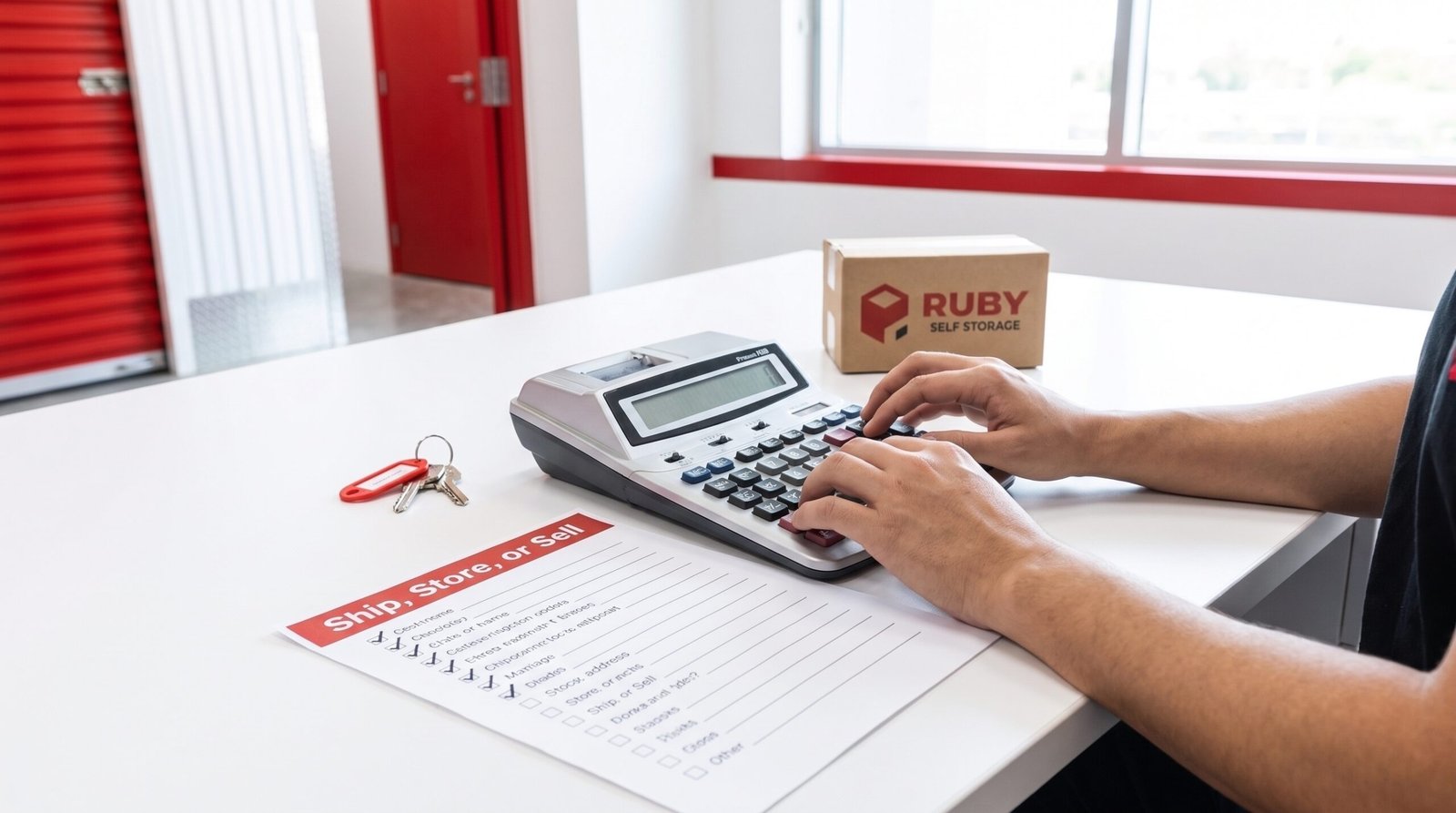
Checklist to compare total monthly cost
When a tenant compares two providers, the tenant can record for each one:
- Base rent per month for the chosen furniture storage unit
- Deposit and whether interest is paid
- Fixed administration fees
- Total round-trip transport cost for move-in and move-out
- Insurance premium and coverage ceiling
- Tax component
- Total of late fee and lockout conditions
Such a checklist converts the furniture self storage in Dubai decision from a marketing comparison into a structured cost analysis.
How does the Dubai climate affect standard storage units holding wood, fabrics, and electronics?
Dubai’s climate increases the risk that standard storage units without climate control expose wood, fabrics, and electronics to temperatures and humidity levels that accelerate damage.
- The average August temperature in Dubai is about 35.7 °C.
- August daily highs often reach 106 °F, rarely fall below 100 °F, and sometimes reach 112 °F.
- Relative humidity during August commonly sits between 30 % and 89 %, with many days in the latter part of the month above 76 %.
- Recent heatwave reports for the UAE note inland temperatures near 51.8 °C and repeated mid-40 °C days in Dubai.
Furniture and material sensitivity facts from industry and conservation guidance in hot, humid regions indicate:
- Solid wood and veneer panels often perform best between about 30 and 60 % relative humidity and moderate temperature ranges
- Repeated exposure to higher humidity and heat can cause swelling, warping, and joint failure
- Mattresses and upholstered sofas provide surfaces for mould growth when humidity stays high
- Electronics often carry recommended storage temperatures that are lower than peak levels reached inside non-climate warehouses in summer
Climate-controlled storage providers in the Gulf region repeatedly highlight that climate regulation exists to protect such items from combined heat and humidity. In this environment, a standard furniture self-storage unit in Dubai can function like an extended exposure box where the interior follows outside conditions. For low-value items, the risk may be acceptable. For high-value furniture or long storage periods, the risk probability becomes a central numeric input.
When do climate-controlled storage units in Dubai become cheaper over time than standard units?
Climate-controlled storage units in Dubai become cheaper over time when the expected value of damage in standard units exceeds the extra rent paid for climate control.
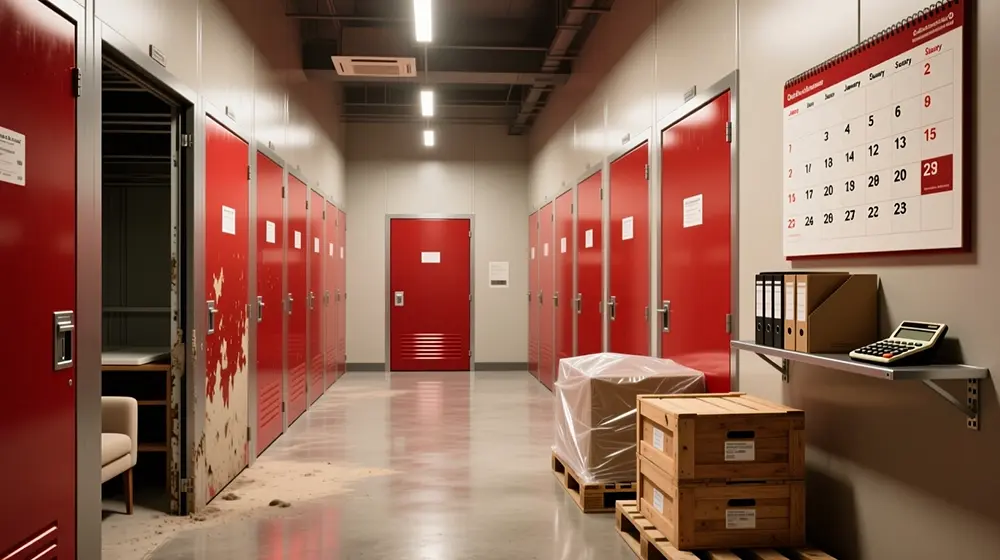
Key variables in a break-even calculation:
- Monthly rent for a standard furniture storage unit
- Monthly rent for a climate-controlled furniture storage unit
- Total value of stored contents
- Probability of partial or full damage during the storage period
Step-by-step example
Assume:
- Standard 50 square foot unit rent equals 1,000 AED per month
- Climate-controlled 50 square foot unit rent equals 1,400 AED per month
- Monthly climate premium equals 400 AED
- Planned storage duration equals twelve months
- Total climate premium across the year equals 4,800 AED
- Furniture and electronics inside the unit have a replacement value of 40,000 AED
Break-even condition:
- Climate control becomes cheaper when the expected damage cost is more than 4,800 AED
- This equals 12 % of the furniture value
If the tenant believes heat and humidity exposure in a standard unit carries a higher than 12 % chance of causing full value loss or an equivalent partial damage amount, then climate-controlled furniture self-storage in Dubai represents the lower expected cost option.
In practice, tenants storing high-value solid wood dining sets, leather sectionals, branded beds, and multiple televisions often approach or exceed this threshold once multi-seasonal storage and possible mould or warping are included.
How can tenants compare contracts for furniture self storage in Dubai before paying a deposit?
Tenants can compare contracts for furniture self storage in Dubai before paying any deposit by building a small contract comparison table that covers climate wording, access rules, liability limits, and disposal powers. Contract elements that deserve structured attention:
Climate control description
- Presence of temperature values or only marketing language
- Any mention of humidity levels or uptime commitments
Access hours and gate rules
- Twenty-four-hour access or restricted daily windows
- Procedures for weekend and public holiday access
Insurance and liability
- Named insurer and maximum claim amounts
- List of excluded items or damage types
Payment timing and penalties
- Grace periods after the due date before penalties start
- Lockout rules and reconnection fees
Disposal and auction clauses
- Number of days in arrears before goods can be sold or disposed of
- Notices required before disposal
Different business models with varying degrees of flexibility, climate emphasis, and insurance offerings confirm that contract quality differs even at similar headline prices.
Contract checklist
Before signing any furniture self storage contract in Dubai, tenants can ask five direct questions:
- Does the contract for this unit contain specific temperature ranges or only general climate language?
- What is the exact procedure and timeline if payment becomes late?
- What insurance cover applies, and what value limit is written in the policy?
- After how many days in arrears may the operator dispose of stored goods?
- What notice is required to terminate the agreement without extra months of rent?
These questions convert contract reading into a structured decision step.
What simple calculator or checklist helps estimate total monthly storage costs in Dubai?
A simple calculator for furniture self storage in Dubai turns all cost elements into a single effective monthly amount over the planned storage duration.
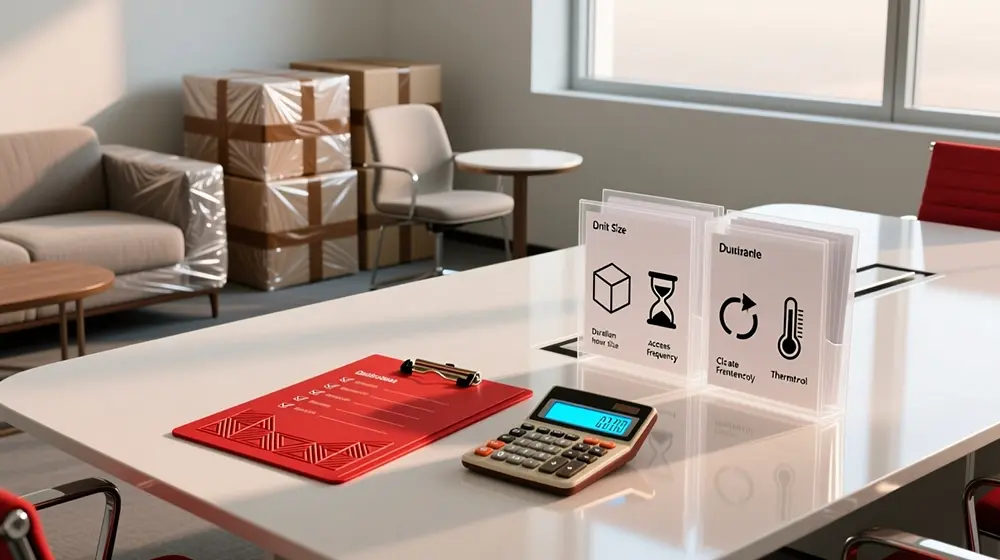
Four-input calculator
Tenants can use four numeric inputs:
- Base rent per month for the chosen unit type
- One-time costs such as setup fees and paperwork charges
- Transport costs for move-in and move-out combined
- Insurance premium for the contents
Formula:
Effective monthly cost = Base rent per month + One-time costs divided by the number of months + Transport costs divided by the number of months + Insurance per month
Which furniture storage mistakes in Dubai create the highest long-term costs for tenants?
The furniture storage mistakes in Dubai that create the highest long-term costs are storage in non-climate units for valuable items during repeated summers, poor contract reading, and incomplete cost planning. Common high-cost mistakes include:
- Using standard units for high-value wood and leather through multiple summers: Raises the probability of permanent warping and mould
- Underestimating the total cost of transport and packing: Can convert a low-rent unit into a high-cost decision
- Accepting unclear climate wording: Leaves no structured recourse when interior conditions vary
- Ignoring insurance gaps: Creates cases where damage or theft produces no payout
- Missing penalty triggers: Late payment and lockout logic can cause extra bills and stress
- Overlooking disposal clauses: Breakdowns in communication can result in the auction or disposal of furniture
Tenants who treat furniture self-storage in Dubai as a financial decision with risk and expected value components, rather than as a pure price comparison, reduce these long-term costs.
Final Thoughts: How to Avoid Costly Furniture Storage Mistakes in Dubai
Furniture self storage in Dubai now sits at the crossroads of rapid population growth, rising housing costs, and one of the most demanding summer climates on the planet. For many tenants, the real decision is no longer simply “standard or climate unit”, but “which option actually costs less when damage risk, transport, deposits, and insurance are all added to the monthly bill”. The numbers in this guide show that a modest climate premium can be cheaper than replacing warped wood, mould-damaged upholstery, or electronics that have sat through repeated August heat spikes.
When tenants treat furniture storage as a financial decision with clear inputs and expected outcomes, the picture changes. Listing base rent, climate premium, transport, insurance, and contract penalties in one simple calculator turns marketing language into measurable trade-offs. That same structure helps families, frequent movers, and small businesses ask better questions about climate wording, insurance caps, and disposal powers before paying any deposit. In the end, the lowest advertised rent is rarely the lowest total cost. The winning choice is the storage contract where climate conditions, risk of loss, and effective monthly cost all align with the actual value of the furniture you want to protect.
FAQs
Is climate-controlled furniture storage in Dubai always worth the extra cost?
It becomes cost-effective when the expected damage to your furniture in a standard unit could exceed the extra rent you pay for climate control.
How much more do climate-controlled units usually cost compared with standard units?
In many Dubai examples, climate-controlled units tend to sit around 20 to 40 percent above comparable standard units of the same size.
Which items should almost always go into a climate-controlled storage unit in Dubai?
Solid wood furniture, leather sofas, mattresses, important documents, and electronics are usually safer in climate-regulated rooms.
What size storage unit do I need for a 1-bedroom apartment in Dubai?
A typical 1-bedroom apartment often fits into a 50 to 75-square-foot unit, depending on how many bulky items and boxes you have.
Why do some tenants underestimate the real monthly cost of storage in Dubai?
Many people focus only on base rent and forget to annualise setup fees, transport, insurance, tax, and possible late payment penalties.
Do all storage companies in Dubai ask for a deposit?
Not all providers do, but many ask for about one month of rent as a refundable deposit, especially for long-term storage.
How long should I commit to a storage contract if I am unsure about my plans?
If your plans may change, shorter monthly contracts with flexible notice periods usually reduce lock-in risk even if the headline rent is higher.
What is the simplest way to compare two storage quotes in Dubai?
Put both quotes into one calculator that adds base rent, divided setup and transport costs, insurance, and tax to find the effective monthly figure.
Can I rely on operator climate claims without specific temperature numbers in the contract?
It is safer to ask for written temperature and, where possible, humidity ranges rather than accepting only general climate marketing language.
What is the most expensive mistake people make with furniture storage in Dubai?
Storing high-value wood and upholstered furniture in non-climate units through several summers is often the single costliest error over time.
Rakan Al-Juraid is a logistics specialist with a focus on commercial storage systems and high-security asset management. With extensive experience in industrial warehousing, he specializes in inventory tracking technology and transit safety. Rakan’s expertise lies in streamlining the storage process for both businesses and homeowners through strategic planning. His writing offers data-driven advice on insurance for stored goods, fire-safe environments, and heavy-duty logistics. He is committed to ensuring that every square foot of storage is utilized with maximum security and efficiency. Rakan aims to provide professional-grade storage standards to every reader navigating the moving process.
Layali Al-Samer is a seasoned storage and organization expert with over 12 years of experience in the logistics industry. She holds a degree in Spatial Design, specializing in high-density residential storage and climate-control solutions. Layali focuses on inventory management for luxury goods and long-term preservation techniques for sensitive heirlooms. Her articles provide expert guidance on maximizing unit efficiency and protecting valuables from environmental damage. She is dedicated to helping readers declutter their lives through strategic and organized spatial planning. Layali’s goal is to ensure every possession is stored with the highest level of care and precision.