The summer damage detail is missing time-linked proof of condition and environment. A claim file fails when it cannot prove the condition at intake, exposure during storage, and condition at release in a continuous evidence chain. Moisture and mold SOPs treat readings, logs, and dated records as core documentation, not optional add-ons.
What benefits does this article deliver?
- It reduces claim rejection risk by specifying the minimum documentation set that supports causation in summer damage disputes.
- It reduces repair and replacement spend by linking Dubai summer exposure data to material-specific failure modes and measurable controls.
What makes furniture storage in Dubai a summer damage risk case?
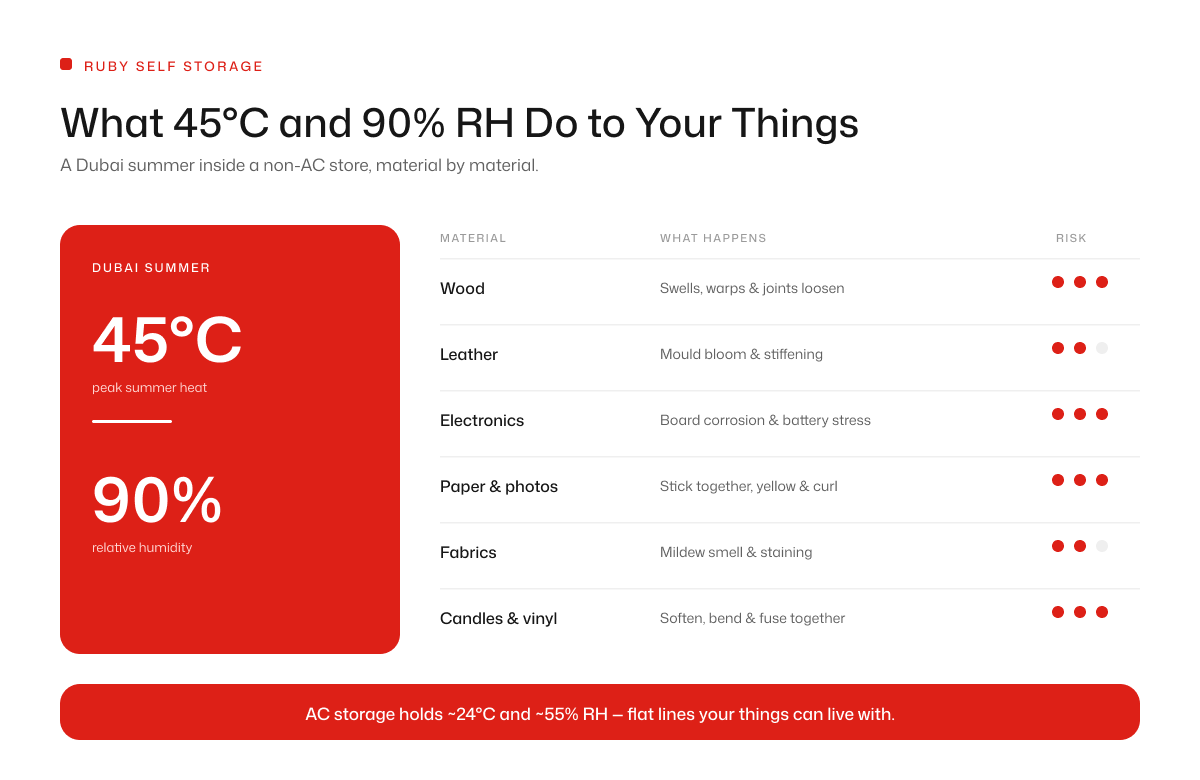
Dubai summer risk is driven by extreme heat plus humidity variability, which accelerates moisture cycling, adhesive creep, corrosion, and microbial growth in enclosed microclimates. Reuters has reported UAE summer conditions, with coastal cities such as Dubai experiencing mid-40s°C regularly during extreme periods.
Reuters also reported an NCM-stated event where Sweihan reached 51.8°C on Aug 1, close to the UAE record, which illustrates the regional cooling load and outage consequence during peak season.

Dubai summer exposure dataset that predicts storage damage risk
Heat stress in Dubai is not only temperature, because high humidity raises the heat index and increases the condensation risk in cooled interiors. July 2024 was the warmest July on record for the globe in NOAA’s 175-year record. The July global surface temperature was 1.21°C (2.18°F) above the 20th-century average of 15.8°C (60.4°F). It is a quantifiable stress indicator for building systems and humidity management.
NCM daily bulletins publish operational weather conditions, including maximum temperature and humidity fields, which show the joint heat-humidity pattern that storage facilities must manage. For example, one NCM bulletin reports Max Temp 42°C, Max Humidity 70%, and Min Humidity 15% for the forecast period, which illustrates the swing between very dry and very humid conditions. UAE official statistics portals publish climate indicators with the stated source as the National Center of Meteorology, which supports governance-grade referencing of humidity and temperature indicators.
Station-level humidity indicators are available via the UAE.STAT with NCM as the cited source, which supports month-level planning rather than anecdotal assumptions.
Which climate variables predict damage risk inside stored furniture?
Temperature, relative humidity, and dew-point proximity predict damage risk because they determine condensation probability and the moisture content trajectory in hygroscopic materials. The UAE official statistics portal lists monthly relative humidity indicators by weather station, with the stated source as the National Center of Meteorology, which supports station-level profiling.
NCM July climate summaries published by UAE outlets report mean July relative humidity around 46%, with mean maximum relative humidity between 64% and 81% and mean minimum relative humidity between 19% and 36%, which is relevant to summer microclimate design.
Which numerical thresholds matter for mold and odor risk?
Most species of fungi cannot grow unless the relative humidity exceeds 60%. That 60% RH statement is widely cited in indoor-environment literature and is often used as a practical risk boundary for moisture control planning.
ASHRAE’s mold and dampness position document emphasizes limiting dampness and moisture conditions that enable mold, including controlling condensation drivers.
What does “climate-controlled” furniture storage in Dubai mean in measurable terms?
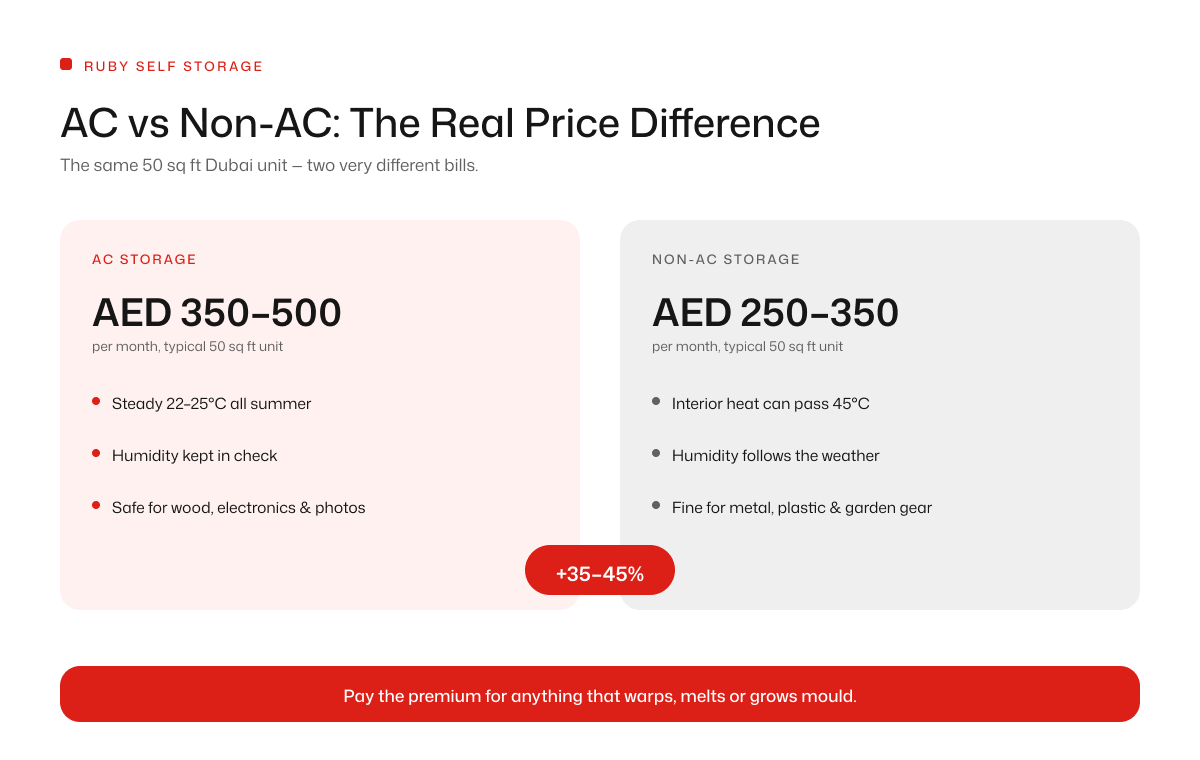
Climate-controlled storage has operational meaning only when a facility states temperature and RH setpoints, monitors them, logs them, and retains records that match your storage dates and storage zone. ASHRAE guidance treats dampness limitation as a measurable moisture-control problem, which makes logged RH and temperature relevant to risk accountability.
Which environmental ranges appear in preservation-grade guidance for mixed materials?
Preservation guidance often targets moderate RH bands because mixed organic materials degrade faster under high humidity and large fluctuations. The Canadian Conservation Institute references moderate RH (40–55%) planning in preventive conservation contexts, and it notes corrosion concerns rising in damp conditions, which maps directly to metal hardware in furniture.
These references are engineering benchmarks, not Dubai-specific regulation, but they provide defensible control logic for mixed-material objects.
Why does dew point matter more than “cold air” in summer storage?
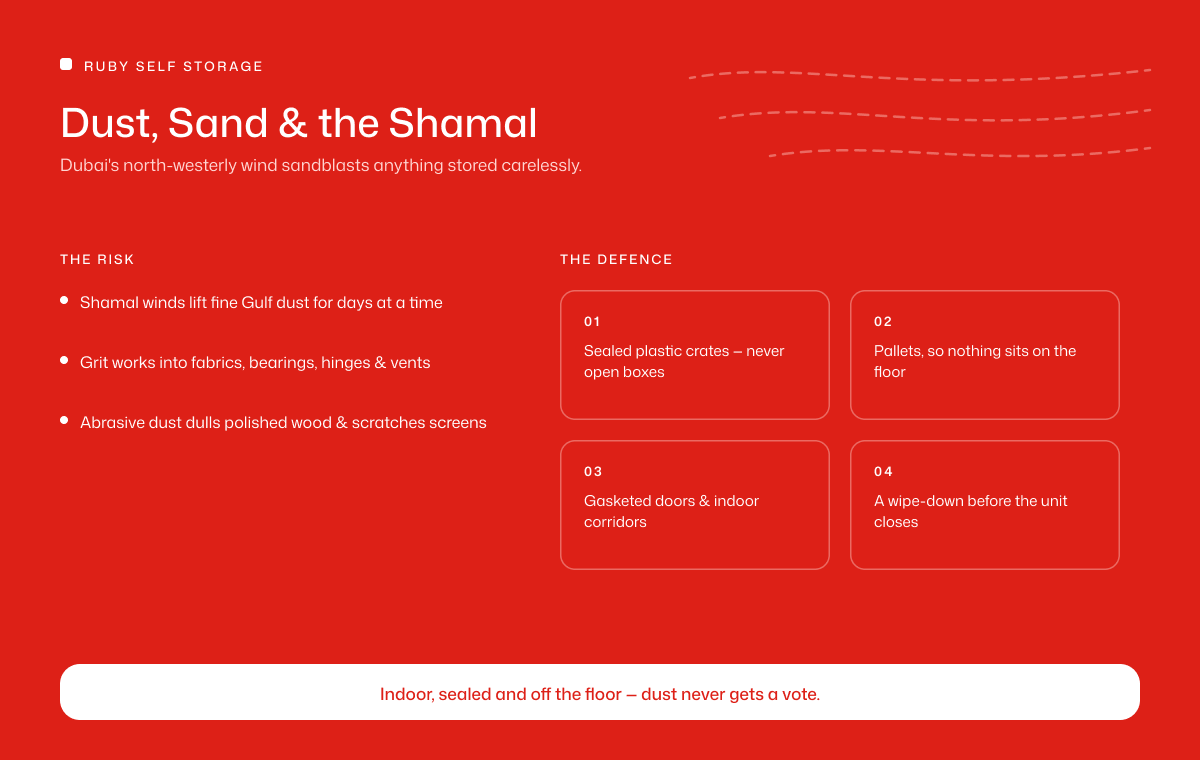
Condensation forms when surfaces fall below the dew point, and condensation is a direct dampness mechanism that supports mold and material degradation. Dew point relevance increases in summer because humid outdoor air entering a cooled space can condense on cooler surfaces, including wrapped furniture microclimates.
Which furniture materials fail first during summer storage exposure?
Layered and composite systems often show earlier failure because interfaces degrade before bulk substrates show deformation. USDA Forest Products Laboratory explains that wood moisture content in service is a function of relative humidity and temperature, and changes induce moisture-content changes, which support interface stress logic in assembled furniture.
What happens to wood and veneer in summer storage?
Wood moisture content in equilibrium depends on relative humidity and temperature, and moisture changes drive dimensional change. The USDA Forest Products Laboratory provides equilibrium moisture content contours as a function of RH and temperature, which supports warping and joint stress logic. Veneer and joints are sensitive because they concentrate stress at glue lines and discontinuities.
Typical summer storage outcomes reported in disputes:
- Veneer checking and edge lift under cycling moisture gradients.
- Joint opening at corners as the moisture content changes.
- Panel warping in assemblies exposed to uneven humidity.
What happens to MDF and particleboard?
Composite wood products are moisture sensitive, and moisture-content changes concentrate at edges and fastener zones, which support swelling and delamination pathways under humid microclimates.
Trapped moisture inside sealed packaging increases local dampness duration even if ambient RH moves, which aligns with ASHRAE dampness and mold control logic.
What happens to leather, fabric, and foam?
High humidity supports microbial growth conditions, and trapped moisture inside wraps increases surface dampness time. Relative humidity also affects offgassing and chemical processes in indoor environments, which can contribute to odor issues in enclosed storage contexts. For mold risk statements, the 60% RH boundary remains a key cited threshold in the classic review.
High sensitivity examples in furniture storage in Dubai:
- coated leather sofas
- upholstered headboards and bed bases
- foam cushions sealed in plastic layers
What happens to metal hardware and mechanisms?
Higher RH and damp conditions increase corrosion risk for metal components, which is relevant to hinges, slides, fasteners, and concealed frame elements. Corrosion outcomes include seizure, pitting, and rust staining transfer, which are consistent with preventive conservation guidance that flags increased corrosion risk at higher RH.
Which packing and storage behaviors create the “claim fails” outcome?
Claims fail when responsibility cannot be allocated because records do not prove baseline conditions, exposure conditions, and inspection outcomes at handover points.
This outcome is common in moisture-related disputes because documentation standards repeatedly emphasize logs and recorded conditions as part of the evidentiary record.
Which evidence gaps appear most often in summer damage disputes?
Five gaps recur because they block causation tracing across time.
- No intake condition report with defect notes and identifiers.
- No dated photo set with repeatable angles and close-ups.
- No unique inventory IDs tied to a register.
- No temperature and RH logs for the stored period and specific zone.
- No release inspection record at pickup or delivery.
NIH defines a drying log that includes daily temperature and relative humidity readings, which establishes an evidence-based norm for moisture-related conditions.
What is a claim-ready evidence pack for furniture storage in Dubai?
A claim-ready evidence pack is a time-ordered document set that proves the chain of custody and exposure conditions. This pack reduces dispute scope because moisture causation is supported through dated records and logs.
Evidence pack table
| Evidence artifact | What it proves | Minimum fields |
|---|---|---|
| Inventory register | Item existence and scope | item ID, description, material tag, count, dimensions |
| Intake condition report | Baseline condition | defect type, location qualifier, finish notes, odor notes |
| Photo log | Visual baseline and repeatability | identifiers, edges, joints, hardware, timestamps |
| Packaging specification | Packing responsibility | wrap layers, barrier type, edge protection, desiccant method |
| Environmental log extract | Exposure conditions | zone ID, temperature, RH, interval, excursion flags |
| Exception log | Event-driven risk | HVAC alarms, power interruptions, door events, water events |
| Release inspection report | Condition at release | signatures, new defects, timestamp, photos |
The requirement for repeated readings and retained records aligns with the documentation logic described in the NIH moisture and mold SOP processes.
How do you capture intake condition evidence that survives disputes?
A defensible intake process captures identifiers, repeatable angles, and close-ups of failure-prone zones. USDA moisture relations explain why edges, joints, and bonded interfaces are early failure zones under RH-driven moisture changes.
Intake photo checklist
- Identifier photo with label or barcode visible.
- Four-angle photo set: front, back, left, right.
- Edge and joint close-ups: corners, seams, veneer edges.
- Hardware close-ups: hinges, slides, fasteners.
- Surface reflection angles to reveal haze and blistering.
Intake note structure
Use consistent fields because consistency supports comparability at release.
- Substrate: Solid wood, veneer, MDF, metal, leather
- Finish: Lacquer, polyurethane, stain, paint
- Observed defect: Scratch, chip, haze, looseness, odor
- Location qualifier: Top-left edge, rear-right corner, underside near joint
Wood moisture relations explain why edges, joints, and bonded interfaces appear as early failure zones under humidity cycling.
How do you verify climate-controlled furniture storage in Dubai using measurable checks?
Verification depends on logs, setpoints, monitoring intervals, and corrective action records. ASHRAE’s position document makes moisture control and dampness limitation the core objective, which supports log-based verification rather than label-based buying.
Vendor verification questions
- Which temperature range applies to the assigned storage zone?
- Which RH range applies, and which alarm threshold is used for excursions?
- Which sensors record data, and what is the logging interval?
- Which calibration schedule applies, and which record exists?
- Which corrective action process triggers after excursions?
- Which data retention period applies to temperature and RH logs?
- Which exception log exists for outages, water incidents, and repeated access events?
What is the summer storage red flag that predicts claims friction?
A red flag appears when the operator cannot export temperature and RH logs for the specific date window, because exposure cannot be verified.
Which numeric humidity targets reduce mold risk in stored contents?
The 60% RH threshold is a widely cited boundary because many fungi cannot grow below it. ASHRAE emphasizes dampness limitation and moisture control, and it treats condensation avoidance as a control priority.
For the summer planning context, NCM-linked summaries report July mean maximum RH up to 81% at the national level in their climate summary reporting, which supports microclimate risk planning for wrapped furniture.
What does risk segmentation look like for furniture storage in Dubai?
Risk segmentation assigns items to tiers by material sensitivity, value, and duration, then maps each tier to controls and evidence depth. This approach is defensible because moisture-content change is quantifiable via RH and temperature exposure, not subjective preference.
Risk segmentation table
| Tier | Item examples | Exposure sensitivity | Control focus | Evidence depth |
|---|---|---|---|---|
| Tier 1 baseline | metal frames, sealed plastics, low-risk items | lower | cleanliness, elevation off the floor | inventory + intake photos |
| Tier 2 controlled | veneer cabinets, mid-value upholstery | medium | RH stability, airflow spacing | Add environmental logs |
| Tier 3 high protection | leather, designer veneer, lacquer finishes | high | tight excursion control, inspections | add exception logs + release inspection |
Leather and coated systems belong in high protection tiers because microbial growth conditions and dampness mechanisms are humidity-anchored.
What is the Dubai summer damage timeline in storage terms?
Damage follows exposure time plus material sensitivity, and structured inspections at fixed intervals detect early signals before defects propagate. NIH documentation logic supports repeatable records over time, which is why inspection cadence belongs inside the claim-ready workflow.
Timeline table
| Time window | Common signals | High-sensitivity materials | Evidence action |
| Day 7 | odor onset, wrap imprint, early haze | leather, lacquer, foam | photo checkpoint + odor note |
| Day 30 | veneer stress, joint movement, corrosion initiation | veneer, MDF edges, metal hardware | log review + targeted inspection |
| Day 90 | delamination, adhesive creep, recurring mold | composites, layered finishes | full condition reassessment |
Humidity thresholds matter across this timeline because fungal growth constraints below about 60% RH shape risk management decisions.
Which engineering controls reduce summer damage in furniture storage in Dubai?
Controls reduce damage by stabilizing RH and temperature, limiting condensation potential, reducing moisture sources, and preventing sealed microclimates inside packaging.
USDA moisture relations support the exposure stability objective because moisture content changes induce dimensional changes over time.
Control set by category
A. Environmental controls
- Define a temperature band per zone and retain documentation.
- Define an RH band per zone with excursion flags and retention.
- Retain logs over the storage period to support dispute resolution.
B. Airflow and placement controls
- Elevate items off floors to reduce localized moisture exposure time.
- Maintain spacing for airflow and inspection access to reduce stagnant microclimates.
C. Packaging controls
- Avoid sealing pre-existing moisture into airtight plastic layers to reduce dampness duration.
- Document wrap layers and barrier types so responsibility is attributable in claims.
D. Process controls
- Apply an inspection cadence mapped to risk tier to detect early signals.
- Maintain exception logs for alarms, outages, and water incidents.
What are the most common pain points for furniture storage in Dubai during summer?
Pain points cluster around unverifiable “climate-controlled” claims, exclusions in liability language, late discovery at release, and missing logs that block causation proof. Moisture-driven disputes persist because mold and dampness conditions are exposure-dependent, so the absence of logs increases argument space.

Pain point to solution map
- Pain point: “Climate-controlled” without records.
Solution: Request log exports for the specific date range and zone.
- Pain point: Denial framed as “pre-existing.”
Solution: Intake condition report plus close-up photo grid.
- Pain point: Mold and odor disputes.
Solution: RH logs plus packaging specification.
- Pain point: Late discovery after delivery.
Solution: Release the inspection record before and after unwrapping.
What are the best pre-contract checks for furniture storage in Dubai, claims, and liability?
Pre-contract checks force clarity on definitions, exclusions, evidence requirements, and reporting timelines.
Humidity and microbial growth thresholds cited by ASHRAE support, including RH setpoints and log retention in procurement language.
Pre-contract checklist
- Damage definition: scratch, warp, mold, odor, corrosion.
- Exclusions list: humidity, mold, inherent vice, improper packing.
- Evidence requirement: intake, logs, photos, and inspection reports.
- Reporting window: defined time after delivery and unwrapping.
- Liability cap: per item, per kg, or per contract.
- Dispute pathway: documentation review steps and escalation route.
This checklist is for procurement discipline and does not replace legal advice.
The Summer-Proof Storage Standard: If It Isn’t Logged, It Didn’t Happen
Dubai summer storage disputes rarely fail because furniture damage is “unclear.” They fail because the claim cannot prove a continuous story: condition at intake, exposure during storage, and condition at release. In moisture and mold control practice, documentation is not administration. If “climate-controlled” cannot be verified with zone-specific temperature and RH setpoints, exportable logs for your exact storage dates, and an exception record for excursions, outages, or water events, accountability collapses. Pair those logs with a repeatable intake photo grid, consistent defect notes, and a release inspection before unwrapping, and you shrink denial space dramatically. The safest summer storage choice is the one that treats environmental control like an engineered systemand treats records as the product.
FAQs
What is the “summer damage detail” most people miss in furniture storage?
Missing time-linked proofintake condition, continuous environmental exposure logs, and release condition in one evidence chain.
Why do summer damage claims fail so often in Dubai storage disputes?
Because the file can’t prove causation without dated condition reports, photos, and zone-specific temperature/RH records.
What does “climate-controlled storage” mean in measurable terms?
Defined temperature and RH setpoints, monitored sensors, logged intervals, retained records, and documented corrective actions for excursions.
Which climate variables best predict furniture damage risk during summer storage?
Temperature, relative humidity, and dew-point proximity, because they drive condensation probability and moisture-content change.
What humidity threshold is commonly used as a mold-risk boundary in indoor environments?
Around 60% RH is widely cited as a practical boundary because many fungi struggle to grow below it.
Why is dew point more important than “cold air” for summer storage safety?
Condensation forms when a surface falls below the dew point, creating dampness even in cooled spaces.
Which furniture materials typically show damage first under summer exposure?
Layered and composite systems, veneers, MDF/particleboard edges, upholstery/foam, and bonded finishes, because interfaces fail early.
What is the minimum “claim-ready” evidence pack for furniture storage in Dubai?
Inventory IDs, intake condition report, dated photo log, packaging specification, environmental log extract, exception log, and release inspection report.
What is the biggest red flag when choosing a storage provider in summer?
If they cannot export temperature/RH logs for your exact date window and assigned storage zone.
How often should inspections happen during longer summer storage stays?
Use a fixed cadence (e.g., early checkpoint, monthly review, and quarterly reassessment) aligned to risk tier and material sensitivity.
Rakan Al-Juraid is a logistics specialist with a focus on commercial storage systems and high-security asset management. With extensive experience in industrial warehousing, he specializes in inventory tracking technology and transit safety. Rakan’s expertise lies in streamlining the storage process for both businesses and homeowners through strategic planning. His writing offers data-driven advice on insurance for stored goods, fire-safe environments, and heavy-duty logistics. He is committed to ensuring that every square foot of storage is utilized with maximum security and efficiency. Rakan aims to provide professional-grade storage standards to every reader navigating the moving process.
Layali Al-Samer is a seasoned storage and organization expert with over 12 years of experience in the logistics industry. She holds a degree in Spatial Design, specializing in high-density residential storage and climate-control solutions. Layali focuses on inventory management for luxury goods and long-term preservation techniques for sensitive heirlooms. Her articles provide expert guidance on maximizing unit efficiency and protecting valuables from environmental damage. She is dedicated to helping readers declutter their lives through strategic and organized spatial planning. Layali’s goal is to ensure every possession is stored with the highest level of care and precision.