Vehicle and car storage in Dubai protects an idle vehicle from four high-probability risks: heat load, dust exposure, battery depletion, and handover disputes during repair or storage transfer. For owners, fleet teams, rental operators, and workshops, the practical benefit is simple: fewer restart problems and stronger condition evidence when the car comes back into use.
This article helps you reduce avoidable battery, tire, brake, paint, and cabin degradation. Second, it helps you build a cleaner handover record with photos, odometer, charge level, keys, and condition notes. That matters in a city where travel volume is large and vehicle activity is intense.
When does vehicle and car storage in Dubai make operational sense?
Vehicle and car storage in Dubai makes sense when inactivity lasts long enough for condition loss or documentation risk to become more expensive than controlled storage. That includes international travel, delayed bodywork, workshop backlog, fleet downtime, seasonal underuse, and high-value vehicles parked in open, heat-exposed locations. Dubai’s travel volume and vehicle-rental activity make this a real operating issue, not a niche use case:

| Dubai storage signal | Current data | Why it matters |
|---|---|---|
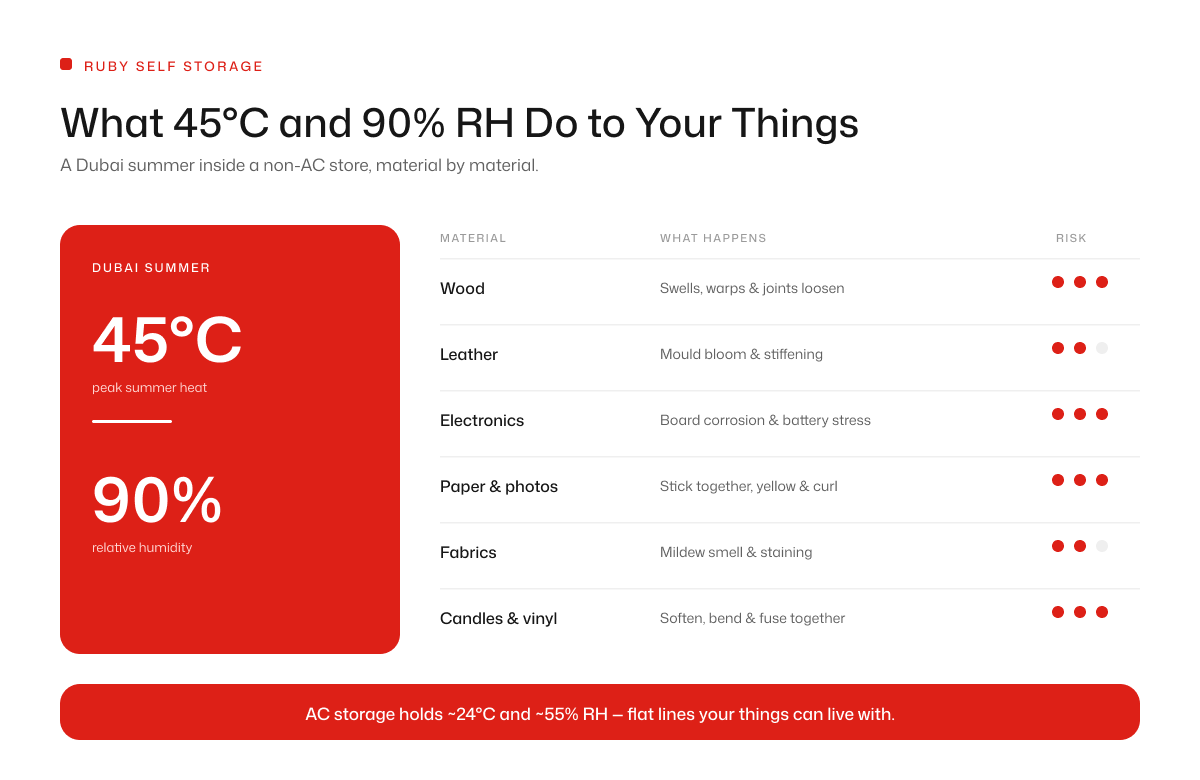
| Summer heat | 41.8°C average summer high; 29.7°C overnight summer low | Heat exposure does not stop when the engine stops. Battery chemistry, cabin materials, rubber, and fluids still sit under thermal load. |
| Humidity | 59% annual average; 65% peak in January and February | Coastal humidity raises oxidation risk on exposed brake surfaces and adds moisture stress inside the cabin and electronics environment. |
| Rainfall | 87.3 mm annual average | Rainfall is low overall, but when moisture, dust, and sea air combine, storage quality matters more than simple parking. |
| Airport throughput | 95.2 million guests at Dubai International (DXB) in 2025 | High outbound and inbound travel volume increases the number of vehicles left parked during long trips. |
| Rental fleet scale | 71,040 rental vehicles at end-2024 | The market has a large and active stock of cars that move in and out of downtime, transfer, and maintenance cycles. |
| Rental-market growth | 867 new rental firms in 2024; 3,494 active firms total | More operators means more vehicles passing through storage, repair, and handover workflows. |
| Premium segment growth | 73% increase in high-end rentals | Premium and luxury vehicles carry higher cosmetic and documentation sensitivity during idle periods. |
| EV fleet growth | 50% increase in EVs inside the rental fleet | EV storage requires charge-state control, not just a parking spot. |
These numbers matter because parked vehicles in Dubai do not remain neutral assets. They continue to lose condition. The UAE National Climate Change Plan lists extreme heat, dust and sandstorms, and desertification as climate risks that affect infrastructure and day-to-day systems. In a storage context, that translates into more pressure on batteries, brakes, seals, paint, cabin filtration, and intake cleanliness than a temperate-market owner might expect.
For a private owner, the trigger point often starts with absence. For a business, the trigger point often starts with asset utilization. A car that sits unused in open parking during a long trip faces environmental exposure. A car that sits at a workshop without a formal condition report faces a separate risk: damage attribution. A fleet vehicle that sits between contracts faces both. That is why secure vehicle storage in Dubai is partly a preservation decision and partly a liability-control decision.
What happens to a car after 7, 30, and 90 days of inactivity?
A stored car does not fail in one step. The risk stack changes with time. The first week is mainly about battery draw and brake oxidation. The first month adds tire-pressure loss and deeper battery stress. Longer periods raise flat-spotting, data-custody, and dispute risk.
What changes in the first 7 days?
The first 7 days mainly expose battery standby draw, surface brake oxidation, and early tire-pressure loss. BMW states that an extended period of non-use affects brakes and that oxidation or surface rust can appear on the brake disc after even a short period. NHTSA says tires lose an estimated 1 psi per month under normal conditions, so the pressure loss curve starts immediately, not after several months.
For electric vehicles (EVs), the first 14 days already matter. Tesla says that if a vehicle stays stationary for more than two weeks, it is best left at around 50% charge, with the charge limit also set to 50%, and kept plugged in if possible. Tesla also lists parked energy loads, such as Sentry Mode, climate functions, and infotainment, as battery drains during storage.
What changes after 30 days?
At 30 days, the risk of a 12V battery becomes much more relevant for petrol and diesel cars. Ford’s support guidance says that if a gas-powered vehicle stays in storage for more than 30 days without battery recharging, disconnecting the battery cables helps preserve charge for quick starting. Real-world roadside data support the importance of battery management. AAA says it handled more than 27 million roadside assistance calls in 2024, with about 7 million related to battery issues. In cooler northern climates, a battery may last five years or longer, while in hot southern locales it typically lasts about three years.
The tire side also becomes more technical by day 30. NHTSA’s 2024 report says direct TPMS reduced severe underinflation by 55.6% in its evaluation. It also reports a comparatively severe underinflation prevalence of about 23% without TPMS versus 12% with direct TPMS. That does not remove the need for manual checks during storage, but it shows how quickly tire-pressure neglect becomes a real maintenance issue.
What changes after 90 days?
At 90 days, ordinary parking becomes a weak storage strategy. Michelin says that long storage while tires remain loaded, over-inflated, and exposed to fairly high temperatures can create semi-permanent flat spotting. Adjust air pressure according to temperature changes – generally, increase 1 PSI (approximately 0.07 bar) for every 10°F (about 5.6°C) decrease, and vice versa, and the correct pressure reference is the vehicle placard, not the number on the tire sidewall.
Long inactivity also increases the value of full preparation. Toyota’s long-term storage guidance for conventionally powered vehicles includes changing engine oil, updating coolant if due, filling the fuel tank, and washing the vehicle before storage. Indoor storage offers more protection than covered or outdoor formats, which becomes a stronger choice when the vehicle sits for months rather than weeks.
| Inactivity period | Main risk cluster | Storage action with source support |
|---|---|---|
| 0 to 14 days | Battery standby draw, early brake oxidation, initial tire-pressure loss | EVs fit best near 50% charge if parked for more than two weeks. Brake oxidation can appear after a short non-use period. Tires still lose about 1 psi per month. |
| 15 to 30 days | 12V battery drop, visible pressure drift, higher restart risk | Begin formal storage prep. Check the placard tire pressure. Reduce parasitic loads. For gas vehicles beyond 30 days, Ford points to battery-disconnect logic if recharging is unavailable. |
| 31 to 90 days | Flat spotting, deeper discharge risk, and documentation gaps | Indoor preference rises. EVs fit best in moderate charge bands such as 30% to 50% or 50%, depending on OEM guidance. |
| 90+ days | Tire shape memory, cabin contamination, claim disputes, privacy exposure | Treat the car as a managed asset. Use indoor storage, evidence-based intake, and data-cleaning steps for navigation, phones, and profiles. |
How does storage preparation differ for petrol, diesel, EV, and hybrid vehicles?
Highest-risk component changes by vehicle type.
What matters most for petrol and diesel vehicles?
For petrol and diesel vehicles, the main storage controls are fuel management, 12V battery preservation, correct tire pressure, clean surfaces, and intake documentation. Toyota’s long-term guidance includes a full fuel tank, oil service, coolant service if due, and a full wash. Ford adds a battery-preservation threshold at more than 30 days without recharging.
The practical checklist is straightforward:
- Wash the vehicle before storage. Toyota includes washing in its minimum recommendations. Clean-in storage reduces the chance that dust and organic residue sit on paint and trim for weeks.
- Fill the tank before long storage. Toyota includes a full fuel tank in its preparation steps.
- Use placard tire pressure, not sidewall max. GM says the recommended pressure comes from the vehicle placard, not the tire sidewall.
- Manage the battery once storage passes 30 days. Ford identifies battery-cable disconnection as an option beyond 30 days without recharge.
- Document brake condition before handover. BMW says brake-disc oxidation can appear after short non-use, so pre-storage notes matter.
What matters most for EVs and hybrids?
For EVs and hybrids, state of charge and parked energy draw become the center of the storage plan. Tesla recommends around 50% charge for long, stationary periods. BMW recommends 30% to 50% for longer stationary periods and adds that hot-weather parking fits best in shade or a garage. BMW also recommends 10% to 80% as the general daily-use range for battery life, reserving 100% for longer trips.
NREL’s battery work supports that approach. Its research shows that battery degradation is strongly affected by temperature and that hot-climate standby cooling supports battery life. That means EV storage in Dubai is not just a parking choice. It is a thermal and charge-band management task.
A practical EV or hybrid checklist looks like this:
- Park at a moderate charge level. Tesla: about 50%. BMW: 30% to 50% for long stationary periods.
- Avoid long parked periods near 0% or 100%. Tesla explicitly warns against leaving the battery near these extremes for days or weeks.
- Reduce parked-energy features. Tesla lists parked functions that continue to draw energy.
- Prefer shade, garage, or indoor storage. BMW says hot-weather long parking fits best in shade or a garage.
Which storage controls protect the battery, tires, brakes, paint, and cabin condition?
The most effective protection comes from a layered control set, not from a single step.

- Use indoor vehicle storage when the asset value or storage duration is high. State Farm ranks indoor storage as the option with the most protection, while covered storage offers partial protection, and outdoor storage leaves the vehicle more exposed to the elements. For vehicle and car storage in Dubai, that hierarchy matters because the environmental load is not mild.
- Control battery state, not just parking location. Ford flags battery preservation for gas cars beyond 30 days, while Tesla and BMW define practical charge windows for EVs. A storage bay without power may work for short periods. A storage bay with charger or maintainer access is stronger for long trips or repair delays.
- Set tires to placard pressure and monitor temperature context. GM says placard pressure, not sidewall pressure, is the correct benchmark. Michelin says over-inflation does not solve flat spotting and that heat exposure during long, loaded storage raises the risk. NHTSA adds that under-inflation affects stopping distance, handling, and crash risk.
- Expect brake oxidation and document it. BMW’s brake guidance confirms that oxidation can appear even after short non-use. In practice, that means a stored or repair-hold vehicle benefits from a pre-storage note stating brake condition on intake and a post-storage note after release.
- Keep the cabin and exterior clean before storage starts. Toyota includes washing the vehicle in long-term preparation. Clean surfaces reduce the chance that dust, salt residue, organic matter, or standing moisture sit on paint, trim, and cabin materials for weeks. In a dusty climate, clean-in is better than dirty-in.
What should a strong storage or repair handover pack contain?
A strong handover pack records the vehicle’s condition, operating state, accessories, and data exposure before the car enters storage or repair.
Handover checklist
- VIN or plate number
- Date, time, and handover location
- Odometer reading
- Fuel level for ICE vehicles, or state of charge for EVs and hybrids
- Exterior photos of all four sides, roofline, wheels, lights, glass, and bumpers
- Interior photos, warning lights, and visible damage notes
- Key count, accessories, and loose items handed over
- Signed intake acknowledgement by both parties
The logic behind that checklist is not theoretical. Europcar’s guidance recommends checking the vehicle against the documented condition and taking photos or video at pickup and return. Its fair wear and tear guide says staff record existing damage before rental and that customers who spot unrecorded damage should notify staff before departure, or they may lose the right to dispute later damage attribution.
Why does data custody belong in the handover pack?
Modern vehicles store more than mileage and fault codes. Toyota’s owner documentation says vehicle systems can store technical data such as tire inflation pressure, battery status, malfunctions, and vehicle-damaging events. It also says that during repairs, warranty cases, and quality-assurance work, technical information can be read from the vehicle together with the VIN. Toyota also notes that vehicles may locally store multimedia content, address-book data, navigation destinations, and some connected-device information.
That means a good handover pack also covers privacy hygiene:
- Delete home and office navigation destinations
- Unpair phones and clear address-book sync
- Remove garage remote controls and access cards
- Clear driver profiles where possible
- Note any dashcam or telematics devices present
How do you evaluate a vehicle and car storage provider in Dubai?
A good provider proves control over environment, security, documentation, and battery management. State Farm’s facility guidance gives a simple starting framework: compare indoor, covered, and outdoor formats, then look for gated premises, video surveillance, and services tied to ongoing vehicle care. In Dubai, those baseline controls matter more because open-environment exposure is harsher than in temperate markets.
Procurement criteria:
- Indoor or covered format for long-term storage and premium vehicles.
- Power access for EV charge maintenance or 12V battery maintenance.
- Documented intake and release workflow with signed condition records.
- Photo-based audit trail at entry and exit.
- Security controls such as gated access and video coverage.
- EV competence, where applicable, because RTA reports strong EV growth inside Dubai’s rental fleet.
For luxury and high-end assets, documentation quality matters almost as much as environmental control. RTA says high-end vehicle rentals in Dubai rose 73% in 2024. That market profile changes the storage conversation. A premium vehicle often carries a higher paint-correction cost, a higher wheel-refinish cost, more privacy exposure through connected systems, and a lower tolerance for undocumented handling.

What quick self-audit helps decide the right storage profile?
A quick self-audit works when it segments the decision by duration, vehicle type, and handover risk. Use this simplified framework:
- Up to 14 days: covered parking can work if the car is clean, the tire pressure is correct, and the battery is healthy. EVs still benefit from charge discipline if parasitic loads stay active.
- 15 to 30 days: controlled storage becomes more attractive, especially for Dubai heat exposure, travel absence, and workshop delay. EVs fit best at about 50% or 30% to 50% state of charge, depending on OEM guidance
- 31 to 90 days: formal storage prep becomes the safer choice. Battery preservation, documented intake, placard tire pressure, and indoor preference gain importance.
- More than 90 days: treat the vehicle as a managed asset, not a parked car. Use indoor vehicle storage, a strict battery strategy, and a complete condition and data-custody handover pack.
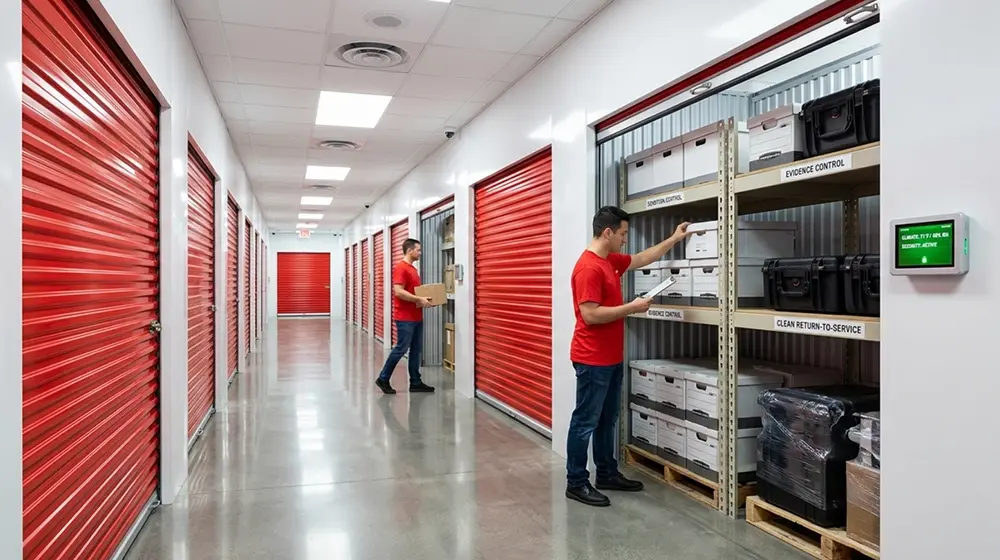
Condition Control, Evidence Control, and a Clean Return to Service
Vehicle and car storage in Dubai performs best when it treats downtime as an operational condition risk, not a parking gap. Dubai’s summer heat and humidity raise exposure for batteries, tires, brakes, paint, and cabin materials. Storage planning becomes simpler when the timeline is clear. Short gaps focus on battery draw and surface oxidation. Longer gaps add tire pressure drift and flat-spot risk. The highest-value control is documentation. Photos, odometer, fuel or state of charge, key count, and signed intake notes reduce dispute risk during repairs or storage transfer. A good outcome is measurable: stable restart behavior, cleaner condition, and a defensible handover record.
FAQs
What is vehicle and car storage in Dubai?
Vehicle and car storage in Dubai is controlled parking that reduces environmental exposure and documents the condition during long trips or repair downtime.
Which Dubai climate factors increase storage risk the most?
Heat, humidity, and dust load are the top exposure drivers for stored vehicles in Dubai.
What changes after 30 days of inactivity for petrol and diesel cars?
12V battery depletion risk rises, and Ford describes battery-disconnect logic when recharging is unavailable.
What EV charge level fits long stationary storage?
Tesla describes long stationary storage near 50% charge with reduced parked-energy loads.
How fast do tires lose pressure during storage?
NHTSA cites about 1 psi per month as an average air-loss rate.
Does over-inflation prevent flat spotting?
Michelin links long-loaded storage under heat and over-inflation to semi-permanent flat spotting risk.
Why do brakes change during inactivity?
BMW notes brake-disc oxidation can appear after short non-use periods.
What belongs in a storage or repair handover pack?
VIN or plate, time stamp, odometer, fuel or charge, full photo set, key count, accessories list, and signed intake notes.
Which storage format offers the highest protection?
State Farm ranks indoor storage as the option with the highest protection against weather-related damage.
What is the most common cause of “car won’t start” after storage?
AAA reports battery-related events as a major roadside category, with millions of battery calls in 2024.
Rakan Al-Juraid is a logistics specialist with a focus on commercial storage systems and high-security asset management. With extensive experience in industrial warehousing, he specializes in inventory tracking technology and transit safety. Rakan’s expertise lies in streamlining the storage process for both businesses and homeowners through strategic planning. His writing offers data-driven advice on insurance for stored goods, fire-safe environments, and heavy-duty logistics. He is committed to ensuring that every square foot of storage is utilized with maximum security and efficiency. Rakan aims to provide professional-grade storage standards to every reader navigating the moving process.
Layali Al-Samer is a seasoned storage and organization expert with over 12 years of experience in the logistics industry. She holds a degree in Spatial Design, specializing in high-density residential storage and climate-control solutions. Layali focuses on inventory management for luxury goods and long-term preservation techniques for sensitive heirlooms. Her articles provide expert guidance on maximizing unit efficiency and protecting valuables from environmental damage. She is dedicated to helping readers declutter their lives through strategic and organized spatial planning. Layali’s goal is to ensure every possession is stored with the highest level of care and precision.