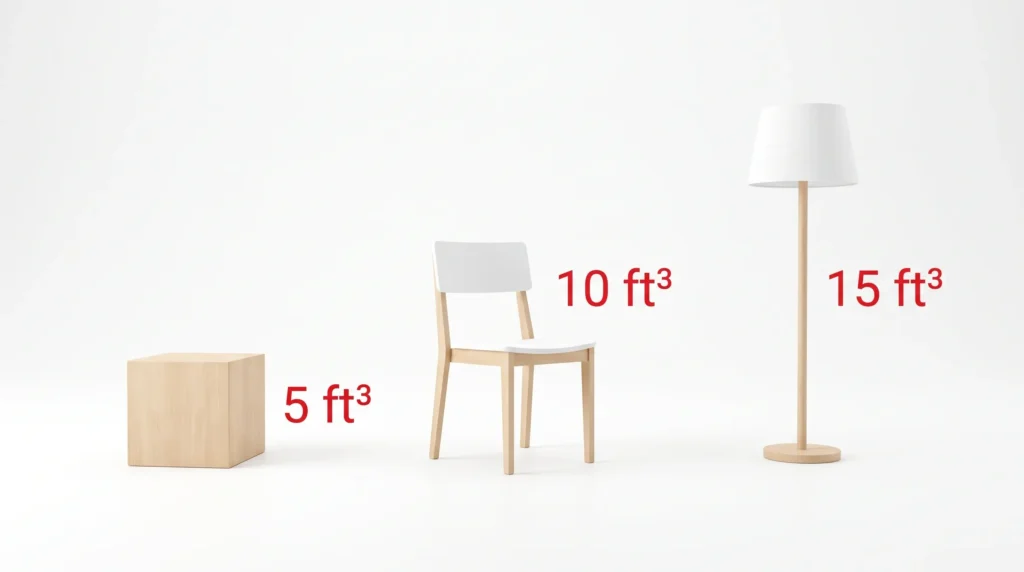
Choosing storage space by apartment size alone can lead to an expensive mismatch. Two 1BHK homes may have the same floor plan but very different furniture, appliances, cartons, and storage needs. The better starting point is the volume of the items going into storage.
If you are asking, “How much storage space do I need in Dubai?”, cubic feet provide a practical way to build that estimate. A sofa, queen bed, wardrobe, refrigerator, dining set, and 30 cartons each add a measurable amount to the final total.
This article breaks those numbers down item by item. It covers:
Cubic feet for living-room furniture
- Bedroom contents
- Kitchen appliances
- Boxes
- Luggage
- Sports equipment
Four worked examples show typical studio, 1BHK, 2BHK, and 3BHK or villa totals. The final calculation adds an access allowance before comparing storage sizes and Dubai monthly price ranges.
How to calculate your own requirement in four steps
Calculate your household storage requirement in 4 steps:
- Inventory your belongings
- Assign cubic feet
- Total the volume
- Add an access allowance
An industry household-goods cubic-feet calculator assigns individual volume estimates to sofas, beds, wardrobes, appliances, boxes, and other household items. It also allows quantities to be added to calculate the total estimated storage volume.
- List each item room by room. Count furniture, appliances, cartons, luggage and sports equipment.
- Enter a cubic-foot value. Use the industry figures below for standard items. Measure unusual furniture separately.
- Multiply volume by quantity. Four 5 ft³ dining chairs equal 20 ft³.
- Add access space. Use the inventory total before selecting a Dubai storage unit.
For custom furniture, measure length × width × height in feet. A cabinet measuring 4 × 2 × 5 feet occupies 40 ft³.
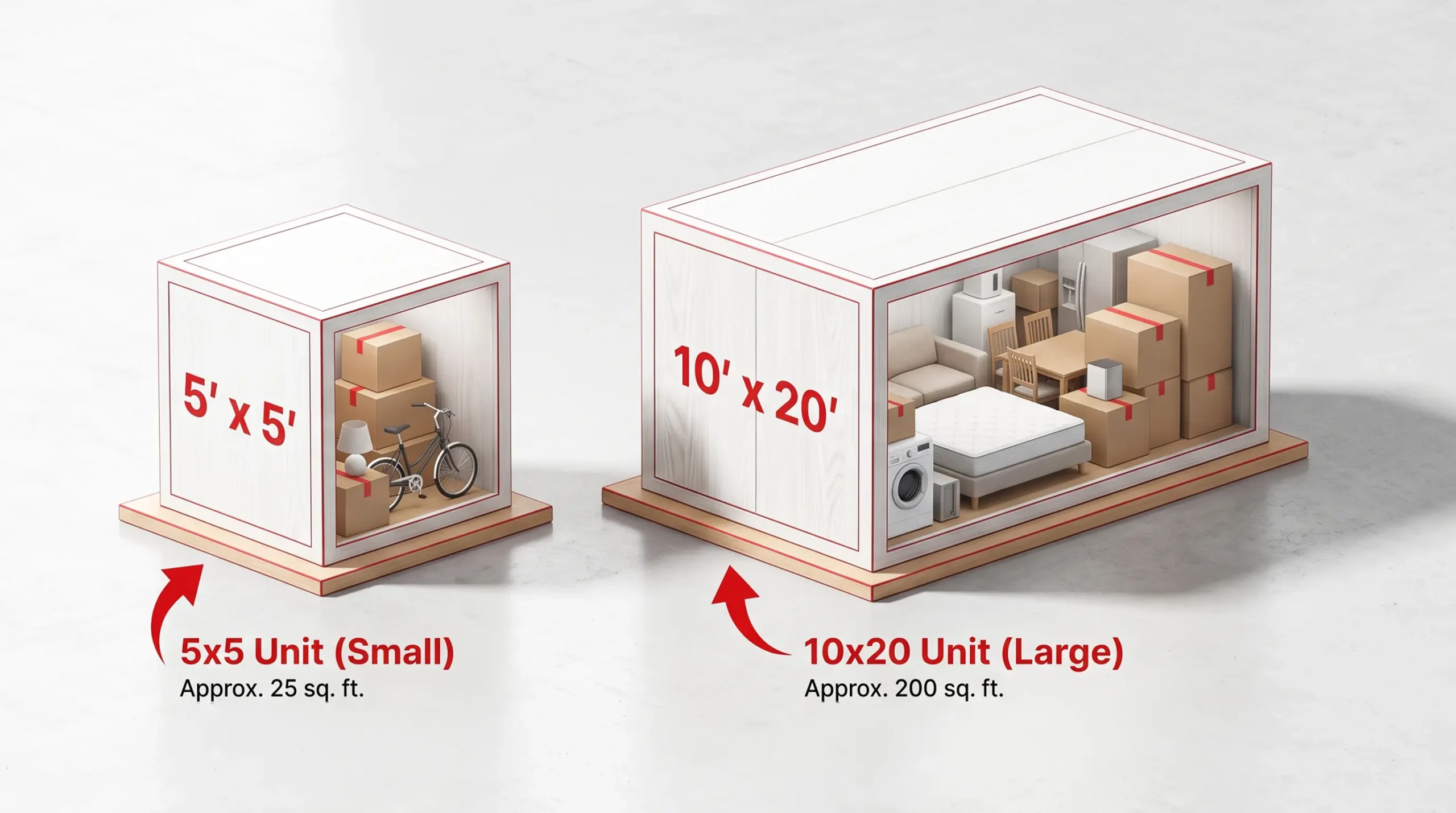
Do not confuse cubic feet with square feet. A 10 × 10-foot room provides 100 square feet of floor space. With an 8-foot clear height, its geometric volume equals 800 ft³.
Cubic feet per item — living room
Living-room storage volume comes mainly from seating, tables and cabinets. Upholstered pieces also leave unused gaps because sofas rarely stack like cartons.
The figures below use the household-goods values. Treat them as planning values rather than exact dimensions.
| Living-room item | Cubic feet |
|---|---|
| Loveseat or 2-seat sofa | 30 ft³ |
| 3-seat sofa | 35 ft³ |
| 4-cushion sofa bed | 50 ft³ |
| Sectional sofa section | 10 ft³ |
| Armchair | 10 ft³ |
| Rocking chair | 12 ft³ |
| Occasional chair | 15 ft³ |
| Overstuffed armchair | 25 ft³ |
| Coffee table | 12 ft³ |
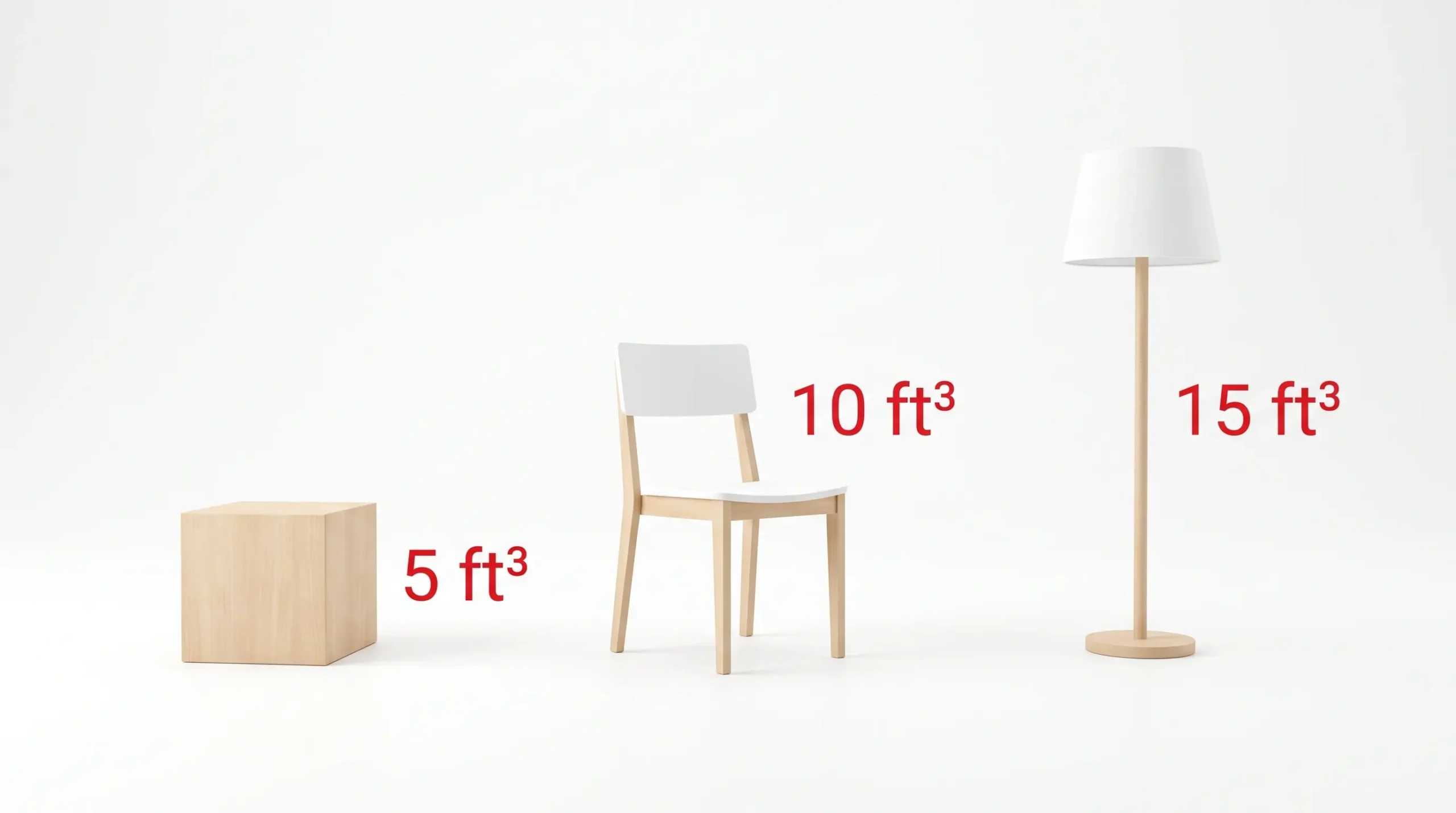
| End table | 5 ft³ |
| Drop-leaf table | 15 ft³ |
| Bookcase | 20 ft³ |
| Sectional bookshelf | 5 ft³ |
| Large rolled rug | 10 ft³ |
| Floor lamp | 3 ft³ |
| Table-model TV | 10 ft³ |
| TV console | 15 ft³ |
| TV stand | 3 ft³ |
The table gives 18 living-room item types. A three-seat sofa, coffee table, two end tables and TV stand already total 60 ft³.
Sofas by seat count, armchairs, coffee tables, TV units
Sofa volume rises with seat count and construction. A published furniture-volume reference assigns 30 ft³ to a loveseat, 35 ft³ to a three-seat sofa, and 50 ft³ to a four-cushion sofa bed.
Count detachable sectional pieces separately. Five sectional modules at 10 ft³ each equal 50 ft³.
Furniture around the sofa adds space quickly. A 12 ft³ coffee table plus two 5 ft³ end tables adds 22 ft³. Add a 10 ft³ television and 3 ft³ stand, and the group reaches 35 ft³ before the sofa.
Measure oversized modular furniture directly if its dimensions differ substantially. Skipping large seating can understate the storage requirement by dozens of cubic feet.
Cubic feet per item — bedroom
Bedroom volume depends on bed size, wardrobe size and the number of drawer units. Large wardrobes can occupy almost as much estimated volume as a single bed.
Published household-item sizing data gives different cubic-foot estimates for single, double, queen, and king beds, while small and large wardrobes receive separate volume values.
| Bedroom item | Cubic feet |
|---|---|
| Rollaway bed | 20 ft³ |
| Single bed | 40 ft³ |
| Double bed | 60 ft³ |
| Queen bed | 65 ft³ |
| King bed | 70 ft³ |
| Bunk-bed set | 70 ft³ |
| Small wardrobe | 20 ft³ |
| Large wardrobe | 40 ft³ |
| Bachelor chest | 12 ft³ |
| Cedar chest | 15 ft³ |
| Armoire chest | 30 ft³ |
| Single dresser | 30 ft³ |
| Double dresser | 40 ft³ |
| Triple dresser | 50 ft³ |
| Night table | 5 ft³ |
| Chaise lounge | 25 ft³ |
A queen bed, large wardrobe, double dresser and two night tables total 155 ft³. That single bedroom can therefore exceed the volume of many complete living-room furniture sets.
Beds by size, wardrobes, chests, mattresses
Bed size changes the estimate by measurable amounts. Published bed-volume figures estimate 40 ft³ for a single bed, 60 ft³ for a double, 65 ft³ for a queen, and 70 ft³ for a king.
Wardrobe size matters too. A small wardrobe carries a 20 ft³ planning value. A large wardrobe doubles that figure to 40 ft³.
Mattress-only storage needs direct measurement because thickness varies. Divide cubic inches by 1,728 to convert the result into cubic feet.
For example, a 60 × 80 × 12-inch mattress occupies about 33.3 ft³. A 76 × 80 × 12-inch mattress occupies about 42.2 ft³.
Dismantled frames often pack more tightly than assembled beds. Record the actual packed dimensions when the frame separates into flat components.
Cubic feet per item — dining and kitchen
Dining and kitchen contents combine stackable furniture with large appliances. Refrigerators, washing machines and sideboards can dominate the total.
| Dining or kitchen item | Cubic feet |
|---|---|
| Dining table | 30 ft³ |
| Dining chair | 5 ft³ |
| Kitchen table | 10 ft³ |
| Kitchen chair | 5 ft³ |
| Sideboard or buffet base | 30 ft³ |
| Hutch top | 20 ft³ |
| Corner cabinet | 20 ft³ |
| Kitchen cabinet | 30 ft³ |
| Microwave | 10 ft³ |
| Dishwasher | 20 ft³ |
| Washing machine | 25 ft³ |
| Tumble dryer | 25 ft³ |
| Small refrigerator | 30 ft³ |
| Medium refrigerator | 45 ft³ |
| Large refrigerator | 60 ft³ |
| Small freezer | 30 ft³ |
| Medium freezer | 45 ft³ |
| Large freezer | 60 ft³ |
| 30-inch cooker | 15 ft³ |
| Stool | 3 ft³ |
| Vacuum cleaner | 5 ft³ |
A dining table with six chairs totals 60 ft³. Add a 30 ft³ sideboard, and the dining group reaches 90 ft³.
Tables by seat count, chairs, sideboards, appliances
Based on the furniture-sizing tool, a standard dining table takes 30 ft³, while one chair takes 5 ft³.
Use quantity to calculate different seating arrangements:
- 4 chairs: 20 ft³ + 30 ft³ table = 50 ft³
- 6 chairs: 30 ft³ + 30 ft³ table = 60 ft³
- 8 chairs: 40 ft³ + 30 ft³ table = 70 ft³
Measure unusually long eight-seat or extendable tables rather than relying on the 30 ft³ benchmark.
Appliances create larger jumps. A washing machine and dryer together add 50 ft³. A large refrigerator contributes another 60 ft³. Adding a dishwasher brings those three appliance categories to 130 ft³.
Cubic feet per item — boxes and miscellaneous
Boxes produce predictable volume because their dimensions remain fixed. Miscellaneous equipment creates less predictable gaps.
One packing calculator places book boxes at 2 ft³, medium boxes at 3 ft³, dish packs at 10 ft³, and wardrobe boxes at 16 ft³. Another carton-size resource uses 1.5 ft³, 3 ft³, 4.5 ft³, and 6.1 ft³ for progressively larger boxes.
| Boxes and miscellaneous items | Cubic feet |
|---|---|
| Small moving box | 1.5 ft³ |
| Book box | 2 ft³ |
| Medium moving box | 3 ft³ |
| Large moving box | 4.5 to 6 ft³ |
| Extra-large box | 6.1 ft³ |
| Dish pack | 10 ft³ |
| Wardrobe box | 16 ft³ |
| Suitcase | 5 ft³ |
| Bicycle | 5 ft³ |
| Golf bag | 4 ft³ |
| Exercise bike | 10 ft³ |
| Bowling bag | 3 ft³ |
| Two-drawer filing cabinet | 10 ft³ |
| Four-drawer filing cabinet | 20 ft³ |
| Medium tool chest | 10 ft³ |
| Workbench | 20 ft³ |
| Personal computer | 4 ft³ |
| Monitor | 4 ft³ |
| Printer | 3 ft³ |
| Large barbecue grill | 10 ft³ |
Across the four tables, you now have 75 household-item categories for a cubic-feet storage calculation.
Standard carton sizes, suitcases, sports equipment
Twenty 3 ft³ cartons occupy 60 ft³. Forty occupy 120 ft³. The published carton dimensions support a 3 ft³ medium-box size.
Box selection also affects usable space. Its small carton measures 1.5 ft³, while its extra-large carton reaches 6.1 ft³.
For these miscellaneous items, the published packing data uses 5 ft³ for a suitcase, 5 ft³ for a bicycle, 4 ft³ for a golf bag, and 10 ft³ for an exercise bike.
Count awkward equipment individually. Ignoring two bicycles, golf equipment and four suitcases removes 34 ft³ from the estimate.
Worked examples
Worked examples show why apartment labels give only a starting point. Actual contents determine the cubic-foot requirement.
The 4 examples below use the item values in the preceding tables. Each calculation then applies a 20% planning allowance for access.
- Studio contents totalled
A moderately furnished studio example totals 331 ft³ before access space.
| Studio inventory group | Volume |
|---|---|
| Sofa, tables, TV and lamp | 58 ft³ |
| Queen bed, wardrobe, dresser, night table | 120 ft³ |
| Kitchen furniture and appliances | 90 ft³ |
| Boxes, luggage and bicycle | 63 ft³ |
| Inventory total | 331 ft³ |
| 20% access allowance | 66.2 ft³ |
| Planning total | 397.2 ft³ |
The published Dubai price range sets studio storage at around AED 800 to AED 1,000 per month. Volume still determines the practical quote. A lightly furnished studio can sit below this example.
- 1BHK contents totalled
A furnished 1BHK example totals 497 ft³, or 596.4 ft³ after the 20% access allowance.
The example contains 108 ft³ of living-room furniture, 155 ft³ of bedroom contents, 135 ft³ of dining and appliances, and 99 ft³ of boxes and miscellaneous items.
Based on this local Dubai market comparison, 1-bedroom storage costs about AED 1,000 to AED 1,500 monthly.
That range is not a fixed tariff. Storage format, inventory volume, access terms and rental period affect quotations.
- 2BHK contents totalled
A fuller 2BHK inventory example totals 823 ft³ before access space.
| 2BHK inventory group | Volume |
|---|---|
| Living room | 153 ft³ |
| Two bedrooms | 270 ft³ |
| Dining room and appliances | 235 ft³ |
| Boxes and miscellaneous | 165 ft³ |
| Inventory total | 823 ft³ |
| 20% access allowance | 164.6 ft³ |
| Planning total | 987.6 ft³ |
For 1-2 bedroom storage in Dubai, a Dubai cost overview places 2-bedroom storage at about AED 1,500 to AED 2,000 monthly.
- 3BHK and villa contents totalled
A furnished 3BHK or compact villa example totals 1,267 ft³ before access allowance.
The inventory contains 176 ft³ of living-room items, 440 ft³ across three bedrooms, 295 ft³ of dining and appliances, and 356 ft³ of boxes and other equipment.
Adding 20% gives 1,520.4 ft³. Using the NIST conversion factor, that equals roughly 43.1 cubic meters.
For a 3-bedroom household in Dubai, the local monthly range sits at roughly AED 2,000 to AED 3,500.
Add the access allowance, then choose your unit
Add access space after calculating the packed inventory. Access space represents the floor area left open for reaching stored belongings.
The recommended unit arrangement includes a 2- to 3-foot-wide central path for reaching stored goods.
A 2-foot aisle running through a 10 × 10-foot unit occupies 20 square feet. That equals 20% of the 100-square-foot floor area. This article therefore uses 20% as a practical worked-example allowance.
Use this planning calculation:
Inventory volume × 1.20 = storage target with access allowance
Examples:
- 400 ft³ becomes 480 ft³
- 600 ft³ becomes 720 ft³
- 800 ft³ becomes 960 ft³
- 1,000 ft³ becomes 1,200 ft³
- 1,250 ft³ becomes 1,500 ft³
Reduce aisle space when long-term storage requires little retrieval. Keep more access space for files, seasonal stock or household items retrieved during the rental.
Dubai pricing also confirms why volume matters. A Dubai storage cost source shows that stored volume affects the final price, with shared storage sometimes charged per cubic meter. It also identifies 10 × 10 feet as a frequently used unit format.
Check tax treatment before comparing monthly quotations. The UAE Federal Tax Authority lists the standard UAE Value Added Tax rate at 5%.
Match the unit to what you actually store
The right storage size starts with the contents, not the apartment label. A studio with bulky furniture can require more space than a lightly furnished 1BHK. Your inventory therefore gives a stronger estimate than bedroom count alone.
Add the cubic feet for furniture, appliances, cartons, luggage, and other stored items first. Then include access space before comparing unit sizes. The worked examples in this guide use a 20% access allowance, which keeps the calculation practical rather than treating every cubic foot as tightly packed.
That approach also makes Dubai price comparisons more meaningful. Instead of asking only what a studio, 1BHK, or 2BHK costs to store, compare quotations against the actual cubic volume of your belongings. The result is a storage choice based on measurable space rather than a broad apartment category.
FAQs
How much storage space do I need in Dubai?
Add the cubic feet of every stored item, then include access space. A 20% planning allowance works for the examples in this article.
How many cubic feet are in one cubic meter?
One cubic meter equals about 35.315 cubic feet, based on the NIST conversion of 1 ft³ to 0.02831685 m³.
How much space do 20 medium boxes take?
Twenty standard 3 ft³ medium cartons occupy 60 ft³.
How much space do 40 medium boxes take?
Forty 3 ft³ cartons equal 120 ft³ before adding an aisle or irregular furniture gaps.
What is the 1-bedroom apartment storage price in Dubai?
Published prices are in the AED 1,000 to AED 1,500 monthly range for one-bedroom apartment storage in Dubai.
What is the 1-2 bedroom storage Dubai price?
The Dubai marketplace lists roughly AED 1,000 to AED 1,500 for 1 bedroom and AED 1,500 to AED 2,000 for 2 bedrooms.
Is bedroom count accurate enough for choosing storage space?
No. Bedroom count cannot capture furniture size, appliance quantity, carton count or dismantling. Item-by-item cubic feet produces a more specific inventory estimate.
Does a 100 sq ft unit equal 100 cubic feet?
No. Square feet measure floor area. Cubic feet measure volume. A 10 × 10-foot room with 8 feet of usable height has 800 ft³ of geometric volume.
Why add an access allowance?
Access space keeps stored items reachable. It is recommended to leave a central aisle about 2 to 3 feet wide.
Rakan Al-Juraid is a logistics specialist with a focus on commercial storage systems and high-security asset management. With extensive experience in industrial warehousing, he specializes in inventory tracking technology and transit safety. Rakan’s expertise lies in streamlining the storage process for both businesses and homeowners through strategic planning. His writing offers data-driven advice on insurance for stored goods, fire-safe environments, and heavy-duty logistics. He is committed to ensuring that every square foot of storage is utilized with maximum security and efficiency. Rakan aims to provide professional-grade storage standards to every reader navigating the moving process.
- Rakan Al-Juraid
- Rakan Al-Juraid
- Rakan Al-Juraid