Choosing a storage unit by floor area alone can lead to paying for space that does not fit your furniture or using less capacity than expected. A 10×10 storage unit dimensions in Dubai gives 100 square feet, but usable volume changes with ceiling height. At 8 feet, the unit holds 800 cubic feet. At 10 feet, capacity rises to 1,000 cubic feet.
The confusion grows because Dubai storage units appear in feet, square feet, square meters, and metric dimensions. A 5×5 unit may suit compact household items, while 10×15 and 10×20 units serve much larger inventories. Price also changes with size, height, access, and facility specifications.
This guide compares 5×5, 5×10, 10×10, 10×15, and 10×20 storage unit dimensions in one format. It covers square-foot and cubic-foot conversions, what fits in each size, current Dubai pricing, ceiling heights, stacking limits, and Dubai versus US dimensional conventions.
Why are storage unit dimensions described in feet, not sq ft?
Storage units use feet because width and depth describe the shape. Square feet describe only the total floor area.
For example, 5 feet multiplied by 10 feet equals 50 square feet. A wider entrance or different room shape can still change how easily you position a sofa or wardrobe.
The National Institute of Standards and Technology (NIST) defines one international foot as exactly 0.3048 meters. Therefore, one square foot equals about 0.092903 square meter.
That gives you these quick conversions:
- 25 sq ft = 2.32 m²
- 50 sq ft = 4.65 m²
- 100 sq ft = 9.29 m²
- 150 sq ft = 13.94 m²
- 200 sq ft = 18.58 m²
Use dimensions first when checking furniture fit. Use square feet when comparing floor area. Use cubic feet when ceiling height becomes relevant.
Every standard dimension and what it means
Standard storage dimensions create useful size categories, but apartment labels remain estimates. Your furniture count, box count, unit height, and access aisle determine the actual fit.
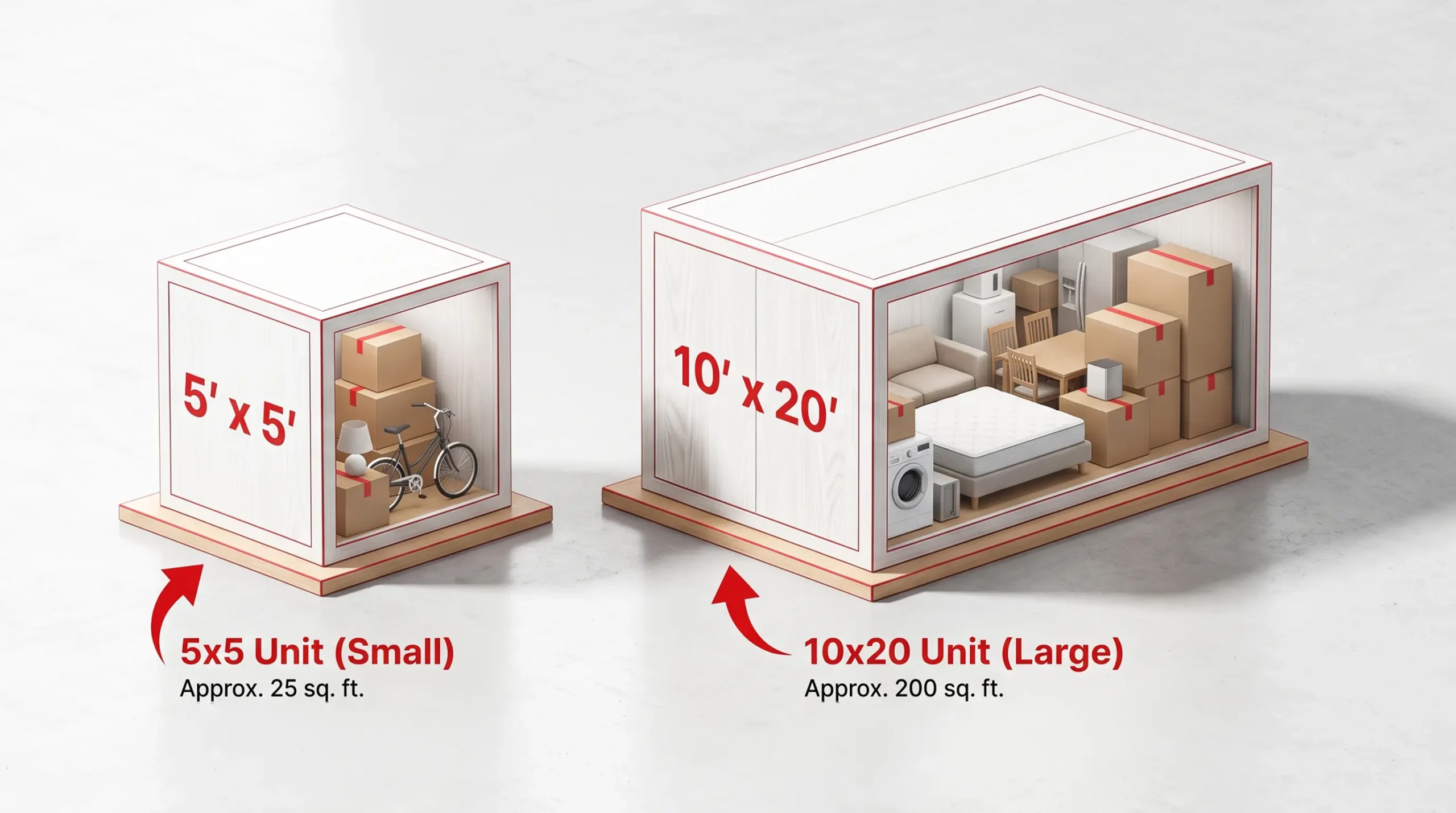
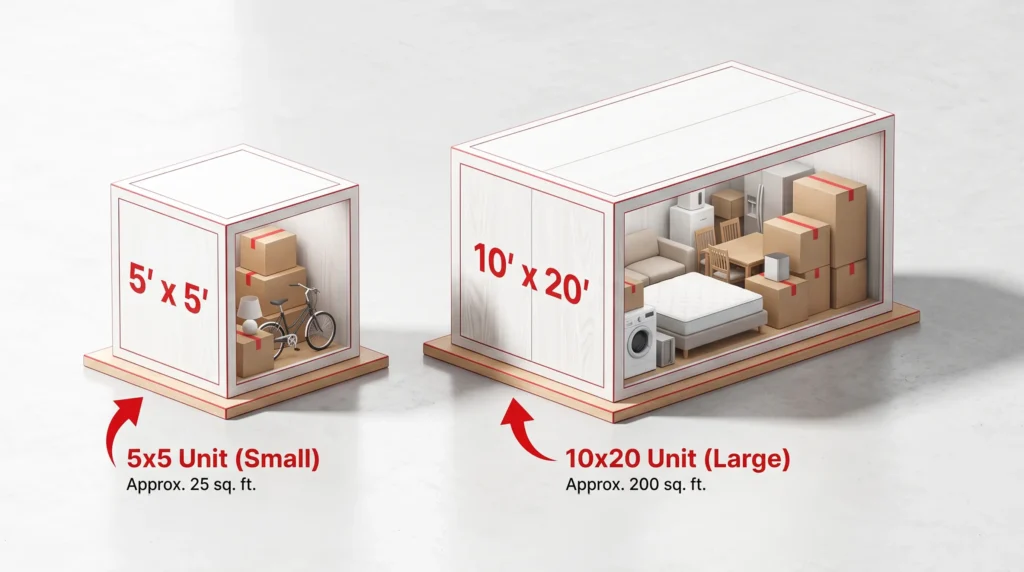
- 5×5 (25 sq ft) — walk-in closet
A 5×5 unit gives you 25 square feet of floor space. At 8 feet high, its theoretical capacity equals 200 cubic feet.
A published 5×5 storage size guide lists 25 square feet and 200 cubic feet as reference measurements. Typical contents include mattresses, compact furniture, documents, sports equipment, and household boxes.
Dubai data supports the closet comparison. A Dubai storage size guide compares 25 square feet with a large walk-in closet. Suitable contents include a dresser, bookcase, twin mattress, packed boxes, and electronics.
A 5×5 works best for:
- Luggage and archive boxes
- Seasonal household items
- Compact furniture
- Small business stock
- Sports equipment
The current 5×5 storage unit price also varies by facility. Current Dubai pricing appears later in this guide.
- 5×10 (50 sq ft) — studio contents
A 5×10 unit provides 50 square feet. At 8 feet high, the unit offers 400 cubic feet of theoretical volume.
A published 5×10 unit guide links this size with studio or one-bedroom belongings. Common examples include a queen mattress, dresser, sofa, television stand, bicycle, and packed cartons.
A 5×10 also gives you twice the floor area of a 5×5. Yet the narrow 5-foot side can limit furniture rotation.
Measure your longest rigid item before booking. A 7-foot sofa creates a different loading problem than ten small cartons.
- 10×10 (100 sq ft) — 1BHK to 2BHK
A 10×10 unit contains 100 square feet. That equals about 9.29 m².
At an 8-foot ceiling, a 10×10 contains 800 cubic feet. Current 10×10 specifications place this 100-square-foot capacity at roughly two furnished bedrooms or belongings from up to three rooms.
For a Dubai 1BHK or compact 2BHK move, this size can accommodate large furniture, appliances, mattresses, and cartons. The actual result depends on furniture density.
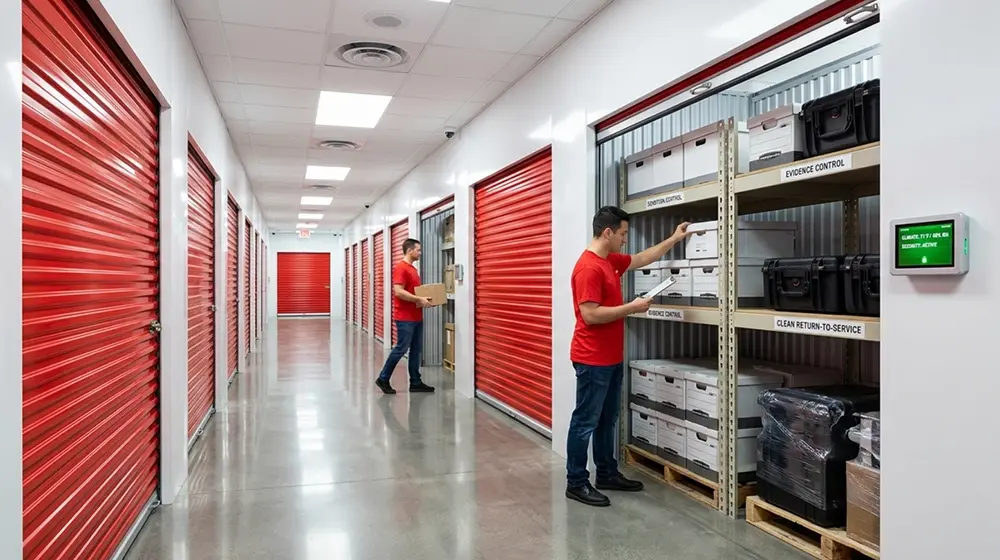
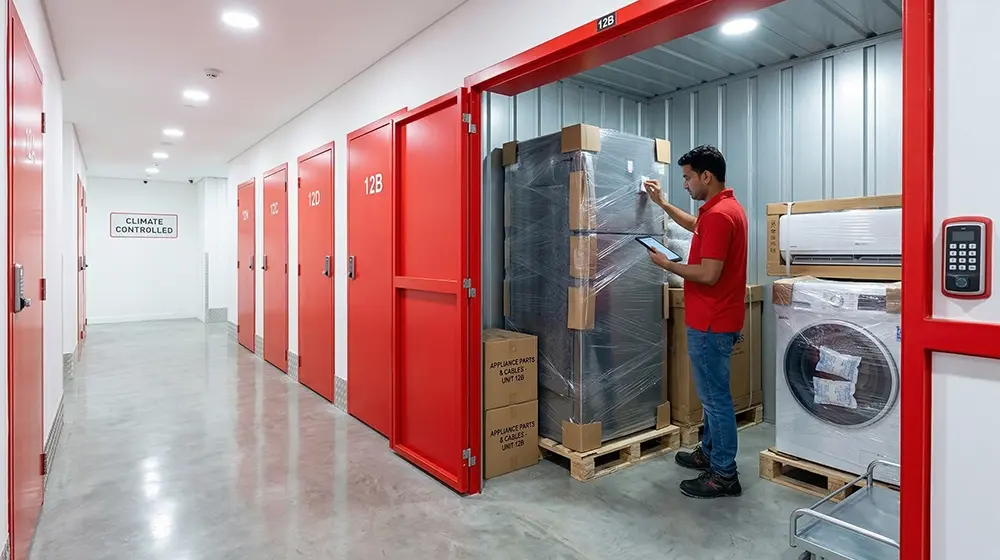
A 10×10 climate controlled storage option needs another check. Climate-control specifications describe this storage type as an indoor environment with more consistent temperature and humidity conditions, although exact controls differ by facility.
Ask for the internal height and environmental specifications, not the 100-square-foot label alone.
- 10×15 (150 sq ft) — 3BHK
A 10×15 unit gives you 150 square feet, or approximately 13.94 m².
At 8 feet high, geometric volume equals 1,200 cubic feet. Current 10×15 capacity guidance places this size at roughly 3 furnished bedrooms or belongings from 4 rooms.
Published examples include king and queen mattresses, sofas, dining furniture, appliances, and household boxes.
That makes 10×15 a useful reference for many 3BHK moves. Large wardrobes and bulky sofas can reduce usable capacity quickly.
The 10×15 storage unit price also needs comparison by actual floor area and height. A lower monthly figure can represent less cubic capacity.
- 10×20 (200 sq ft) — 4BHK or villa
A 10×20 storage unit provides 200 square feet, or about 18.58 m².
At an 8-foot ceiling, total geometric capacity reaches 1,600 cubic feet. Published 10×20 dimensions show 200 square feet, 1,600 cubic feet, and an average 8-foot height.
That capacity can accommodate furniture from several bedrooms, living room and dining furniture, major appliances, exercise equipment, and packed household boxes.
For Dubai villas, count bulky items separately. Outdoor furniture, oversized sofas, multiple appliances, and large wardrobes can consume the 200-square-foot footprint faster.
- 3×3 and 3×5 lockers
A 3×3 footprint contains 9 square feet. A 3×5 footprint contains 15 square feet.
Lockers suit suitcases, documents, tools, cartons, seasonal items, and compact stock. Height can differ sharply from room-sized units.
A Dubai unit-dimension listing shows a roughly 10-square-foot locker at about 4 feet by 3 feet with a 3-foot height. The 25-square-foot room, by contrast, extends to about 10 feet high.
That is why a locker and a small room with similar floor footprints can offer very different cubic capacities.
Dimensions to sq ft to cubic ft conversion table
This table converts every requested dimension using an 8-foot reference height. A second cubic-foot column shows the effect of a 10-foot Dubai room.
| Unit dimension | Floor area | Approx. m² | Volume at 8 ft | Volume at 10 ft |
|---|---|---|---|---|
| 3×3 | 9 sq ft | 0.84 m² | 72 cu ft | 90 cu ft |
| 3×5 | 15 sq ft | 1.39 m² | 120 cu ft | 150 cu ft |
| 5×5 | 25 sq ft | 2.32 m² | 200 cu ft | 250 cu ft |
| 5×10 | 50 sq ft | 4.65 m² | 400 cu ft | 500 cu ft |
| 10×10 | 100 sq ft | 9.29 m² | 800 cu ft | 1,000 cu ft |
| 10×15 | 150 sq ft | 13.94 m² | 1,200 cu ft | 1,500 cu ft |
| 10×20 | 200 sq ft | 18.58 m² | 1,600 cu ft | 2,000 cu ft |
| 20×20 | 400 sq ft | 37.16 m² | 3,200 cu ft | 4,000 cu ft |
The conversions use the exact NIST relationship of 1 foot = 0.3048 meters. NIST also identifies square meter and cubic meter as the corresponding SI area and volume units.
To calculate any unit yourself, multiply:
- Width × depth = square feet
- Square feet × height = cubic feet
- Square feet × 0.092903 = square meters
A 20×20 storage unit provides 400 square feet. It appears here as a comparison because the supporting search query extends beyond the article’s 10×20 household range.
What fits in each dimension?
Choose a storage dimension by inventory, not bedroom count alone. Industry size descriptions act as reference points rather than guaranteed packing limits.
| Dimension | Practical approach | Size guidance |
|---|---|---|
| 5×5 | Closet overflow | Small furniture, mattress, cartons, documents |
| 5×10 | Studio contents | Queen mattress, couch, dresser, bicycle, boxes |
| 10×10 | 1BHK to compact 2BHK | Up to 2 furnished bedrooms |
| 10×15 | 3BHK | 3 furnished bedrooms or 4 rooms |
| 10×20 | 4BHK or villa | Up to 4 bedrooms of contents |
Before renting, record 4 measurements:
- Measure furniture length. Record sofas, wardrobes, tables, and bed frames.
- Measure furniture width. Check whether large pieces can rotate inside the room.
- Check door clearance. Internal space has little value if an item cannot enter.
- Reserve retrieval space. Leave an aisle when you expect regular access.
Dismantling bed frames and tables can reduce empty gaps. Uniform cartons also use vertical space better than irregular loose items.
Price per dimension in Dubai
Dubai storage prices change with unit size, location, contract length, availability, and facility specifications. Current public rates provide a better benchmark than a single unsupported citywide average.
As checked on 18 August 2026, a current Dubai storage rate card lists exact monthly prices for all five principal unit sizes, with the advertised figures including tax.
| Dimension | Floor area | Monthly price | AED per sq ft |
|---|---|---|---|
| 5×5 | 25 sq ft | AED 625 | AED 25.00 |
| 5×10 | 50 sq ft | AED 1,150 | AED 23.00 |
| 10×10 | 100 sq ft | AED 2,250 | AED 22.50 |
| 10×15 | 150 sq ft | AED 3,200 | AED 21.33 |
| 10×20 | 200 sq ft | AED 4,000 | AED 20.00 |
The table reveals a useful pricing pattern within this single rate card. Price per square foot falls by 20%, from AED 25 at 25 square feet to AED 20 at 200 square feet.
Another current Dubai rate card provides a lower comparison. A published Dubai pricing schedule lists 50 square feet at AED 850 before VAT, 100 square feet at AED 1,400 before VAT, and 200 square feet at AED 2,400 before VAT.
The UAE Federal Tax Authority applies the UAE standard Value Added Tax (VAT) rate of 5%. A price advertised as “plus VAT” therefore needs tax added before comparison.
For example, AED 1,400, including 5% VAT, becomes AED 1,470. AED 2,400 with 5% becomes AED 2,520.
Compare total payable price, floor area, height, and access conditions together.
Why the third dimension matters most
Height turns square footage into cubic capacity. Two 100-square-foot units can carry different theoretical volumes when their ceilings differ.
A 100-square-foot room at 7.85 feet gives 785 cubic feet. At 10 feet, the same floor area gives 1,000 cubic feet.
That is 215 extra cubic feet, or about 27.4% more geometric volume.
- Ceiling height by facility type
Dubai storage listings show meaningful height variation.
| Example | Ceiling height | 100 sq ft equivalent volume |
|---|---|---|
| Dubai 100 sq ft storage listing | 7.85 ft | 785 cu ft |
| Standard storage size reference | 8 ft | 800 cu ft |
| UAE storage unit listing | 2.65 m / 8.69 ft | 869 cu ft |
| Climate-controlled UAE storage listing | 3 m / 9.84 ft | 984 cu ft |
| Dubai storage room listing | 10 ft | 1,000 cu ft |
A current Dubai unit specification gives a 7.85-foot internal height for the 100-square-foot unit, and the 150-square-foot option uses the same 7.85-foot height.
One UAE unit specification gives an internal height of 2,650 mm, or about 8.69 feet. A separate climate-controlled storage listing shows units reaching 3 meters, or about 9.84 feet.
At the higher end, published Dubai unit specifications show approximate 10-foot ceiling heights for 25, 50, 100, 150, and 200-square-foot storage units.
So, a 10×10 storage unit in Dubai comparison needs three measurements: width, depth, and height.
- Stacking limits and what they cost you
Unused vertical space has a measurable cost. Take a 10×10 unit with a 10-foot ceiling. The room provides 1,000 cubic feet geometrically.
Stack only to 6 feet, and your belongings occupy at most 600 cubic feet before allowing for gaps or aisles. That leaves 400 cubic feet, or 40% of the room’s theoretical volume, above the stack.
The financial effect is easy to see. At the current AED 2,250 monthly 100-square-foot example, 800 cubic feet at an 8-foot reference height costs about AED 2.81 per theoretical cubic foot.
Effective storage becomes more expensive when you leave major vertical gaps.
Use strong, similarly sized cartons at the bottom. Keep frequently accessed items near the front. Leave enough access space for retrieval rather than filling every cubic foot.
Dubai versus US dimensional conventions
US self-storage commonly uses width and depth in feet. Common self-storage sizing conventions use labels such as 5×5, 5×10, 10×10, 10×15, and 10×20 to describe standard unit dimensions.
Dubai uses both imperial and metric descriptions. Some Dubai storage listings present unit sizes mainly in square feet, while other local specifications use meters, millimeters, and square meters. A separate UAE storage listing also shows compact units such as 1 m² with full metric dimensions.
That creates easy comparison errors. A 10×10 US-style unit equals 100 sq ft or 9.29 m². A 10×20 equals 200 sq ft or 18.58 m².
Convert both floor area and height before comparing Dubai quotations. Matching square meters do not guarantee matching cubic meters.
Choose storage by usable volume, not the label
The right storage unit is not always the one with the closest bedroom-size label. A 10×10 storage unit in Dubai may provide 100 square feet, yet ceiling height can change capacity from 800 cubic feet at 8 feet to 1,000 cubic feet at 10 feet.
That is why width, depth, internal height, doorway clearance, and usable stacking space deserve equal attention. Price matters too, but only after comparing the space you can actually use. Current Dubai listings also show that storage dimensions appear in both imperial and metric formats, which makes direct conversion useful before comparing quotations.
A 5×5 may be enough for compact household overflow. A 10×15 or 10×20 suits much larger inventories. The safest choice comes from measuring the items first, checking the unit’s full dimensions, and comparing total cubic capacity rather than square footage alone. That simple check can prevent paying for empty air or discovering too late that a large item does not fit through the door.
FAQs
How large is a 10×10 storage unit in Dubai?
A 10×10 storage unit contains 100 square feet, or about 9.29 m². With an 8-foot ceiling, the total capacity reaches 800 cubic feet.
Can a 10×10 storage unit hold a 2BHK?
A 10×10 storage unit can accommodate many compact 2BHK contents, with 2 fully furnished bedrooms, although the final fit depends on furniture volume and packing efficiency.
What is the 5×5 storage unit price in Dubai?
A current Dubai price listing places a 25-square-foot storage unit at AED 625 per month, including tax. Prices differ between facilities.
What is the 10×15 storage unit price in Dubai?
A current 150-square-foot Dubai listing costs AED 3,200 per month, including tax.
How much space does a 10×20 storage unit provide?
A 10×20 gives you 200 square feet and 1,600 cubic feet at an 8-foot height.
How large is a 20×20 storage unit?
A 20×20 storage unit provides 400 square feet, about 37.16 m², and 3,200 cubic feet at an 8-foot ceiling.
Is 10×10 climate controlled storage different from standard indoor storage?
Yes. Climate-controlled storage manages indoor environmental conditions more consistently, including temperature and humidity exposure. Specifications vary by facility.
Does ceiling height matter more than square footage?
Ceiling height can materially change capacity. A 100-square-foot unit increases from 785 to 1,000 cubic feet when height rises from 7.85 feet to 10 feet.
Does ceiling height matter more than square footage?
Ceiling height can materially change capacity. A 100-square-foot unit increases from 785 to 1,000 cubic feet when height rises from 7.85 feet to 10 feet.
That 215-cubic-foot difference equals about 27.4% additional geometric volume. Current Dubai listings document both 7.85-foot and 10-foot examples.
What measurements matter before renting a Dubai storage unit?
Check width, depth, internal height, doorway clearance, floor area, and usable stacking height. Those measurements show actual capacity more accurately than the advertised square-foot figure alone.
Rakan Al-Juraid is a logistics specialist with a focus on commercial storage systems and high-security asset management. With extensive experience in industrial warehousing, he specializes in inventory tracking technology and transit safety. Rakan’s expertise lies in streamlining the storage process for both businesses and homeowners through strategic planning. His writing offers data-driven advice on insurance for stored goods, fire-safe environments, and heavy-duty logistics. He is committed to ensuring that every square foot of storage is utilized with maximum security and efficiency. Rakan aims to provide professional-grade storage standards to every reader navigating the moving process.
- Rakan Al-Juraid