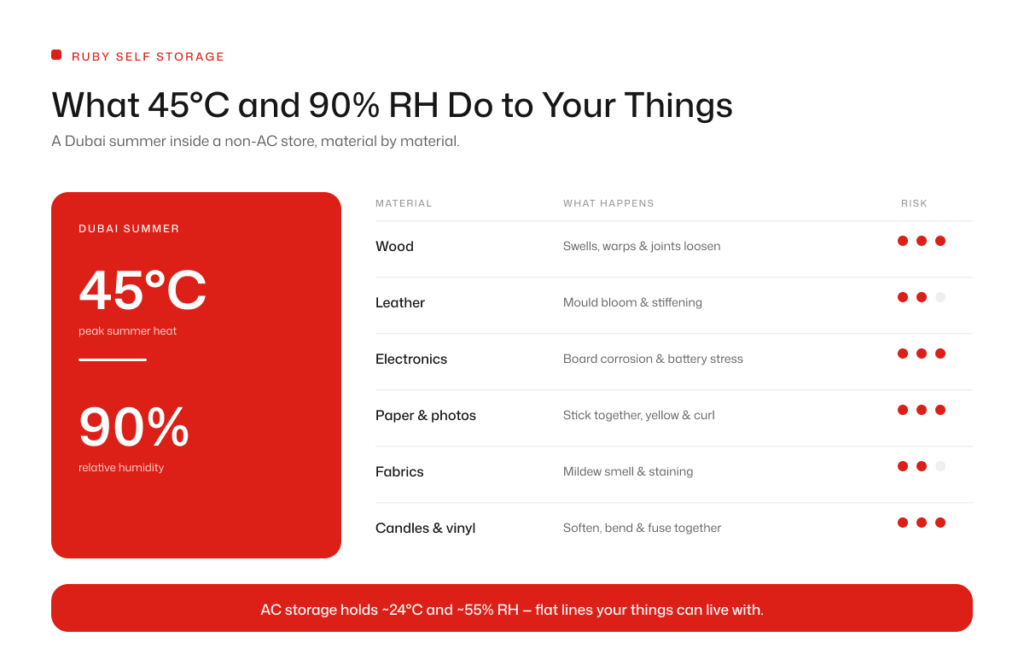
At 45°C, an air-conditioned room can still hide a moisture problem. Warm Dubai air enters through doors and loading bays; when it reaches colder surfaces, relative humidity rises. The damage may appear later:
- A solid-wood door sticks
- Leather smells musty
- Photographs ripple
- An electronic connector corrodes
Dubai summer humidity can damage household materials when storage conditions stay hot, damp, or unstable. Wood swells, leather supports mould, paper distorts, metals corrode, and instruments shift. A monitored, air-conditioned space protects belongings when temperature and relative humidity remain controlled.
This article separates Dubai’s outdoor summer conditions from the climate around your belongings. It compares May-to-September heat and humidity, explains the risks for common household materials, defines practical temperature and RH ranges, and shows how to check the actual conditions in a home or storage unit instead of trusting a cooling claim.
What are Dubai’s actual summer conditions?
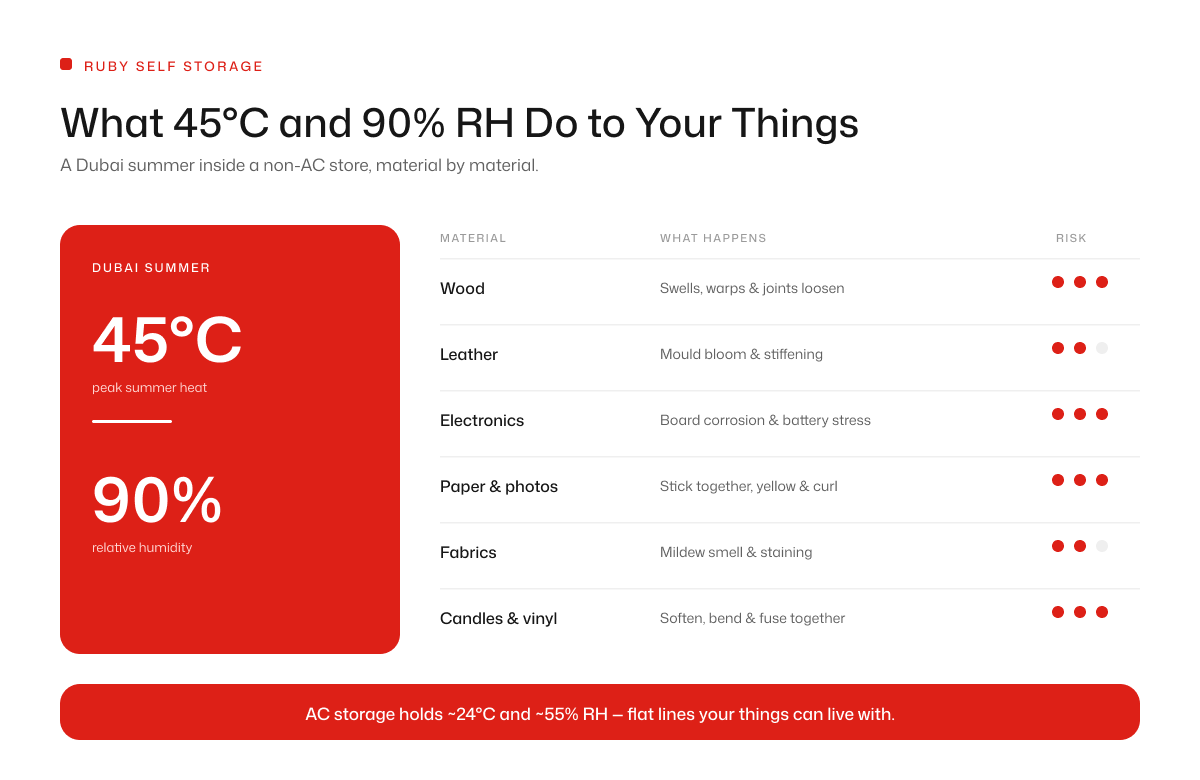
The 45°C heat and 90% relative humidity (RH) in this topic are peak-risk readings, not paired monthly averages. A peer-reviewed UAE station study identifies hotter, more humid coastal summers and reports coastal temperatures near 45°C. Damage starts when heat and moisture enter a poorly controlled room, warehouse, truck, or unit.
Cooling hot, humid air raises RH at colder surfaces. That process creates local dampness even when a room feels cool, according to the Canadian Conservation Institute. A cold cabinet, a supply vent, and the back of a sofa can therefore face different conditions.
Monthly temperature and humidity, May to September
Dubai’s household-storage risk spans May to September. The airport climate record places average daytime highs between 37.2°C and 40.6°C across those months. It also defines a hot season from 19 May to 24 September, when average highs exceed 37.2°C.
The table defines the seasonal heat and humidity load that your storage space must resist. Temperatures convert from the published Fahrenheit values. “Muggy or worse” uses dew-point-based humidity categories, not a monthly RH average.
| Month | Average daily high / low | Days rated muggy or worse | Storage meaning |
|---|---|---|---|
| May | 37.2°C / 25.6°C | 14.4 | Heat begins; a closed, non-air-conditioned unit starts accumulating stress. |
| June | 38.9°C / 28.3°C | 22.3 | Humid nights leave less drying time for materials. |
| July | 40.0°C / 30.6°C | 25.5 | The longest humid exposure in the five-month period. |
| August | 40.6°C / 31.1°C | 25.3 | The highest average daytime heat. |
| September | 38.3°C / 28.3°C | 24.3 | Heat eases, but humid exposure remains frequent. |
Across those five months, the dataset records 111.8 muggy-or-worse days. That figure does not equal 65% RH inside a unit. It does show why a single outdoor reading or a unit visit at midday says little about overnight storage conditions.
- August carries the greatest average heat: 40.6°C by day and 31.1°C overnight.
- July carries the most muggy days: 25.5 days in the airport record.
- Every listed month contains at least 14.4 muggy-or-worse days: Moisture exposure is a season, not an August-only problem.
Coastal versus inland variation
Coastal Dubai carries a stronger moisture load, especially after sunset. WeatherSpark puts average surface-water temperature at 33.3°C in August. The UAE station study, based on 1980–2018 data, describes Dubai and Abu Dhabi as more humid than inland Al Ain.
Inland areas often face harsher dry heat. The same study reports interior summer temperatures above 49°C. A warehouse door, roof, vehicle, or cold air-conditioning surface can still create damaging local RH changes.
Ask for a temperature-and-RH record from the exact room or unit. Check whether it sits near a loading bay, roller shutter, external wall, or roof. Dubai Health Authority HVAC guidance addresses condensation prevention in Dubai’s high-humidity climate.
What happens to each material?
Dubai humidity damage to furniture is not one problem. Household items contain materials that react differently to heat and moisture. Inspect the materials, then control the condition that harms them.
- Solid wood — movement, joint failure, warping thresholds
Solid wood gains or loses moisture until it approaches equilibrium with the surrounding RH. The USDA Forest Products Laboratory confirms that moisture change drives dimensional change. Seasonal movement opens furniture joints, cups panels, cracks finishes, or distorts veneered surfaces when layers move differently.
This matters most for solid-wood tables, wardrobes, cabinets, antique furniture, and instruments with wooden bodies. There is no single “warping threshold” in RH. Species, grain, panel width, glue, and restraint decide the outcome. The USDA laboratory notes that tangential shrinkage is about twice radial shrinkage, which helps explain cupping and twist.
Store furniture in a unit that records stable RH, raise it off a concrete floor, and leave room for air around wrapped pieces. Protective coatings slow moisture exchange but do not stop it, the USDA laboratory notes. Skip measurement and you may discover the problem only after joints loosen or a door no longer closes squarely.
- Leather — mould growth threshold and finish damage
Leather supports mould growth above 65% RH. The Canadian Conservation Institute identifies 65% RH as favorable for mould on leather. Prolonged warm, moist conditions darken the finish, stiffen fibers, and increase hydrolytic breakdown.
Leather sofas, handbags, shoes, car seats, book bindings, and upholstered chairs face the highest risk when boxed or covered without air movement. A musty smell, pale web-like deposits, dark dots, or sticky residue demand attention. Wiping the surface does not correct the damp condition.
Keep leather clean, dry, and in a documented 45–55% RH band. The Canadian Conservation Institute gives that range for leather-type materials and advises temperatures below 25°C. Skip that band, and mildew can stain the finish before mould becomes obvious in a routine inspection.
- Paper and photographs — foxing and cockling
Paper absorbs moisture from surrounding air, and uneven expansion makes a sheet cockle or form permanent-looking waves. Photographs add another layer of risk because albums, paper supports, inks, and image layers respond differently. The Canadian Conservation Institute lists paper among materials whose moisture content responds to RH.
Important contracts, certificates, books, family albums, prints, and framed photographs deserve care during a Dubai move or long storage period. High humidity does not explain every brown foxing spot; paper chemistry, metals, past water exposure, and fungal activity also contribute.
Use clean archival-quality folders or boxes, keep photographs flat, and avoid sealing damp paper in plastic. At 20°C, wood-pulp paper stored at 30% RH has about twice the lifespan of comparable paper at 50% RH, according to the Canadian Conservation Institute. At 90–100% RH, water-sensitive inks and photographic dyes can bleed.
The Library of Congress uses 30–60% RH for controlled drying of wet collections. That emergency range is not a general storage target. Skip humidity control, and distorted pages, transferred inks, mould staining, and bonded photograph surfaces become harder to reverse.
- Electronics — condensation and corrosion
Electronics face two linked hazards: condensation and corrosion. Condensation forms when a device surface falls below the dew point; the National Institute of Standards and Technology describes the corrosion risk when water condenses on conventional steel. In a laptop, television, camera, appliance, or server, moisture then reaches connectors, boards, and metal contacts.
High RH also accelerates corrosion without obvious droplets. Above 65% RH, adsorbed water on clean metal surfaces can act as an electrolyte, and corrosion speeds up, according to the Canadian Conservation Institute. The exact threshold differs by component, contamination, salt exposure, and manufacturer design.
Use a logged, air-conditioned space for electronics and retain the original packaging or clean padded cartons. Let a device acclimatize after a hot move before you connect power if the unit arrived in a much cooler room. Skip this step, and a device can look dry while corrosion begins inside connectors or a cold surface collects moisture.
- Textiles — mildew and insect activity
Textiles become a moisture-and-pest issue when you store them dirty, compressed, or damp. The Canadian Conservation Institute identifies damp conditions above 70% RH as a condition to avoid. Its humidity risk table estimates visible mould in about 10 days at 80% RH and 25°C. It estimates about two days at 90–100% RH.
Wool rugs, coats, curtains, bedding, uniforms, and fabric sofas face different pest risks. Humidity does not create insects by itself. Textiles and costume collections attract insects because they provide food and sheltered, undisturbed spaces, the Canadian Conservation Institute explains.
Clean and fully dry each item before packing, use breathable protective covers where appropriate, and inspect for holes, webbing, casings, or frass. Skip cleaning and monitoring, and a humid unit can turn a small food stain or a few moth larvae into an expensive fabric-loss problem.
- Musical instruments — tuning and structural stability
Musical instruments react to RH because many combine wood, glue, metal, felt, leather, varnish, strings, and stretched skins. The Smithsonian Museum Conservation Institute notes that RH changes can distort instrument structure and affect tuning and tonal quality.
Guitars, violins, oud instruments, pianos, drums, and wooden wind instruments benefit from climate control during Dubai summer. A hard case slows change but does not replace a controlled room. A sudden move from a hot vehicle into cold AC creates a high temperature and RH transition.
Keep the instrument in its case inside a stable, logged space and allow gradual acclimatization before playing or tuning. Skip stability, and you risk loose glue joints, altered action, distorted wood, or a drumhead that tightens and slackens unpredictably.
The safe ranges
A mixed household collection has no single perfect climate target. Use 15–25°C, 45–55% RH, and modest variation as the working band for mixed furniture and belongings. The Canadian Conservation Institute confirms that the least-damaging range depends on the materials present.
Target temperature band
Maintain 15–25°C for household storage, then aim near 20–22°C, where a single setting serves furniture, documents, leather, and instruments. The Canadian Conservation Institute identifies 15–25°C as a typical reliable control range for sensitive packed items.
Temperature alone does not protect household materials. Heat above 25°C softens some adhesives and raises chemical deterioration rates. Ask for temperature and RH on the same log.
Target relative humidity band
Maintain 45–55% RH for a mixed household load. This band matches the Canadian Conservation Institute’s ideal 45–55% RH recommendation for leather. It also sits inside the Institute’s 40–55% moderate range for most metals in composite objects.
This table defines the practical RH decisions for a mixed load. The 65%, 75%, and mould-time thresholds come from the Canadian Conservation Institute humidity framework.
| Logged condition | Meaning for household materials | Decision |
|---|---|---|
| 45–55% RH | Overlap range for leather and mixed metal-containing objects | Keep this as the normal target. |
| 56–64% RH | Above the target, but below the leather mould threshold | Investigate repeated peaks and door or AC cycles. |
| 65–74% RH | Leather mould becomes favorable; metal corrosion risk rises | Correct the unit climate before storing sensitive items. |
| 75% RH or higher | The Institute classifies this as damp | Move the load or dehumidify the room. |
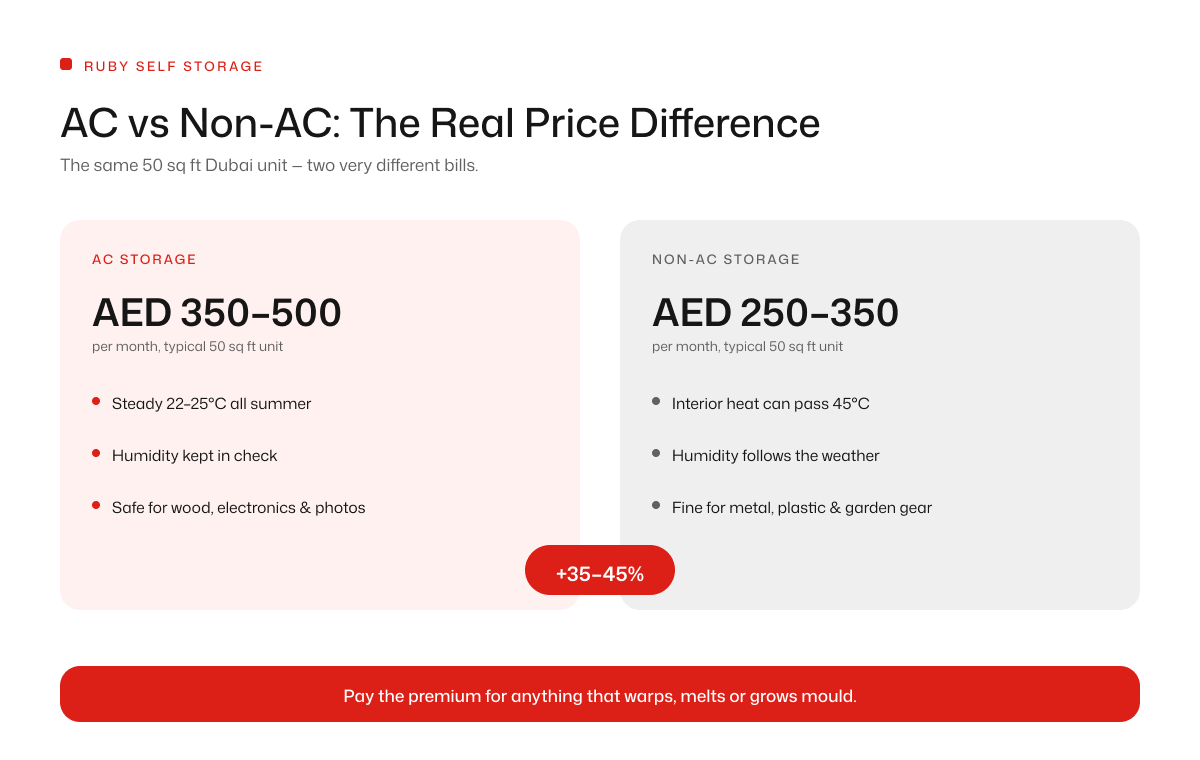
Leather supports mould growth above 65% RH. Dubai Airport records muggy-or-worse conditions in every month from May to September. That does not prove the RH in your unit, so a temperature-only promise proves little. One UAE operator publishes climate-controlled storage from AED 400 per month; treat that as a starting rate, not a citywide AC premium. An AC cost earns its place only when the unit log stays within the safe band.
Why rate of change matters more than peak
For wood, leather, paper, and instruments, a rapid shift causes mechanical stress because outer surfaces respond before inner material catches up. The USDA Forest Products Laboratory links moisture gradients and differential shrinkage to warp. The Canadian Conservation Institute records physical damage from RH fluctuations in leather.
Paper provides a useful scale. For highly sensitive restrained sheets, the Canadian Conservation Institute rates a 5% RH swing as possible damage and a 10% swing as a serious risk. Peak RH still matters. A sustained period above 65% RH supports mould and speeds corrosion; 75% RH marks damp conditions.
Limit both the duration above critical RH and the speed of change during moves, AC outages, and door openings. A unit that reads 50% RH at reception but oscillates overnight does not meet the same standard as a unit holding 50% RH steadily.
How to measure conditions where your items are now
Measure beside the belongings, not at reception or outside the building. The Canadian Conservation Institute recommends several recording instruments in locations where the collection sits because damage depends on the pattern over time.
A spot hygrometer tells you the condition now. A logger captures 2 a.m. conditions, power interruptions, and humid loading days. Photograph furniture joints, leather surfaces, and instruments before storage; later comparisons separate new climate damage from old wear.
Act on the record, not on a sales label. A repeated 65% RH reading calls for climate correction. A 75% RH reading calls for immediate drying or relocation, especially where leather, paper, or electronics sit.
The record, not the label, protects your belongings
Dubai summer does not damage every household item on the first hot day. The risk builds when heat, humid air, and uneven air conditioning create a climate that nobody measures. A storage unit can feel cool at the entrance and still cross the 65% RH level that supports mould growth on leather, according to the Canadian Conservation Institute.
The practical decision is simple: measure the space beside your belongings. A reliable log shows whether the unit holds 15–25°C and 45–55% RH through hot afternoons, humid nights, door openings, and AC interruptions. If it cannot hold that range, it does not suit solid wood, leather, paper records, electronics, or instruments.
Climate control is not a label on a storage advert. It is a documented condition. That distinction protects the things that are costly, difficult, or impossible to replace.
FAQs
Does Dubai humidity damage wooden furniture?
Yes, repeated RH changes alter wood moisture content, which moves panels and joints and can produce cupping, cracks, and poor door alignment.
Is an air-conditioned storage unit enough for a leather sofa?
An air-conditioned unit protects a leather sofa only when its own log shows stable 45–55% RH and moderate temperature, not merely cool air at the entrance.
What RH causes mould on leather?
Leather supports mould growth above 65% RH, and mould grows more vigorously above 75% RH, according to the Canadian Conservation Institute.
Can humidity damage electronics without visible water?
Yes, high RH leaves adsorbed moisture on metal surfaces and accelerates corrosion, while cooling below the dew point creates visible condensation.
Rakan Al-Juraid is a logistics specialist with a focus on commercial storage systems and high-security asset management. With extensive experience in industrial warehousing, he specializes in inventory tracking technology and transit safety. Rakan’s expertise lies in streamlining the storage process for both businesses and homeowners through strategic planning. His writing offers data-driven advice on insurance for stored goods, fire-safe environments, and heavy-duty logistics. He is committed to ensuring that every square foot of storage is utilized with maximum security and efficiency. Rakan aims to provide professional-grade storage standards to every reader navigating the moving process.
- Rakan Al-Juraid
- Rakan Al-Juraid
- Rakan Al-Juraid
- Rakan Al-Juraid