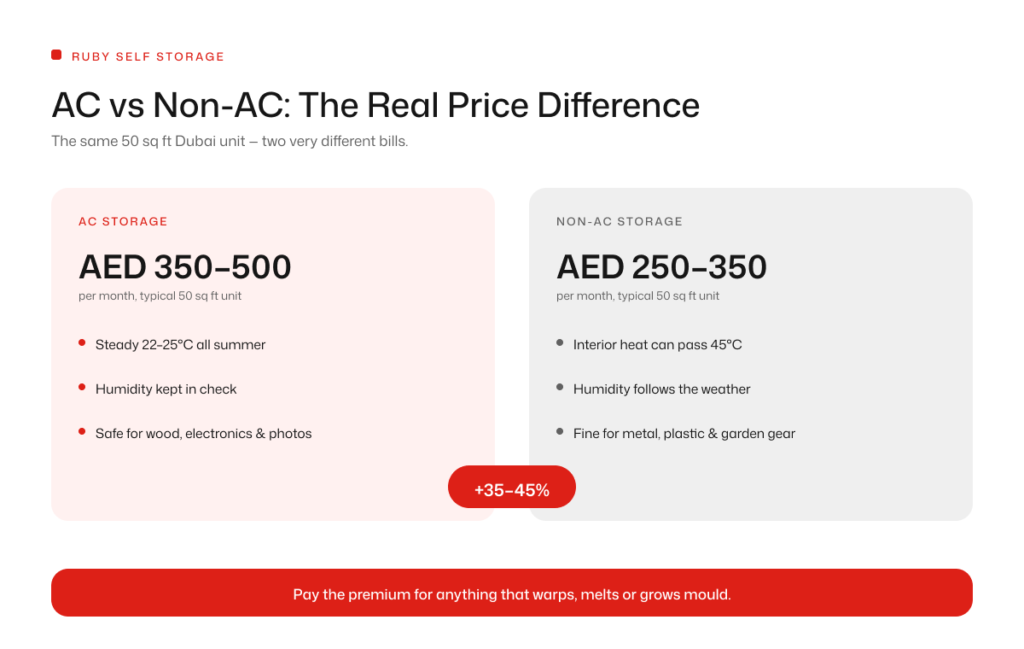
Dubai storage quotes can look similar until climate control enters the calculation. A current Al Quoz rate card shows an AED 2.40 per sq ft monthly gap between AC and non-AC bulk space. For 100 sq ft, that becomes AED 252 a month, including the UAE’s 5% VAT rate from the Federal Tax Authority.
The extra rent pays for more than lower air temperature only when the facility documents the conditions it maintains. The lower monthly rate only makes sense when the stored items tolerate undocumented heat and humidity.
This article separates air conditioning from verified climate control, calculates the AC price delta by unit size and racked volume, reviews Dubai summer evidence, and identifies which items justify the upgrade. It also gives a practical break-even calculation and the exact temperature and humidity records to request before signing.
What is the difference between AC and non-AC storage?
AC storage uses mechanical cooling. Non-AC storage has no active cooling system. Climate-controlled storage is more specific because it states the temperature range, relative humidity (RH) range, monitoring method, and response to a fault.
The price gap only makes sense after separating cooling from environmental control. A unit can have air conditioning yet provide no temperature log, no humidity target, and no confirmation that conditions remain stable during a power failure or maintenance outage.
Temperature and RH affect materials differently. Some objects respond mainly to temperature, others to RH, and many objects contain materials with conflicting requirements.
- Ask for the set-point range in °C.
- Ask for the RH range and whether a dehumidifier operates.
- Ask for the last 30 days of temperature and RH records.
- Ask what happens during HVAC failure, planned maintenance, or access-door use.
A storage operator that cannot provide these facts offers cooled space, not a verified climate-control specification. That distinction matters most for assets that include wood, paper, leather, coatings, batteries, adhesives, or organic fibers.
How much more does climate control cost?
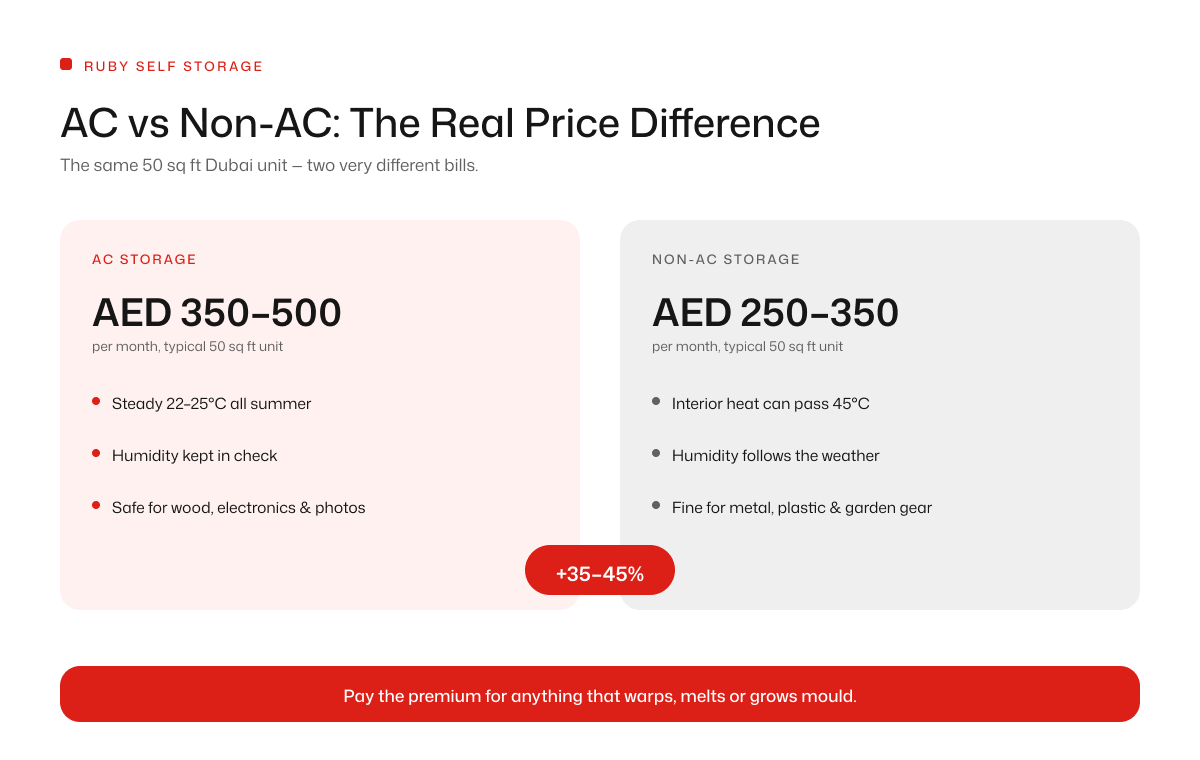
Climate control costs AED 2.40 per sq ft a month more in the verified benchmark. The public Al Quoz rate card lists AED 7.44 per sq ft for non-AC bulk space and AED 9.84 per sq ft for AC bulk space, both before VAT and handling.
Price status: AC price delta verified on 19 August 2026. This is a live benchmark, not a citywide tariff. Private lockers, warehouse bays, access hours, insurance, collection, racking, handling, location, and contract term can change the final quote.
Price delta by unit size
The table converts the listed per-square-foot rates into monthly figures. It applies the UAE 5% VAT rate and excludes handling because the published rate card excludes it.
| Unit size | Non-AC/month | AC/month | AC premium/month |
|---|---|---|---|
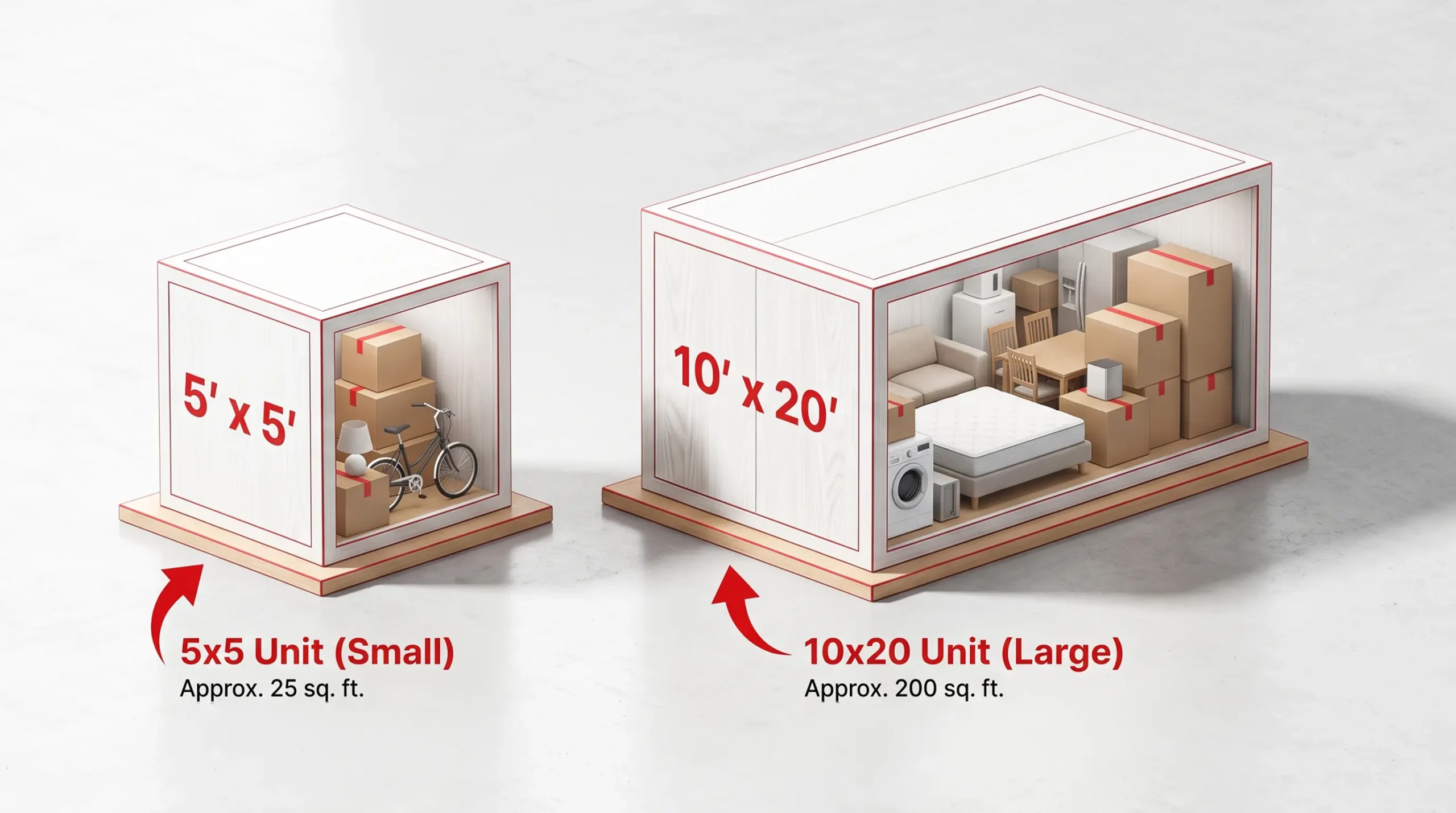
| 25 sq ft | AED 195.30 | AED 258.30 | AED 63.00 |
| 50 sq ft | AED 390.60 | AED 516.60 | AED 126.00 |
| 100 sq ft | AED 781.20 | AED 1,033.20 | AED 252.00 |
| 150 sq ft | AED 1,171.80 | AED 1,549.80 | AED 378.00 |
| 200 sq ft | AED 1,562.40 | AED 2,066.40 | AED 504.00 |
This comparison uses AED 7.44 non-AC and AED 9.84 AC per sq ft, plus 5% VAT. It is a calculation from the cited rate card, not a market average.
Use the table as a quote-checking tool. A 0.1 sq ft measurement error does not change the decision. A different space type does. Compare like with like: private lockable unit against private lockable unit, or bulk pallet space against bulk pallet space.
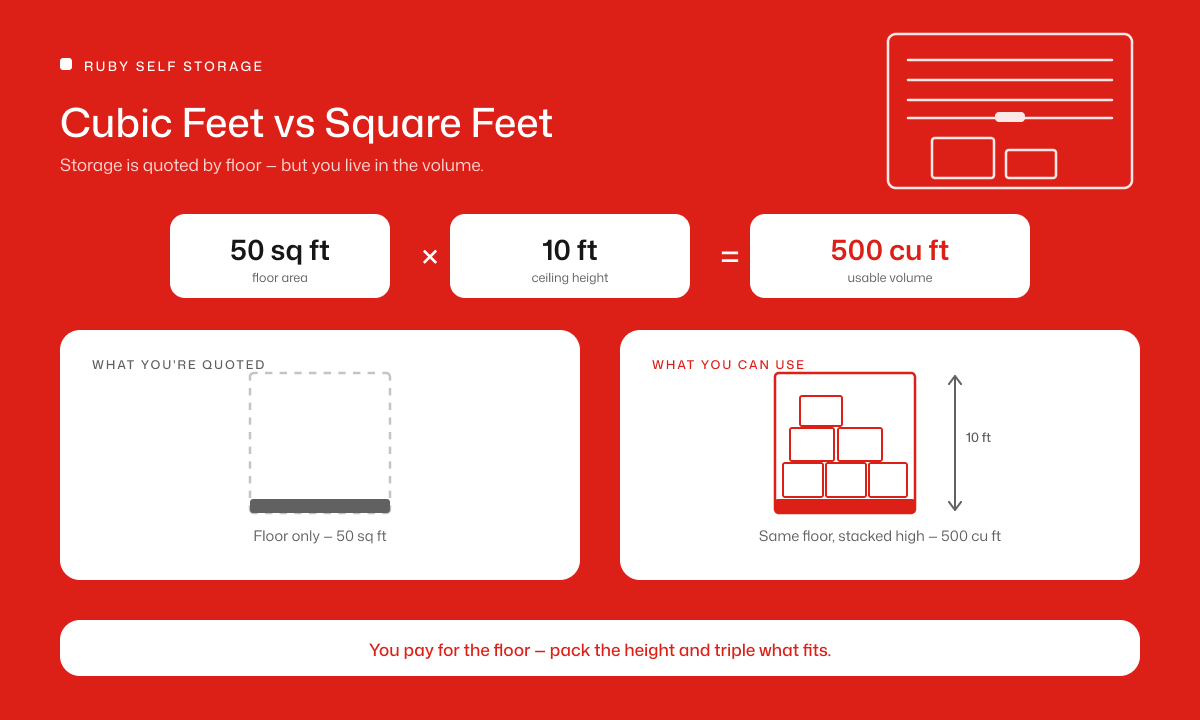
AC premium for racked bulk space
| Billing basis | Non-AC, pre-VAT | AC, pre-VAT | AC premium, pre-VAT |
|---|---|---|---|
| Racked bulk space, 1 CBM | AED 44.40 / month | AED 64.80 / month | AED 20.40 / month |
This volume comparison is a racked bulk-space tariff. It does not represent the price of a private lockable unit.
Compare a private lockable unit with a private lockable unit, or bulk pallet space with bulk pallet space. A 0.1 sq ft measurement error rarely changes the decision. A different storage basis does.
The delta as a percentage of base rent
The AC premium equals 32.3% of the non-AC base rent in this benchmark. The calculation is AED 2.40 divided by AED 7.44. The AC rate equals 132.3% of the non-AC rate before VAT, and VAT preserves the same percentage difference.
The racked-space premium is higher. AED 20.40 divided by AED 44.40 equals 45.9%. Rate basis explains the difference, so compare square-foot prices only with square-foot prices and cubic-meter prices only with cubic-meter prices.
Annual cost of the upgrade
The annual AC premium is AED 756 for 25 sq ft, AED 1,512 for 50 sq ft, AED 3,024 for 100 sq ft, AED 4,536 for 150 sq ft, and AED 6,048 for 200 sq ft. These figures equal the VAT-inclusive monthly premium multiplied by 12.
A 100 sq ft unit costs AED 3,024 more over one year, before handling and insurance. That amount provides the relevant budget for comparing documented climate control against repair, replacement, reprinting, downtime, or stock-write-off costs.
Record usable area, storage type, access, VAT treatment, collection, and handling fees before comparing climate controlled storage Dubai quotes.
What does a Dubai non-AC unit reach in summer?
No credible public source provides an August logger record from a specific non-AC storage unit in Dubai. A universal internal-temperature claim would therefore be unsupported. Roof exposure, wall insulation, ventilation, door opening, unit position, occupancy, and sensor location can produce different results in the same facility.
This evidence gap is material. The Canadian Conservation Institute identifies measurement as the way to establish storage conditions and recommends data loggers for continuous temperature and RH records through seasonal cycles.
Peak internal temperature June to September
Measured non-AC internal temperature in August: no verified public number from a named Dubai storage unit was located in this source review. Dubai experiences extremely hot, long, windy, and humid summers, with an average high temperature of around 40 °C and overnight lows of around 30 °C in August, the hottest month. The region generally experiences sunny days every year.
Dubai Municipality uses a 46°C dry-bulb and 29°C wet-bulb outdoor condition for air-conditioning load calculations. That is a mechanical-design condition, not an August average and not a warehouse measurement.
The closest published Dubai measurement covers 26 homes under autonomous summer conditions, not warehouses and not August. The study recorded a 25.8°C mean indoor temperature and a 22.6°C to 31.2°C range during its May to June survey.
| Evidence set | Period | Temperature result | Decision limit |
|---|---|---|---|
| Named Dubai non-AC storage unit | August | No public logger record found | Obtain a unit-specific log |
| 26 autonomous Dubai homes | May to June | 25.8°C mean; 22.6°C to 31.2°C | Not a warehouse or August reading |
The table separates a missing facility measurement from the closest published Dubai indoor comparator.
Do not convert that residential range into a storage-unit promise. A non-AC storage decision needs a facility-specific logger record, not a generic claim that every unit reaches a fixed temperature.
A usable August record states the unit type, sensor position, sampling interval, low, high, average, and fault periods. A wall-thermostat photo does not provide this history.
Peak relative humidity
The same 26-home Dubai summer dataset measured RH from 45.0% to 71.0%, with a 58.6% mean. It is comparable indoor evidence, not a non-AC storage-unit August measurement.
Humidity matters because organic materials absorb and release moisture. The Canadian Conservation Institute identifies both RH level and RH fluctuation as preservation factors.
Ask for the highest RH, the lowest RH, and time above 60% for the previous August. A single current reading cannot describe a four-month summer cycle.
Which items need it and which do not
Material composition determines the choice. The categories below separate items that justify a documented climate-control specification from durable goods that often tolerate non-AC storage when they remain clean, dry, packed correctly, and within their manufacturer limits.
Needs it — wood, leather, electronics, paper, textiles, art
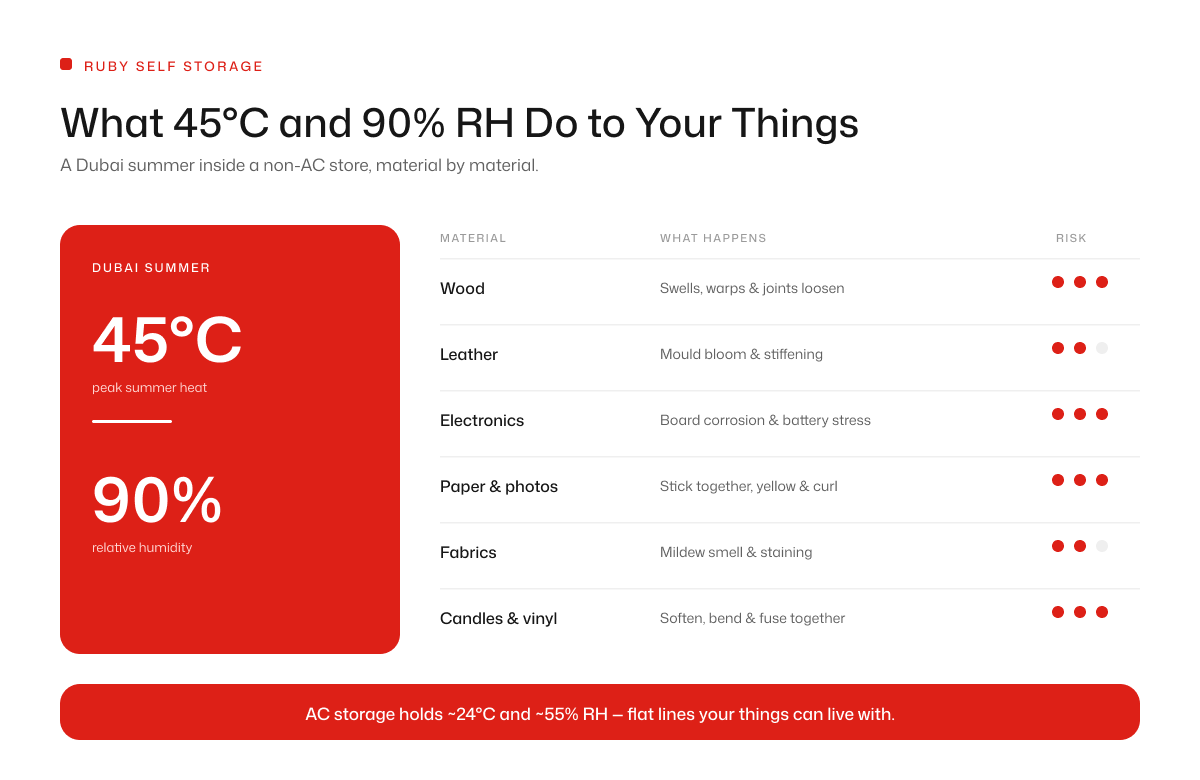
Wood, leather, paper, textiles, art, and specification-limited electronics need recorded temperature and RH control. The Canadian Conservation Institute advises against storing wood furniture in fluctuating environments.
The National Park Service reports that hot, dry conditions embrittle leather and paper, while damp conditions support mould growth. These materials need an operating record, not a generic cooling claim.
Art and family heirlooms add a second issue: value can exceed replacement price. The Library of Congress advises stable ambient temperature and RH between 30% and 50% for controlled display of art and heirlooms. That band is preservation guidance, not a universal self-storage contract term.
Check each electronics manufacturer’s storage-temperature range, battery guidance, and warranty condition. Select air-conditioned storage in Dubai only when the operator documents conditions inside that range.
Does not need it — metal, plastic, ceramics, tools
Durable metal, rigid plastic, ceramics, and basic hand tools do not automatically require AC. Non-AC storage can suit these items when heat does not exceed product limits and packaging blocks dust, water, and pests.
This category still needs material checks. Metal can corrode when RH remains high. The Canadian Conservation Institute treats low RH as a key preservation condition for metals.
Plastic can soften, deform, or age depending on polymer type. Ceramic bodies tolerate heat well, but glazes, painted finishes, adhesives, and packaging may not.
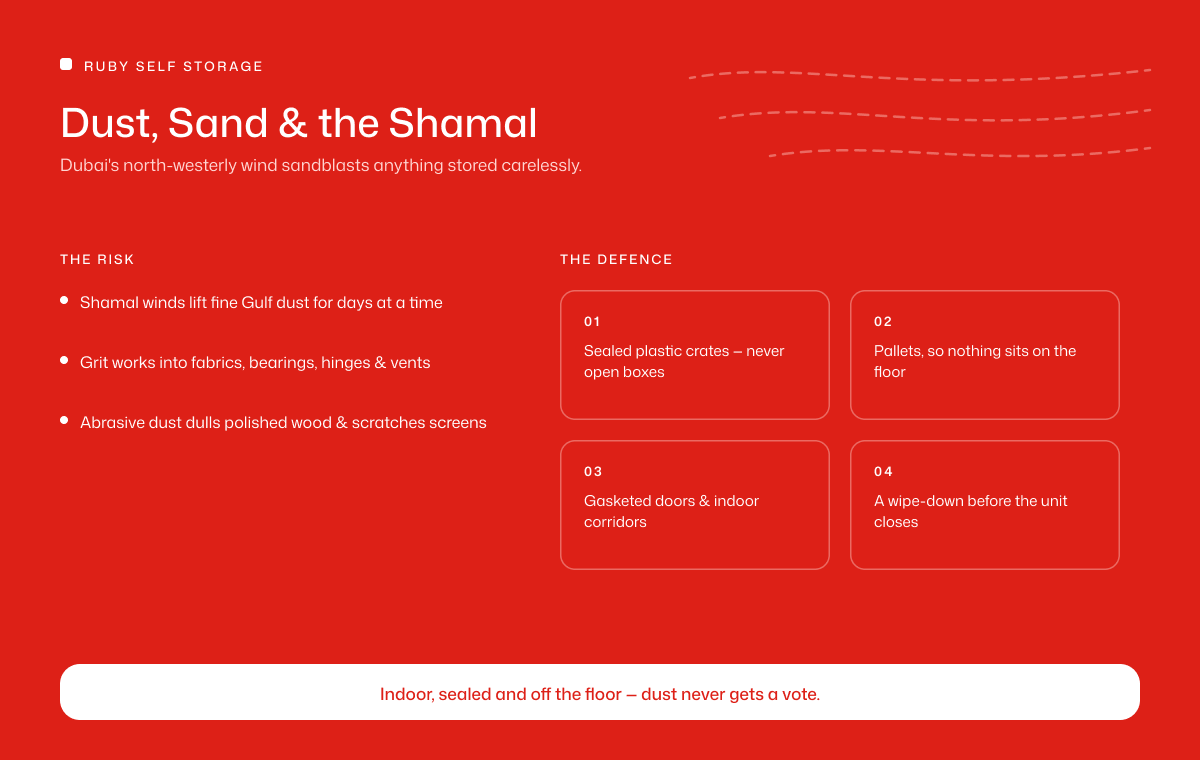
Store these goods off the floor, use sealed containers where suitable, add desiccant only inside a closed enclosure, and inspect the unit after the first humid period.
Sealed appliances, luggage, sports gear
Sealed appliances, luggage, and sports gear sit in the borderline group because each item combines different materials. An appliance can contain circuit boards, rubber seals, foam, coatings, and batteries. A suitcase can include fabric, leather trim, adhesive, and metal hardware.
Choose non-AC storage for a short, low-value holding period only after checking the item’s storage limit and condition. Choose documented climate control for higher-value equipment, battery-powered goods, leather-trimmed luggage, foam products, or gear that you cannot inspect regularly.
Calculate the AC premium, then compare it with the cost and disruption of a preventable failure. This keeps the choice commercial rather than emotional.
The break-even calculation
The break-even point equals the cost of one credible climate-related loss divided by the monthly AC premium. For a 100 sq ft benchmark unit, use AED 252 per month including VAT. An AED 1,512 repair or replacement cost equals six months of AC premium. An AED 3,024 loss equals 12 months.
- List the items that cannot tolerate undocumented heat or humidity.
- Record each item’s replacement, repair, reprint, or downtime cost.
- Add the costs that one climate event can trigger.
- Divide that total by the monthly AC premium for the chosen unit size.
This calculation does not predict damage. No public dataset in this review assigns a damage probability to a particular Dubai non-AC unit. It gives you a transparent cost threshold. Include business interruption, document recovery, customer penalties, and staff time only where your records support those costs.
Space reduction improves the calculation more than downgrading the environment. Reducing a 100 sq ft AC requirement to 50 sq ft cuts the cited monthly AC premium by AED 126, while retaining the same documented conditions for the remaining inventory.
What set-point should you ask for?
Ask for a documented temperature target between 22.5°C and 25.5°C, RH not above 60%, and continuous records. Dubai’s Green Building Regulations specify that HVAC systems provide 22.5°C to 25.5°C and 30% to 60% RH for 95% of the year in normal occupied spaces. This is a building comfort benchmark, not a universal storage specification.
A stronger request names five facts: the sensor location, reading interval, target temperature, target RH, and fault response. The provider can then show whether its Dubai climate controlled storage matches the condition your assets require.
- Request a 30-day temperature and RH graph before booking.
- Request the maximum and minimum values from the latest August.
- Request the alarm threshold and maintenance-response procedure.
- Request written confirmation of access, handling, and insurance exclusions.
Use a stricter figure where an item manual, insurer, regulator, artist, conservator, or manufacturer specifies one. Food, medicines, chemicals, and controlled products follow their own approved storage conditions, not a general household-storage set-point.
Set-point is only the target. Retain the quoted condition, operating report, storage agreement, and inventory record for high-value items. These records support procurement, insurance, and claims review.
Choose the storage condition, not the label
AC becomes a cost decision only after it becomes a condition-control decision. In the current Al Quoz benchmark, a 100 sq ft AC unit adds AED 252 each month, or AED 3,024 across a year, including the UAE’s 5% VAT. Compare that amount with inventory value, recovery work, delayed operations, and the consequences of storing sensitive materials without evidence.
Non-AC storage remains a rational option for robust, correctly packed goods that stay within their stated product limits. For paper records, wood, leather, electronics, textiles, and art, do not treat the words “air conditioned” as proof. Request temperature and RH records for the same unit type, confirm the fault-response process, and compare square-foot and cubic-meter prices on the same basis. The stronger choice protects the stock you actually hold and provides records when procurement, insurance, or a client asks why.
FAQs
What is air conditioned storage Dubai?
Air conditioned storage uses mechanical cooling, while verified climate control states temperature, RH, monitoring, and fault-response details.
How much more does AC storage cost?
The current public Al Quoz benchmark shows AED 2.40 per sq ft per month before VAT, equal to AED 252 per month including VAT for 100 sq ft.
Does an AC unit automatically control humidity?
No. Cooling may reduce moisture, but only an RH set-point and a facility log confirm humidity control inside the unit.
Can non-AC storage in Dubai space suit a short rental?
Yes, for durable items that meet their product limits and do not rely on stable temperature or RH. Inspect the unit condition and packaging before moving goods in.
What evidence proves a unit’s conditions?
A time-stamped temperature and RH log from the same unit type provides useful evidence. The Canadian Conservation Institute identifies measurement as the way to establish storage conditions.
Rakan Al-Juraid is a logistics specialist with a focus on commercial storage systems and high-security asset management. With extensive experience in industrial warehousing, he specializes in inventory tracking technology and transit safety. Rakan’s expertise lies in streamlining the storage process for both businesses and homeowners through strategic planning. His writing offers data-driven advice on insurance for stored goods, fire-safe environments, and heavy-duty logistics. He is committed to ensuring that every square foot of storage is utilized with maximum security and efficiency. Rakan aims to provide professional-grade storage standards to every reader navigating the moving process.
- Rakan Al-Juraid
- Rakan Al-Juraid
- Rakan Al-Juraid