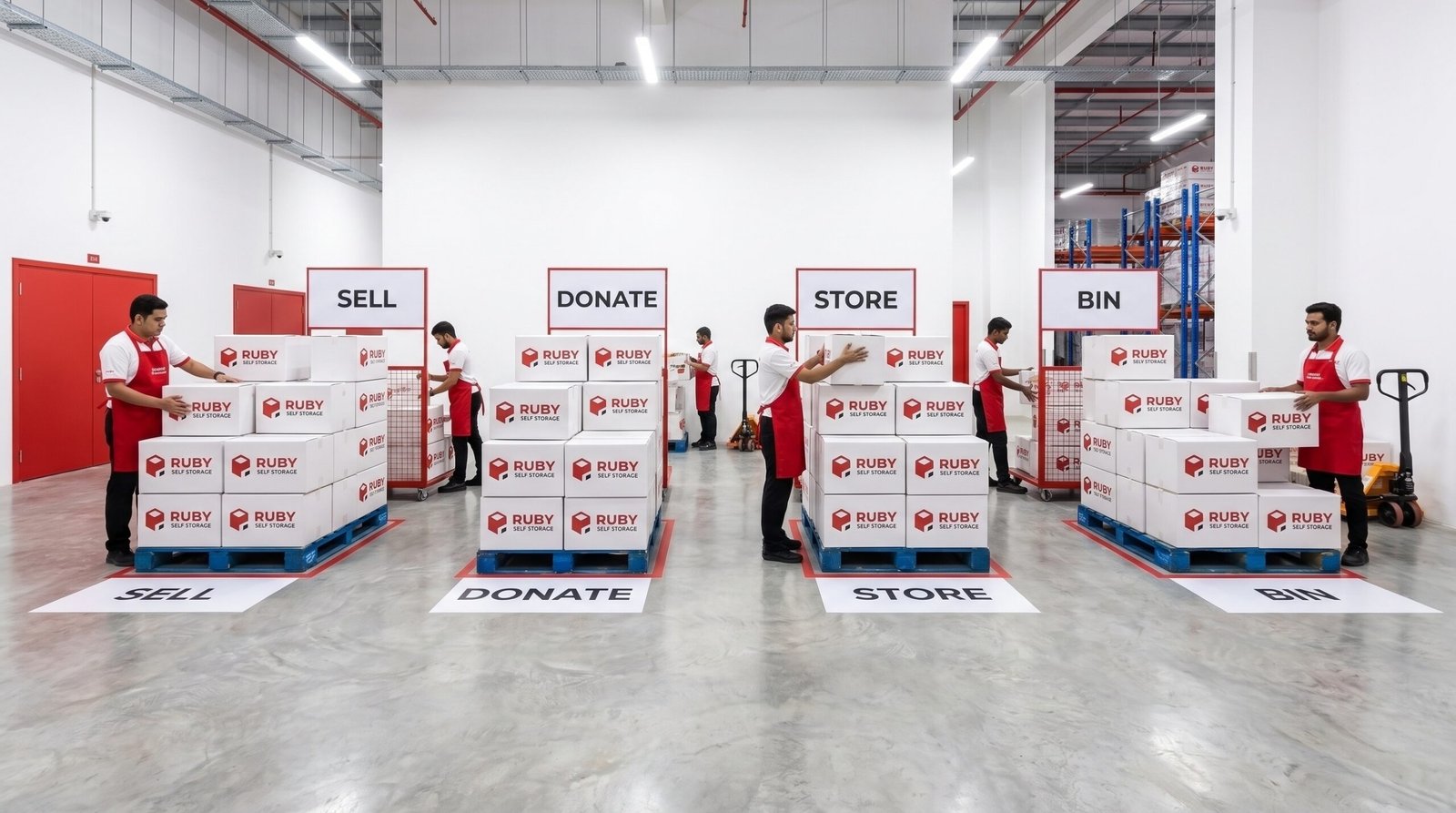
Dubai e-commerce sellers can outgrow their storage space before they outgrow their sales channels. Cartons start occupying work areas, stock becomes harder to track, courier collections interrupt daily operations, and a full warehouse can feel excessive for a business holding only a few cubic meters of inventory.
The commercial decision is not simply whether self storage or warehouse space costs less. The better question is which storage model matches your inventory volume, order frequency, access needs, and licensed activity.
This guide compares e-commerce inventory storage in Dubai across 3 practical thresholds:
- Under 5 CBM
- 5 to 20 CBM
- Over 20 CBM
It also compares AED per cubic meter, explains the limits of self storage, covers licence and dispatch requirements, and shows when warehouse or 3PL fulfillment becomes more practical.
What do Dubai e-commerce sellers actually need?
Dubai e-commerce sellers need storage that matches inventory volume, SKU count, stock turnover, receiving frequency, dispatch volume and licensed activity.
A seller holding 10 CBM of slow-moving spare parts has a different storage requirement from a fashion seller holding the same 10 CBM with 50 daily orders. The physical volume is identical. The handling workload is not.
One cubic metre, or CBM, equals one meter × one meter × one meter. For boxed inventory, calculate each carton as:
- Length × width × height in meters = CBM
Twenty cartons measuring 0.50 m × 0.40 m × 0.30 m occupy 1.2 CBM before allowing for racking, aisles or packing space.
Five factors give you a more useful storage requirement:
- Calculate stored CBM. Include average stock and peak seasonal stock.
- Count active SKUs. More SKU locations increase picking complexity.
- Record dispatch frequency. Five weekly shipments create less handling than 50 daily shipments.
- Separate storage conditions. Cosmetics, electronics and other controlled products can require specific temperature or handling conditions.
- Check licensed activity and premises use. Renting space does not extend the activities listed on your business licence.
This is why business storage demand cannot be measured through floor space alone.
The volume thresholds
The practical volume framework has three bands: under 5 CBM, 5 to 20 CBM, and over 20 CBM.
Volume starts the decision. Dispatch workload finishes it.
- Under 5 cubic meters—keep in place
Keep inventory under 5 CBM in existing approved business space when the stock does not disrupt normal operations or create licensing problems.
This range fits compact e-commerce inventory, limited SKU counts and relatively low dispatch volumes. Five CBM represents five one-meter cubes, although shelves can reduce the floor footprint.
The incremental storage rent can equal AED 0 per CBM per month when you already pay for suitable premises and the inventory uses spare capacity. That figure does not mean the space has no economic cost. It means no additional storage rent arises.
Existing-space storage becomes less attractive when:
- Cartons take over working areas;
- Employees repeatedly move stock to reach other SKUs;
- Returns mix with sellable inventory;
- Daily courier traffic interrupts business operations;
- Seasonal inventory pushes stock beyond available capacity.
Licence status matters here. According to Dubai’s official business portal, every Dubai mainland company requires a licence. Its commercial licence covers activities involving physical products, buying and selling, import and export and logistics. Dubai also lists an E-Trader licence for qualifying home-based online businesses.
Existing space works below 5 CBM only when the premises and licensed activity fit the way you use that stock.
- 5 to 20 cubic meters—self-storage
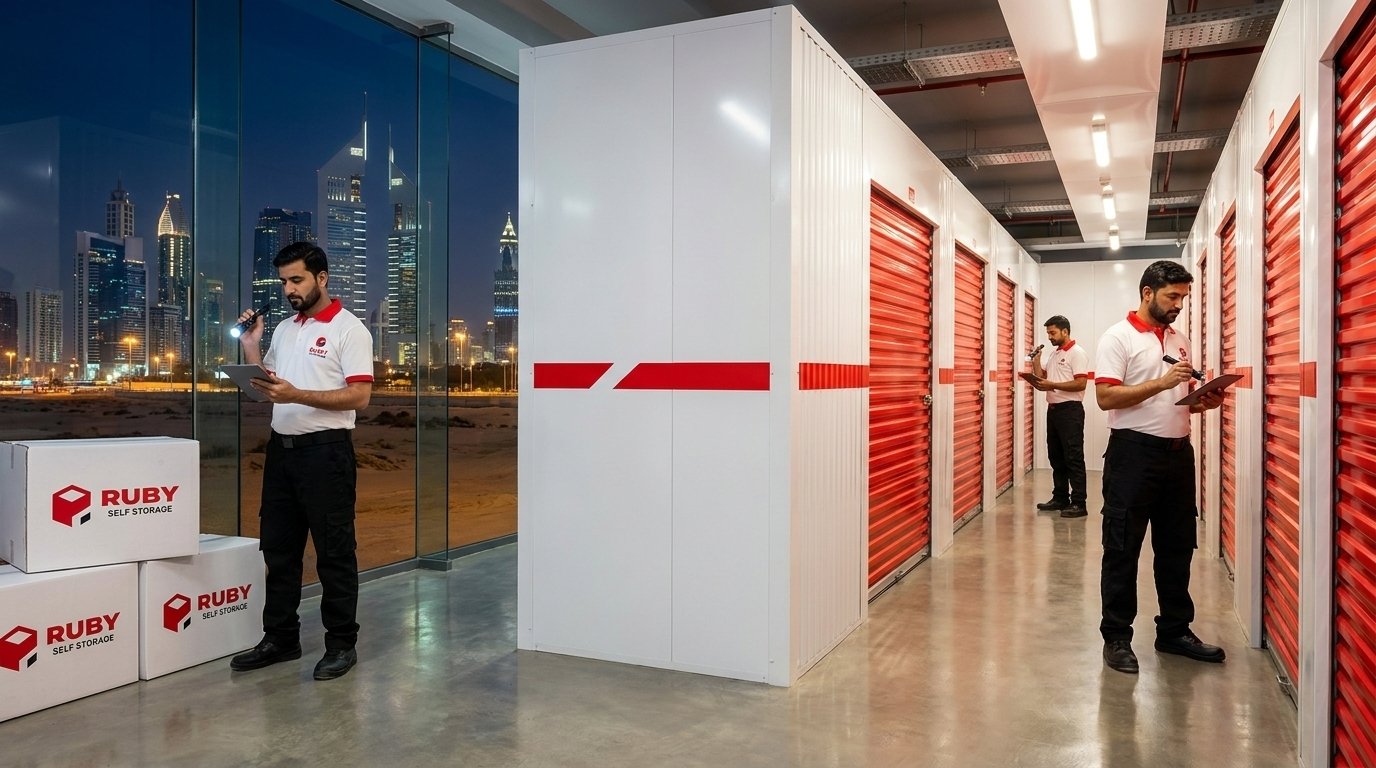
Self storage fits the 5 to 20 CBM band when you want dedicated inventory space but still manage receiving, picking, packing and dispatch yourself.
Current Dubai self-storage tariffs provide a clear benchmark for this volume range. One published rate schedule lists 5 CBM at AED 595 per month, 8 CBM at AED 795, 12 CBM at AED 895, and 18 CBM at AED 1,295, before VAT.
Those figures convert to approximately:
| Storage volume | Published monthly price | Approx. AED/CBM/month |
|---|---|---|
| 5 CBM | AED 595 | AED 119 |
| 8 CBM | AED 795 | AED 99 |
| 12 CBM | AED 895 | AED 75 |
| 18 CBM | AED 1,295 | AED 72 |
The table compares physical storage rent only. Larger units generally reduce the cost per CBM because fixed facility costs spread across more stored volume.
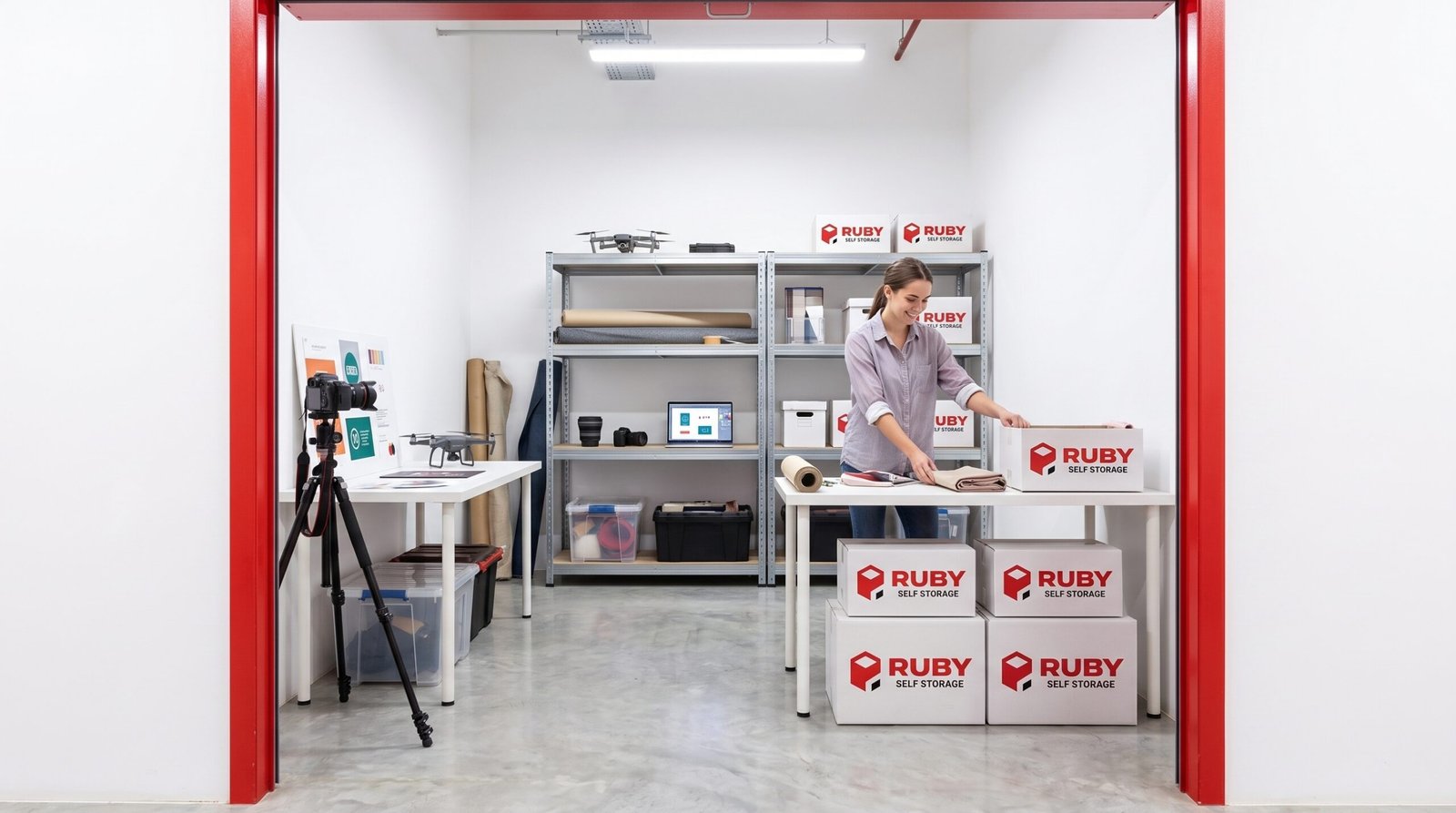
Self storage works particularly well for startup inventory that still requires owner control. You can separate business stock from living space without taking a conventional warehouse lease.
The weakness appears when order activity rises. Ten CBM with five weekly orders remains simple. Ten CBM with 60 daily orders creates picking, packing, courier and stock-count workload that the storage unit itself does not perform.
- Over 20 cubic meters—warehouse or 3PL
Inventory above 20 CBM creates a useful review point for warehouse or third-party logistics, especially when order volume rises with stock volume.
Twenty CBM is not a regulatory warehouse threshold. It is a commercial comparison point.
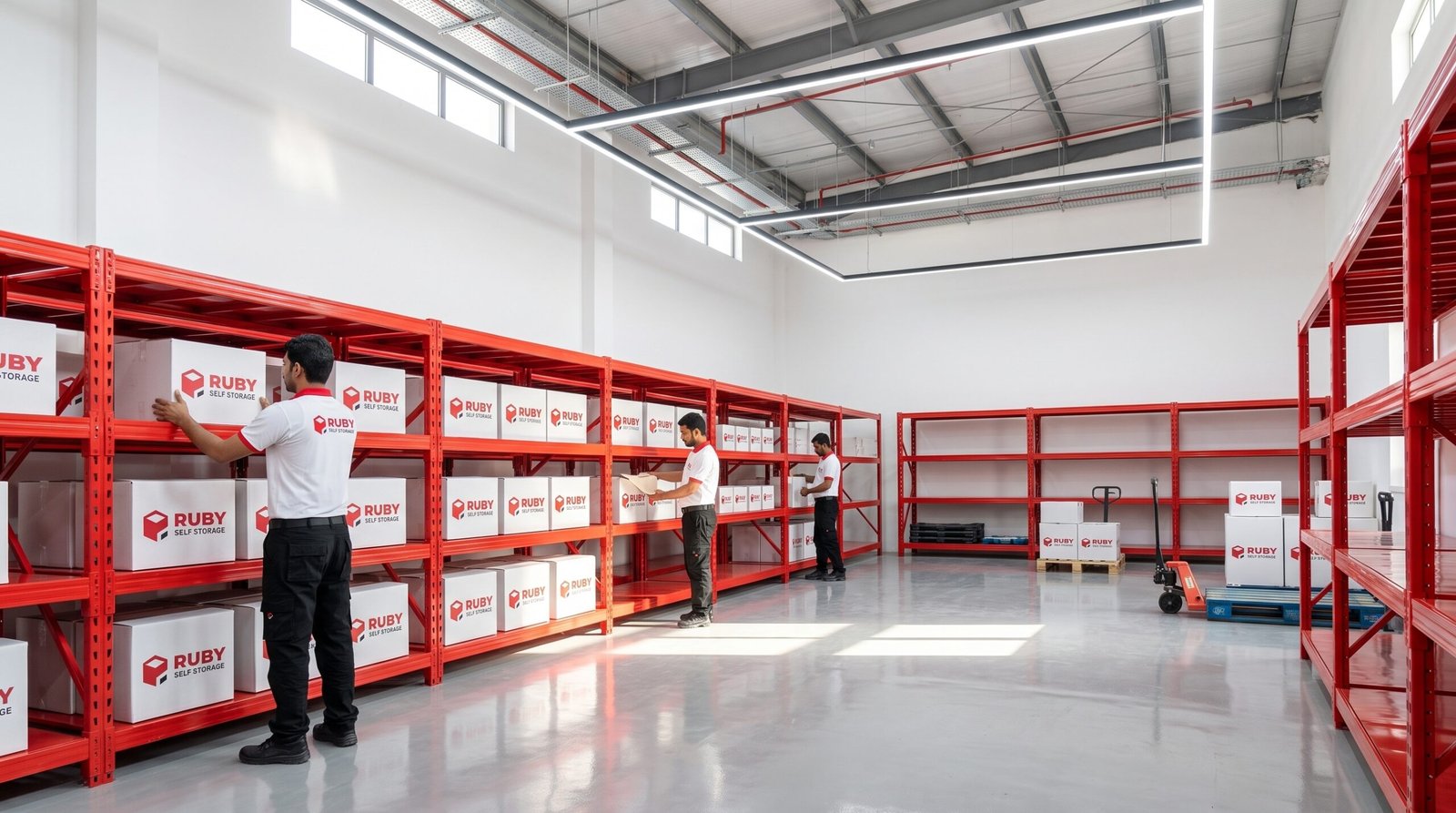
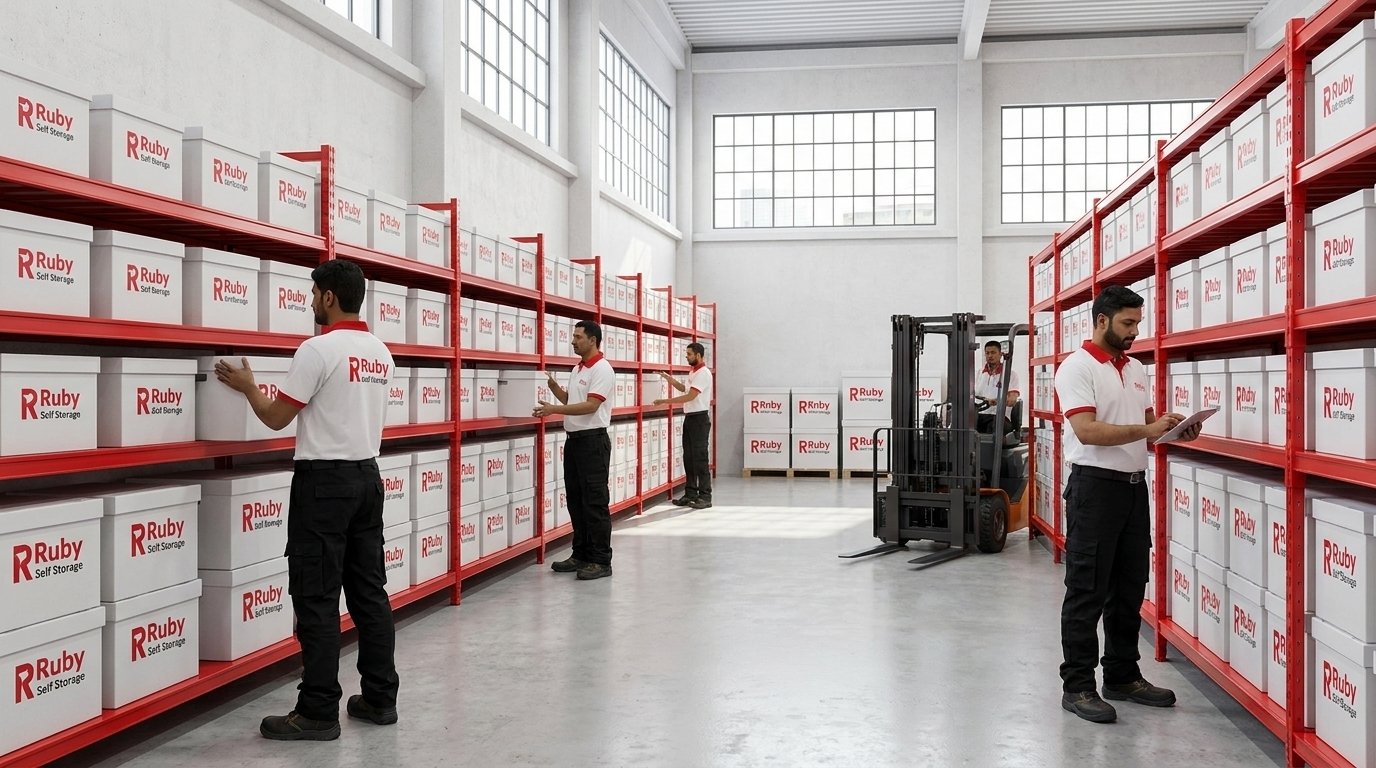
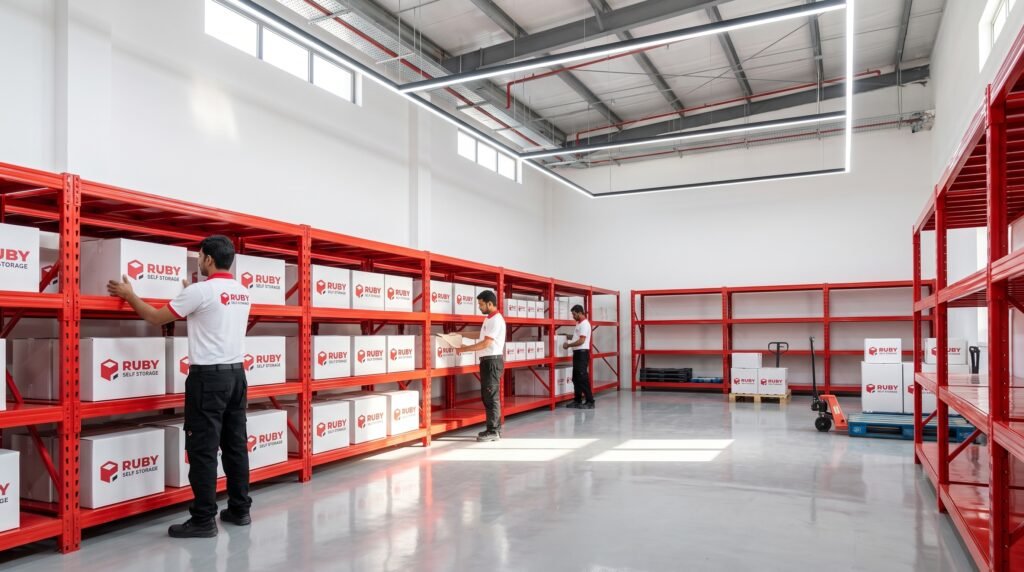
A dedicated warehouse storage gives you more control over receiving, racking, packing and dispatch. A third-party logistics provider (3PL) combines storage with outsourced operational work.
Current rents show the property-cost difference between Dubai locations. Knight Frank UAE reported H1 2026 Grade A industrial rents of AED 90 per sq ft annually in Al Quoz and AED 55 per sq ft annually in Dubai South. Dubai South rents had risen 22% year on year.
A 3PL uses another pricing model. One published Dubai 3PL rate card lists dry storage from AED 85 per CBM per month and temperature-controlled storage at AED 120 per CBM per month. Pick and pack carries a separate AED 3 per eligible order charge.
At 20 CBM, the published dry-storage line alone equals AED 1,700 per month before VAT.
That does not make 3PL storage expensive by definition. The value changes when the provider replaces internal warehouse labor, inventory handling and fulfillment infrastructure.
Cost comparison at each threshold
A fair comparison converts every storage option into the same unit, then identifies what the number excludes.
For Dubai e-commerce inventory, AED per CBM per month provides that common unit.
AED per cubic meter per month, all three options
The table compares the three volume strategies. Warehouse figures use a transparent three-meter-height normalization so the annual square-foot rent can be expressed as geometric cubic volume.
| Storage model | Planning volume | Approx. storage cost | Example at 20 CBM | Main limitation |
|---|---|---|---|---|
| Existing approved space | Under 5 CBM | AED 0 incremental rent | Not applicable | Uses space you already occupy |
| Self storage | 5 to 20 CBM | About AED 72 to AED 119/CBM/month | Nearby published sizes: 18 CBM at AED 1,295; 23 CBM at AED 1,395 | Handling remains your responsibility |
| Warehouse, base rent only | Over 20 CBM | About AED 16.4 to AED 26.9/geometric CBM/month | AED 329 to AED 538 normalized | Excludes full warehouse operating costs |
| 3PL dry storage | Over 20 CBM | Published example: AED 85/CBM/month | AED 1,700 | Fulfilment and delivery billed separately |
Warehouse conversion uses Knight Frank’s H1 2026 Dubai South and Al Quoz annual rents and a three-meter normalization. It does not mean you can lease a 20 CBM warehouse for AED 329 to AED 538.
Industrial landlords charge for floor area, not efficiently occupied carton volume. Your warehouse still contains aisles, receiving zones, dispatch staging, workstations, fire clearance and unused vertical capacity.
A warehouse also brings costs beyond headline rent:
- Racking and fit-out
- Electricity and cooling
- Warehouse employeesfulfillment
- Packing benches and materials
- Stock-control software
- Loading equipment
- Security and insurance
- Unused capacity during slower months
A 3PL cost comparison becomes more accurate when fulfilment and delivery charges are added to the storage rate. A published Dubai 3PL rate card lists AED 3 per eligible order for pick and pack and AED 29 per order for UAE-wide last-mile delivery. At 200 orders per month, these two services total AED 6,400 before storage charges and VAT.
The Federal Tax Authority applies a 5% standard VAT rate to taxable goods and services in the UAE, unless the supply qualifies for zero-rating or a specific exemption.
For a genuine comparison, request a written quote with CBM, storage duration, VAT, access conditions, collection cost and redelivery cost shown separately.
What self storage will not do
Self storage gives you physical capacity. Conventional self storage does not automatically give you an e-commerce fulfilment operation.
That boundary matters once orders start leaving the unit every day.
- Pick and pack
Pick and pack covers locating the ordered SKU, removing it from stock, packing it, applying the shipping label and staging the parcel for collection.
With self storage, you normally provide that labour yourself.
This model fits sellers with manageable order volumes and simple SKU layouts. Use labelled rack locations, a dedicated packing area and one inventory record for every movement.
A 3PL shifts the task to the fulfillment provider. The published Dubai benchmark above charges AED 3 per qualifying order up to 20 kg, including SKU picking, standard packing, labelling, and movement to outbound staging.
Ignoring pick-and-pack labour makes self storage appear cheaper than it is. Measure employee time per order before comparing the two models.
- Courier collection from the unit
Courier collection means handing completed orders to a carrier directly at the storage location. A self-storage rental does not automatically guarantee unrestricted commercial courier access.
Check 4 points in writing:
- Courier entry rules
- Loading-bay availability
- Collection hours
- Visitor or vehicle registration requirements
One courier collection every few days creates little operational pressure. Multiple collections each day change the use pattern considerably.
Confirm the arrangement for the actual facility in the written storage quote because access terms can differ between services. Skipping this check can leave you with enough storage capacity but a poor daily dispatch location.
- Stock counts and inventory systems
Self storage does not automatically maintain your SKU quantities, batch records, returns or stock reconciliation.
You control those records unless the contract includes inventory-management services.
Regulated product categories make this more important. Dubai Municipality’s Technical Guidelines for Consumer Products Storage Requirements require controlled consumer products to use racks or shelves rather than normal floor storage. Cartons can sit on the floor in a designated receiving or dispatch area, and packaging must take place in an assigned area.
The guidelines also require separation for expired, recalled or quarantined products. Earlier guidance specifies temperature controls based on product instructions, including 21°C to 25°C for consumer products without labelled storage conditions. Moisture-sensitive products can require relative humidity no higher than 60%.
These requirements matter for sellers handling categories such as cosmetics, detergents, health supplements and similar controlled consumer products.
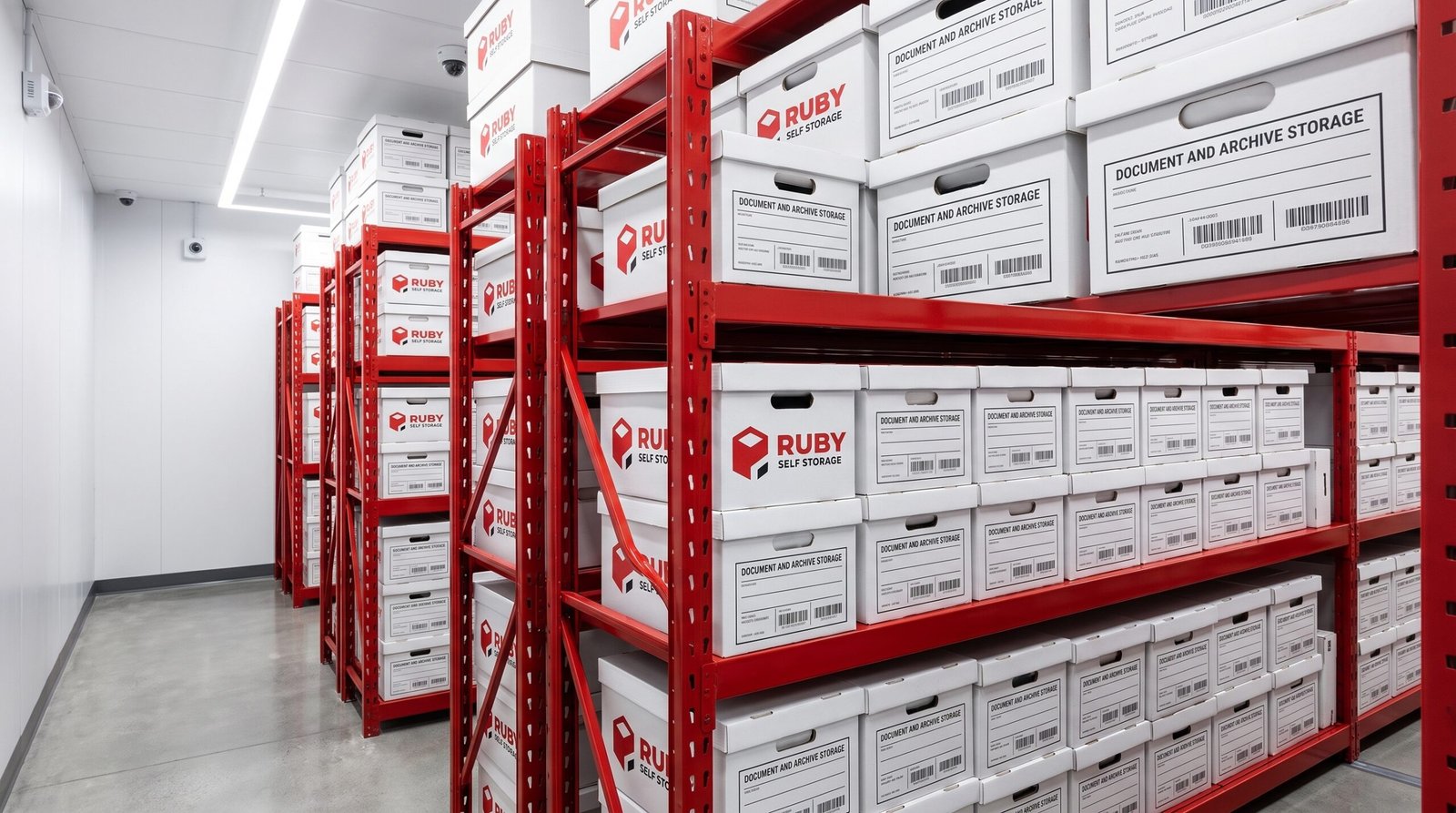
A spreadsheet can handle a small catalogue. A growing multi-channel seller gains more value from barcode locations, batch tracking and synchronized inventory.
Licensing — what you can legally operate from a unit
A storage contract gives you access to space. It does not give you permission to conduct activities outside your business licence or outside the permitted use of the premises.
Dubai’s official business portal states that every mainland company requires a licence. A commercial licence covers many businesses that buy or sell physical products and conduct import, export or logistics activities. Some activities also require additional approvals.
The UAE Government’s e-commerce guidance states that businesses require the appropriate licence to conduct e-commerce. Federal Decree-Law No. 14 of 2023 regulates online trade in physical goods, digital products and services.
For free-zone sellers, location matters as well. Executive Council Resolution No. 11 of 2025 allows Dubai free-zone establishments to operate outside their free zone within Dubai when they obtain the required DET licence or permit. Dubai Protocol’s official resolution summary also states that licensed businesses remain subject to relevant federal and local regulations.
The practical licence limits are therefore based on activity, jurisdiction, product category and premises approval, not storage volume.
There is no rule that turns a 20 CBM self-storage unit into an authorized warehouse.
Bonded inventory creates another legal category. Dubai Customs currently lists an AED 25,000 fee for a private Customs Warehouse Licence and AED 150,000 for a public Customs Warehouse Licence. The service also lists guarantees of AED 50,000 and AED 1.5 million respectively, plus the applicable Knowledge and Innovation fee.
Those customs licences concern goods stored under Customs supervision without immediate customs-duty payment. Ordinary e-commerce self storage is not the same arrangement.
Access requirements for daily dispatch
Daily e-commerce dispatch requires predictable stock access, loading access and courier handover capacity.
Twenty-four-hour access sounds useful, but access hours alone do not determine operational suitability. Your workflow also depends on how fast cartons move between shelving, packing space and the courier vehicle.
Check 6 points before using self storage for regular dispatch:
- Confirm access hours for both your staff and authorized visitors.
- Confirm courier rules for recurring commercial collections.
- Check loading access for vans and larger inbound deliveries.
- Measure lift and doorway dimensions against cartons, pallets and equipment.
- Separate inbound and outbound stock to reduce picking errors.
- Record every stock movement in the same inventory system used by your sales channels.
Dubai storage facilities must include wide corridors, loading bays and parking. Treat those features as provider-specific, then confirm the exact access arrangement in the written quote.
Self storage still fits if your team can receive, pick and dispatch without repeated access delays. A warehouse or 3PL becomes stronger when storage activity starts controlling the working day.
Choose the storage model that matches your inventory
For e-commerce storage in Dubai, the decision becomes clearer once you stop comparing storage types in isolation and start with actual inventory volume.
Keep stock below 5 CBM in existing approved space when it remains easy to manage. Move into self storage at 5 to 20 CBM when inventory needs dedicated space but your team can still handle receiving, picking, packing, and dispatch. Once stock moves beyond 20 CBM, compare warehouse and 3PL costs immediately. At that point, labor, access, fulfillment, and unused capacity can cost more than the storage rate itself.
Do not choose a facility on monthly rent alone. Calculate your CBM, SKU count, order volume, access frequency, licence position, and handling workload first. Those figures show which option actually fits the business.
Request a written storage quote based on your real CBM and storage period. Ask for VAT, access terms, pickup, redelivery, and any handling charges separately.
Measure your inventory first. Then compare the full monthly operating cost, not just the price of the space.
FAQs
How much does e-commerce self storage cost in Dubai?
Published Dubai units between 5 and 18 CBM currently work out to about AED 72 to AED 119 per CBM per month before VAT, depending on unit size.
What storage option fits less than 5 CBM of stock?
Existing approved business space can remain economical below 5 CBM when inventory does not disrupt operations and the premises fit the seller’s licensed activity.
When does self storage make sense for an e-commerce startup?
Self storage fits the 5 to 20 CBM planning range when you require dedicated inventory capacity but can still manage receiving, stock counts, picking and dispatch internally.
When does an e-commerce seller outgrow self storage?
Review warehouse or 3PL options around 20 CBM, or earlier when daily order volume makes manual picking, packing and courier handling inefficient.
Is a warehouse cheaper than self storage per CBM?
Base warehouse rent can be lower per geometric CBM, but that number excludes aisles, fit-out, employees, utilities, racking, systems and unused capacity.
How much does a Dubai 3PL charge for storage?
One published 2026 Dubai benchmark lists AED 85 per CBM per month for dry storage and AED 120 for temperature-controlled space. Fulfilment and delivery charges remain separate.
Can you run an e-commerce operation from any self-storage unit?
No. Your licensed activities, jurisdiction, premises rules, product regulations and facility agreement determine what commercial activity you can conduct from the location.
Rakan Al-Juraid is a logistics specialist with a focus on commercial storage systems and high-security asset management. With extensive experience in industrial warehousing, he specializes in inventory tracking technology and transit safety. Rakan’s expertise lies in streamlining the storage process for both businesses and homeowners through strategic planning. His writing offers data-driven advice on insurance for stored goods, fire-safe environments, and heavy-duty logistics. He is committed to ensuring that every square foot of storage is utilized with maximum security and efficiency. Rakan aims to provide professional-grade storage standards to every reader navigating the moving process.
- Rakan Al-Juraid
- Rakan Al-Juraid
- Rakan Al-Juraid
- Rakan Al-Juraid