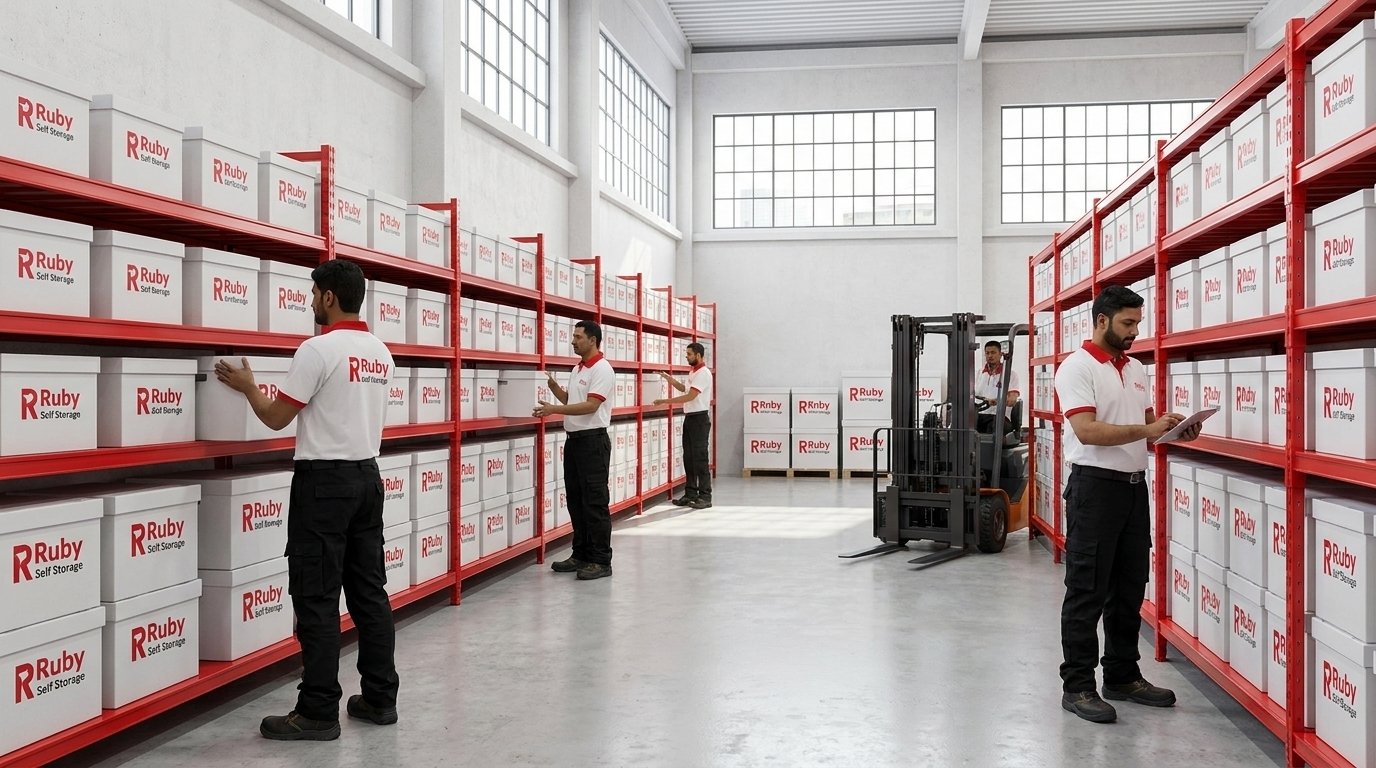
If you want to keep items in storage for a few weeks, it is simple. Keeping them there for a year or longer raises different questions:
- How long does the contract actually allow?
- What happens if you miss a payment?
- And how often do stored items need checking?
In Dubai, storage duration depends largely on the rental agreement, payment status, renewal terms, and the condition of the goods. Ruby Self Storage publishes a one-month minimum rental period and offers both short-term and long-term storage options.
This guide explains:
- Maximum practical storage term
- Rolling and fixed contracts
- Automatic renewals
- Rate changes
- Non-payment timelines
- Sale procedures
- Disposal charges
- Inspection intervals
- Long-stay discounts
It also separates ordinary self-storage rules from UAE public-warehouse provisions, which can cause confusion around one-year and seven-day timelines.
Is there a maximum storage term in Dubai?
No universal maximum storage period appears in the UAE federal provisions reviewed for ordinary self-storage. The actual storage duration comes primarily from your agreement and the provider’s rental structure.
Ruby Self Storage lists a minimum Dubai rental period of one month and says customers can use short-term or long-term storage.
Ruby’s broader services page also advertises short-term, long-term, daily, monthly, and yearly rental plans across its storage services.
The legal position changes for a licensed public warehouse that issues negotiable warehouse documents. Article 176 of Federal Decree-Law No. 50 of 2022 defines that public-warehouse framework.
Article 176(3) specifically excludes warehouses that accept goods without issuing a storage receipt or pledge document from those public-warehouse provisions.
Article 192 contains the often-misunderstood one-year figure. For an unlimited-term qualifying public warehouse deposit, one year without a retrieval request or intention to continue can trigger a sale application procedure.
That provision does not say ordinary Dubai self-storage must end after 12 months. It governs the specific public-warehouse structure defined by Article 176.
What the contract actually says
Your Dubai storage contract controls the billing period, renewal method, cancellation deadline, rate changes, access conditions, and consequences of non-payment.
Read those clauses as dates and numbers, not general wording. The main contract structures differ as follows:
| Contract structure | How the duration works | Main issue to check |
|---|---|---|
| Monthly rolling | Continues through recurring monthly rental periods | Cancellation deadline |
| Fixed term | Runs for a stated period, such as 6 or 12 months | Early-exit conditions |
| Renewable fixed term | Ends or renews after the initial term | Renewal notice |
| Prepaid long-term | Payment covers several months or a year | Refund and early-exit rules |
| Indefinite term | Continues until valid termination | Notice and price-review clauses |
The table separates contract duration from billing frequency. A monthly invoice does not always mean that you can leave without notice.
Rolling monthly versus fixed term
A rolling monthly arrangement continues through monthly rental periods. A fixed-term arrangement records a defined commitment period and end date.
Ruby publishes a one-month minimum for Dubai self-storage and offers flexible short-term and long-term rentals.
Ruby’s services page also lists monthly and yearly rental plans, giving customers more than one duration format across its service range.
Ruby’s September 2026 review of published Dubai storage contracts found exit-notice examples of 14, 15, 15, and 30 days. The median of those four examples was 15 days.
That 15-day median is a market observation, not a Dubai statutory notice period. Ruby explicitly makes that distinction in its review.
For your own contract, record 4 items:
- Record the initial rental period.
- Record the payment date.
- Record the cancellation notice in calendar days.
- Record the last date for valid notice.
This simple check prevents a monthly billing cycle from being mistaken for an unrestricted same-day cancellation right.
Automatic renewal clauses
An automatic renewal clause extends the rental arrangement when the customer does not terminate it through the agreed procedure.
Ruby’s public Dubai storage page confirms flexible long-term rental but does not publish a Ruby-specific automatic-renewal deadline.
Published Dubai storage terms reviewed by Ruby contained exit-notice periods ranging from 14 to 30 days.
Read the renewal clause for:
- renewal frequency
- required notice period
- accepted cancellation channel
- treatment of partial months
- final rental date
- deposit-return conditions
Do not assume 15 days or 30 days applies to your Ruby agreement. Use the number written in the signed contract.
Rate-increase notice periods
There is no universal 30-day rate-increase period stated in the UAE consumer regulation for self-storage contracts.
Instead, Cabinet Decision No. 66 of 2023 regulates harmful consumer contract conditions. Article 34 restricts clauses allowing suppliers to change service-subscription conditions unilaterally.
Article 34(9) also addresses long-term contracts where the service price can be reviewed solely by the supplier. The rule protects termination rights where the final price becomes exorbitant compared to the agreed price.
The same regulation requires service prices to be displayed clearly. Article 6 also requires the consumer invoice to state the service price in local currency.
For a long storage stay, extract the exact AED rate, fixed-price period, review date, notice period, and cancellation right from the contract.
What happens if you stop paying
Stopping payment can affect access before it affects ownership of the stored goods. The exact sequence depends on the contract and the legal structure of the storage arrangement.
A late-payment date, access suspension date, notice date, and sale date are not the same event.
Access suspension timeline
There is no single published Ruby access-suspension day on Ruby’s main Dubai storage service page. Ruby’s separate contract guide instead describes examples found in storage agreements.
That guide reports examples where late fees begin after 5 to 7 days and lockout can start after 10 to 14 unpaid days.
Ruby presents those numbers as examples of contract structures rather than its own published standard lockout policy.
The most useful timeline therefore separates contractual examples from statutory public-warehouse procedures:
| Stage | Evidence basis | |
|---|---|---|
| Rent becomes due | Contract date | Customer agreement |
| Example late-fee trigger | 5 to 7 days | Ruby market guidance |
| Example access lockout | 10 to 14 days | Ruby market guidance |
| Public-warehouse pledge sale application | 7 days after payment notice | UAE Commercial Transactions Law |
| Unlimited public-warehouse deposit | 1 year without retrieval or continuation request | UAE Commercial Transactions Law |
Article 170 permits a pledgee to apply to court seven days after serving a payment notice when a qualifying pledged debt remains unpaid.
That seven-day figure belongs to the statutory pledge procedure. It is not a general seven-day self-storage lockout rule.
Lien and sale of goods under UAE practice
UAE law does not give every ordinary self-storage operator an automatic right to sell belongings seven days after missed rent.
Article 170 applies to the qualifying commercial pledge procedure. After seven days from the payment notice, the pledgee can ask the court for permission to sell the pledged property.
The court determines the manner of sale under Article 170.
Article 174 makes an agreement void if it lets the pledgee own or sell the pledged property while bypassing Article 170 procedures.
For public warehouses, Article 192 permits the warehouse keeper to request a sale after the bailment contract expires. The warehouse keeper can recover amounts due from the proceeds.
Article 192 requires any remainder to go to the depositor or to the court treasury for the depositor’s account.
Again, Article 176(3) excludes storage without the specified warehouse receipt or pledge document from this public-warehouse regime.
Clearance and disposal charges
Dubai does not have one standard self-storage clearance charge published in the federal sources reviewed here.
Ruby’s current hidden-fee review cites one published Dubai contract with AED 100 after seven overdue days and AED 200 after 14 days. The same example includes another AED 100 storage-clearance fee, excluding separate removal costs.
Ruby clearly identifies those figures as terms from a specific market contract rather than a Dubai-wide tariff.
For qualifying public warehouses, Article 187 places expenses for keeping, storing, and selling goods ahead of distribution of remaining sale proceeds.
Get the following amounts in writing before storing:
- Late-payment fee
- Access-reactivation fee
- Clearance fee
- Transport charge
- Disposal charge
- Deposit deduction
How long items themselves last in storage
A long rental period does not stop stored materials from aging.
Dubai’s external humidity provides useful context. Digital Dubai, using Dubai Civil Aviation Authority data, recorded a mean daily maximum relative humidity of 62% in July 2025.
The same official data recorded 60% in August and 73% in September 2025.
October 2025 reached a mean daily maximum relative humidity of 74%, according to the fourth-quarter Digital Dubai dataset.
These figures describe outdoor Dubai conditions, not the environment inside Ruby’s climate-controlled units.
What degrades even in climate control?
Photographs, books, paper, leather, and other organic materials remain sensitive to temperature and relative humidity during long-term storage.
The Library of Congress recommends approximately 30% to 50% relative humidity for photographic storage and 70°F (about 21°C) or below.
The Library of Congress also recommends keeping daily relative-humidity fluctuations below 5 percentage points within 24 hours for photographs.
For most books, the Library of Congress identifies 30% to 55% relative humidity and temperatures at or below 70°F as a safe range.
The Library also warns that relative humidity above 60% raises risks including warping and mold growth in books.
The Canadian Conservation Institute gives a quantified paper-longevity example. Typical wood-pulp paper lasts about twice as long at 20°C and 30% RH as at 20°C and 50% RH.
Climate control therefore reduces important environmental risks, but it does not make stored materials permanent.
Recommended inspection intervals
The sources reviewed do not identify a general Dubai household self-storage law prescribing a mandatory three-month or six-month inspection cycle.
Conservation authorities do provide evidence-based inspection benchmarks. The Canadian Conservation Institute recommends annual inspection for pest management in stored collections.
Its storage-area guidance recommends a more intensive approach for valuable collections. It calls for complete object inspections quarterly or semi-annually.
For leather, skin, and fur, the Institute advises inspecting storage areas and vulnerable objects at least twice each year for insect activity.
Use those benchmarks to build a practical Dubai schedule:
| Stored material | Practical inspection interval | Evidence basis |
|---|---|---|
| Important documents and photographs | Every 3 months | Quarterly inspection benchmark |
| Business records and boxed inventory | Every 3 to 6 months | Quarterly or semi-annual benchmark |
| Leather, rugs, wool, fur | At least twice yearly | CCI vulnerable-material guidance |
| Standard household furniture | Every 6 months | Semi-annual storage inspection benchmark |
| Low-risk sealed household goods | At least annually | Annual pest-inspection benchmark |
These intervals are preservation recommendations, not statutory Dubai deadlines.
Photograph the unit and selected items during each inspection. Keep the date, visible condition, packaging status, and any humidity reading in the same record.
Long-stay discounts and how to negotiate them
Ruby Self Storage advertises discounts for long-term rentals on its Dubai storage page.
Ruby also publishes prices from AED 300 per month for small units, with the actual price by unit size, storage type, and rental term.
At that published starting rate, 12 months of base rent equals AED 3,600 before any additional charge or discount.
Use percentages to test a long-stay offer. A hypothetical 10% discount on AED 3,600 reduces base rent by AED 360 to AED 3,240.
The UAE Federal Tax Authority confirms that the standard UAE Value Added Tax rate is 5%.
The Federal Tax Authority also says goods and services generally attract 5% VAT unless they qualify for zero-rating or exemption.
Ask for these figures before accepting a long-storage quote:
- Confirm the normal monthly rate in AED.
- Confirm the discount percentage.
- Confirm the discounted monthly rate.
- Confirm the fixed-price period.
- Confirm whether the quote includes VAT.
- Confirm the renewal rate after the discounted period.
- Confirm the cancellation and prepaid-rent refund terms.
The UAE consumer regulation requires suppliers to display service prices clearly and include the service price in local currency on the consumer invoice.
Compare the total AED cost across the entire planned storage period rather than comparing the first month’s promotional figure.
How can you plan a long-term storage stay in Dubai?
Long-term storage in Dubai comes down to two things: what your contract allows and how well your belongings hold up over time. There is no general 12-month maximum for ordinary self-storage, while Ruby Self Storage publishes a one-month minimum and flexible long-term options.
Before committing for several months or longer, check the renewal date, cancellation notice, rate-review clause, late-payment terms, and any disposal charges. Then match the inspection schedule to what you are storing. Sensitive items require closer attention because climate control reduces environmental stress but does not stop material ageing.
Choose the storage term by reading the contract first, then plan regular checks around the value and sensitivity of the items inside. That gives you clearer costs, fewer surprises, and better control over a long storage period.
FAQs
How long can you keep items in storage in Dubai?
You can keep items in Dubai storage for months or years under the applicable rental agreement. Ruby publishes a one-month minimum and flexible long-term storage.
Is there a 12-month maximum for storage in Dubai?
No general 12-month maximum appears in the federal public-warehouse provisions reviewed. The one-year rule applies specifically to unlimited-term qualifying public warehouse deposits.
What is Ruby Self Storage’s minimum rental period?
Ruby’s Dubai storage page states a one-month minimum rental period.
Can a Dubai storage provider suspend access after late payment?
Access restrictions depend on the contract for ordinary self-storage. Ruby’s contract guide cites market examples with lockout after roughly 10 to 14 unpaid days.
Does UAE law allow stored goods to be sold after seven days?
Not as a general self-storage rule. Article 170 permits a court application seven days after payment notice within the qualifying commercial pledge procedure.
How often do long-term stored items require inspection?
The Canadian Conservation Institute recommends annual pest inspection generally and quarterly or semi-annual condition checks in more intensive storage programs.
Does climate-controlled storage stop deterioration?
No. Preservation authorities still specify controlled temperature and humidity ranges because photographs, books, paper, and organic materials continue to deteriorate over time.
Are long-term storage discounts available at Ruby Self Storage?
Yes. Ruby’s Dubai storage page specifically advertises discounts for long-term rentals, although it does not publish a standard discount percentage.
Rakan Al-Juraid is a logistics specialist with a focus on commercial storage systems and high-security asset management. With extensive experience in industrial warehousing, he specializes in inventory tracking technology and transit safety. Rakan’s expertise lies in streamlining the storage process for both businesses and homeowners through strategic planning. His writing offers data-driven advice on insurance for stored goods, fire-safe environments, and heavy-duty logistics. He is committed to ensuring that every square foot of storage is utilized with maximum security and efficiency. Rakan aims to provide professional-grade storage standards to every reader navigating the moving process.
- Rakan Al-Juraid
- Rakan Al-Juraid
- Rakan Al-Juraid