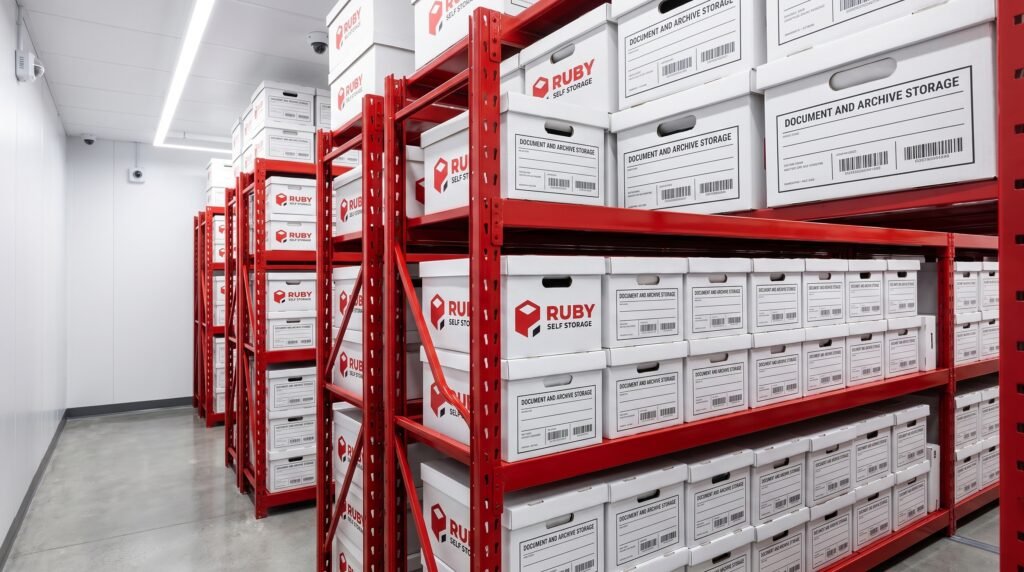
Choosing document and archive storage in Dubai is not just about finding space for old files. UAE businesses may retain records for 2, 5, 7, or even 15 years, depending on whether the documents relate to employment, commercial activity, corporate tax, or VAT.
That creates a practical problem. Boxes build up, retrieval becomes slower, and poorly indexed archives can cost more than expected. Current Dubai-managed box-storage benchmarks reach about AED 75 to AED 120 per box per month, while self-managed storage follows a different cost model.
This guide explains:
- Retention rules behind business archive storage in Dubai
- Real cost per archive box
- Retrieval lead times
- Physical conditions paper records require
It also covers 35% to 50% relative humidity, fire protection, pest control, chain of custody, household paperwork, and the choice between digitisation and physical retention.
How long must UAE businesses retain records?
UAE businesses retain records for different periods because tax, labor, commercial, and company laws govern different document classes.
The following table gives the main retention periods relevant to business archive storage. Sector-specific regulations, litigation holds, audits, and contractual requirements can extend them.
| Record type | Main retention period | Retention point |
|---|---|---|
| VAT invoices and general VAT records | 5 years | After the relevant tax period |
| VAT records relating to real estate | 15 years | After the relevant tax period |
| Corporate tax records | 7 years | After the relevant tax period |
| Former worker files | At least 2 years | From end of service |
| Commercial correspondence and invoices | At least 5 years | From issue or receipt |
| Company accounting records | At least 5 years | From the end of the financial year |
The Federal Tax Authority (FTA) confirms the 5-year VAT and 7-year corporate tax periods. UAE federal legislation sets the 2-year worker-file period and 5-year commercial-record periods.
A mixed archive box creates a practical problem. If one carton contains records with 5-year and 7-year retention periods, the longer period controls the box unless you separate the files.
- Tax and VAT records
VAT records generally remain available for at least 5 years, while VAT records relating to real estate remain for 15 years.
The Federal Tax Authority states that taxable persons must retain VAT invoices issued and received for at least 5 years. Current FTA guidance also confirms the 15-year period for real-estate-related VAT records.
Corporate tax uses a longer general period. The FTA requires relevant corporate tax records and supporting documents for at least 7 years after the relevant Tax Period.
A tax archive can include:
- Tax invoices and credit notes
- General ledgers and accounting records
- Inventory and fixed-asset records
- Contracts supporting taxable transactions
- Calculations supporting tax return positions
Cabinet Resolution No. 74 of 2023 expressly identifies business correspondence, invoices, licences, and contracts as supporting accounting documents.
Label each archive carton with the tax type, period, financial year, box ID, and earliest review date. “Old accounts” gives staff no usable retention information.
- Employment records
Private-sector employers retain each worker’s file for at least 2 years after the worker’s service ends.
Article 13 of Federal Decree-Law No. 33 of 2021 Concerning Regulating Labour Relations requires employers to maintain worker files for at least 2 years from the end-of-service date.
An employment archive may contain contracts, amendments, leave records, disciplinary documents, payroll evidence, and end-of-service calculations.
Do not treat every payroll document as a 2-year record. Payroll information supporting a corporate tax entry may remain relevant for the longer 7-year tax period.
For storage, index former-worker files by employee identifier and service-end date. Restrict access because employment files contain personal information.
- Commercial contracts
UAE commercial contracts do not share a single universal destruction date. The governing retention period depends on the contract’s legal, accounting, and tax function.
Article 29 of the UAE Commercial Transactions Law requires merchants to retain business correspondence, invoices, incoming documents, and supporting commercial records for at least 5 years.
The Commercial Companies Law separately requires companies to keep accounting records for at least 5 years after the end of the financial year. It also permits electronic copies under applicable controls.
A contract supporting corporate tax treatment can fall within the 7-year tax record period. An active dispute, audit, claim, or sector rule can extend practical retention further.
Use a review date instead of an automatic destruction date for major contracts. That control reduces premature disposal.
What are archive storage costs?
Archive storage cost depends on whether you pay per box or rent a self-managed private unit.
The difference matters. Per-box document storage ties cost to archive volume. A private unit gives your business fixed space and direct physical control.
- Per archive box per month
Current Dubai-managed box-storage pricing provides a planning benchmark of roughly AED 75 to AED 120 per box per month, according to Ruby Self Storage’s September 2026 market analysis.
That range produces the following archive-budget examples:
| Archive volume | Monthly benchmark | 12-month benchmark |
|---|---|---|
| 1 box | AED 75 to AED 120 | AED 900 to AED 1,440 |
| 5 boxes | AED 375 to AED 600 | AED 4,500 to AED 7,200 |
| 10 boxes | AED 750 to AED 1,200 | AED 9,000 to AED 14,400 |
These figures are Dubai market benchmarks, not a fixed Ruby document-storage tariff.
Ruby’s live document and archive storage page currently uses a personalized quotation. The same service page states that general personal storage starts at AED 300 per month, depending on size, storage type, and duration.
Confirm these 6 charges in a business archive storage quotation:
- Monthly box charge
- Collection charge
- Standard retrieval charge
- Urgent retrieval charge
- Re-filing charge
- Value Added Tax treatment
The UAE standard VAT rate is 5%, according to the Federal Tax Authority.
- Per unit for self-managed archives
Self-managed archive storage charges for floor space rather than individual cartons.
Ruby’s current pricing research places a 25 sq ft unit around AED 300 to AED 400 per month. Its published 50 sq ft range runs around AED 895 to AED 1,400.
A private unit can therefore cost less than managed per-box storage once box volume rises. Ten boxes at AED 75 each already equal AED 750 monthly.
Price alone does not define the crossover. Shelf width, carton dimensions, aisle access, insurance, transport, and retrieval frequency change the usable cost.
Use shelf coordinates such as A-03-02 for self-managed archives. Link every shelf code to a digital box register.
- Retrieval cost and lead time
Archive retrieval cost measures what you pay to locate, deliver, and return a stored box.
Current Dubai market comparisons published by Ruby Self Storage place managed box retrieval commonly around 24 to 48 hours, depending on service level. Some current plans also charge separately for deliveries outside their included allowance.
Ruby’s self-storage service provides 24/7 direct unit access, which changes the retrieval model. Staff visit the unit instead of ordering an individual carton return.
Ruby does not currently publish a fixed archive retrieval fee on its document-storage page.
For finance, legal, or human resources archives, record the retrieval service level agreement in hours. A cheap monthly box rate loses value if a requested contract arrives after an audit deadline.
Physical requirements for document storage
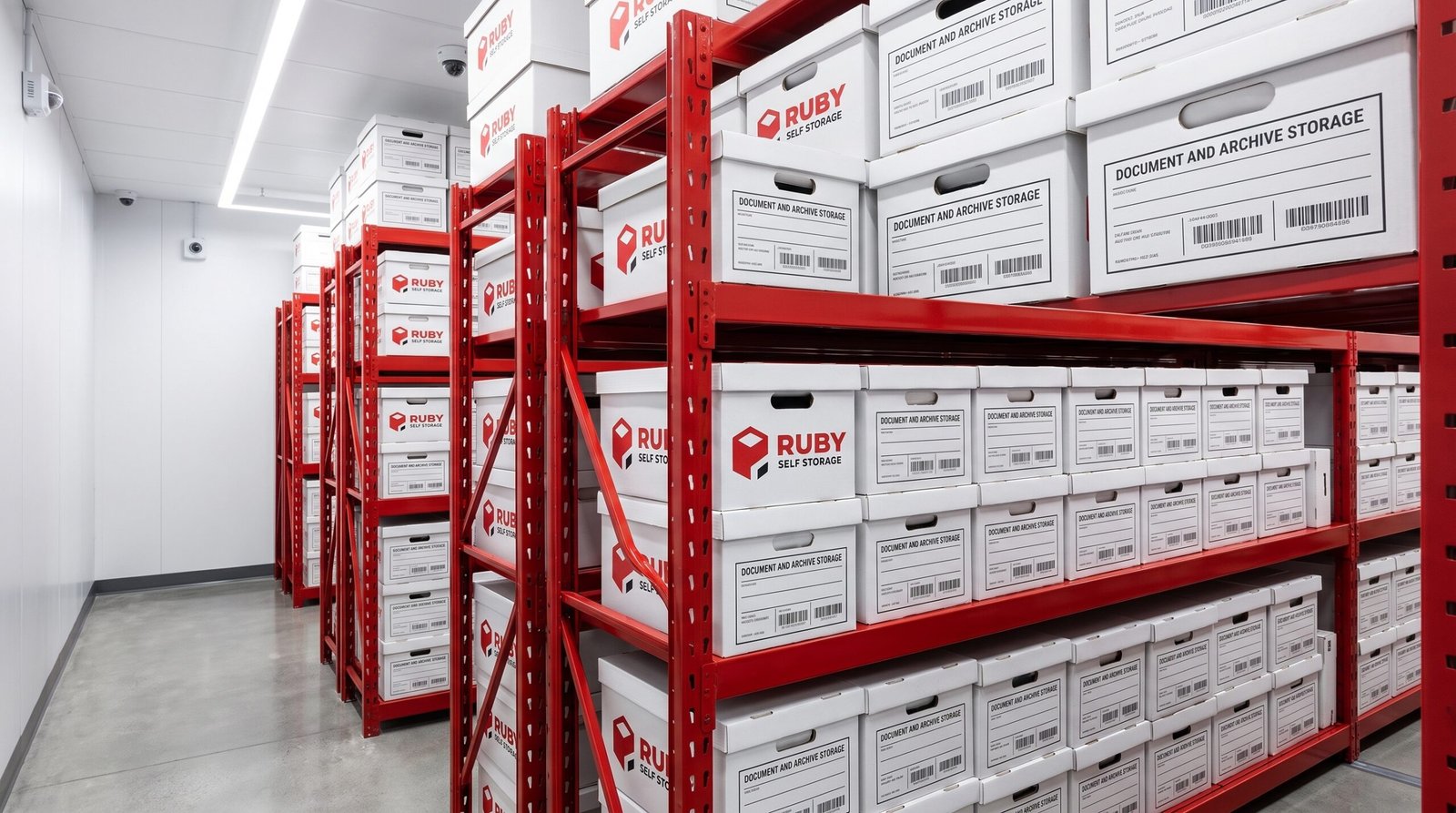
Paper archive storage requires controlled humidity, suitable fire protection, clean handling, and pest monitoring.
The storage environment matters more as retention periods increase. A record kept for 15 years faces far more environmental exposure than a working file kept for several months.
- Humidity range for paper
Keep paper archives around 35% to 50% relative humidity (RH) where practical, with limited fluctuations.
The Library of Congress recommends a cool, stable environment around 35% RH for works on paper. Its preservation guidance also identifies 35% to 50% RH as a suitable range for collection environments.
This range is a preservation benchmark, not a UAE statutory humidity limit.
High humidity raises biological deterioration risk. The Library of Congress recommends clean areas, stable conditions, minimal direct light, and acid-free or lignin-free protective enclosures.
For long-term document storage, request actual RH monitoring records. The phrase “climate controlled” does not give a measurable storage condition on its own.
- Fire protection standards
Dubai archive facilities operate within the fire-safety requirements that apply to the building, occupancy, storage method, and combustible load.
Dubai Civil Defence (DCD) requires warehouse and storage submissions to identify stored materials and describe the storage method. DCD evaluates fire systems against the UAE Fire and Life Safety Code of Practice and project-specific conditions.
DCD’s guidance also covers fire alarms, fire-water systems, pumps, monitoring, and other systems according to facility category.
Paper cartons create a combustible load. Avoid assuming that an office fire certificate automatically covers a high-density archive arrangement.
For a storage provider, verify:
- The applicable Civil Defence approval.
- The fire detection system serving the archive area.
- The maintenance status of fire systems.
- The storage layout permitted for that facility.
- Pest control
Archive pest control uses prevention, inspection, monitoring, and approved treatment.
Dubai Municipality’s Public Health Pest Control Section operates Integrated Pest Management programmes and regulates pest-control companies through its approval system.
Paper archives attract risk when cartons become damp, dusty, undisturbed, or contaminated before intake.
Inspect boxes for holes, droppings, insects, water marks, and mold. Keep cartons above the floor on suitable racking.
The Library of Congress identifies cleanliness and controlled humidity as first-line measures against collection pests.
Use a Dubai Municipality-approved pest-control company when professional treatment becomes necessary.
Storing household documents and paperwork
Household document storage separates long-retention paperwork from identity documents required at short notice.
Property records, education certificates, historic financial papers, insurance files, family records, and older legal paperwork can suit indexed archive storage.
The Library of Congress recommends acid-free and lignin-free folders and document boxes for long-term paper protection.
Give each household box a specific code. HOME-PROPERTY-01 gives more information than “documents.”
Passports, certificates, deeds—what to store and what not to
Store certificates, archived property paperwork, historical family papers, and inactive legal records when you do not require frequent access.
Keep active passports, current Emirates ID documents, visa paperwork, immediate medical files, and documents required for current transactions close at hand.
A practical household archive separates documents into 4 access classes:
- Daily or immediate access
- Occasional access
- Long-term retention
- Permanent family archive
Scan important papers before offsite storage. Record the physical location separately from the carton.
Avoid damp cupboards, direct floor storage, pressure-sensitive tape, and poorly ventilated spaces. For irreplaceable originals, use appropriate archival enclosures.
Chain of custody and access logging
Chain of custody records who handled a document, where it moved, when the transfer occurred, and who received it.
For business storage in Dubai, custody documentation connects physical security with record accountability. A locked room alone cannot show who removed Box HR-014 last Tuesday.
The UAE Personal Data Protection Law, Federal Decree-Law No. 45 of 2021, requires processors to maintain records containing authorized-access details, processing periods, restrictions, security measures, and related processing information.
Where an archive provider processes personal data for your organization, create a movement record for each custody event:
- Assign a unique box ID.
- Record collection date and sender.
- Record warehouse receipt.
- Record shelf or location code.
- Record each retrieval request.
- Record delivery and recipient.
- Record return or authorized destruction.
The same law requires appropriate technical and organizational security measures against loss, alteration, disclosure, and unauthorized access.
Access logs turn archive storage into an auditable process instead of a room full of numbered cartons.
Digitisation versus physical retention
Digitisation reduces physical retrieval, but a scan only works as a retained record when the electronic copy preserves the required information.
A major current rule comes from FTA Decision No. 4 of 2026, effective from 30 July 2026. The FTA requires electronic copies and photocopies of accounting records to remain complete, identical, clear, legible, and accessible.
The 2026 FTA requirements also set specific controls:
- Include every page in the original order.
- Preserve all original data and details.
- Reject partial scanning.
- Maintain sufficient image quality.
- Provide system access to the FTA when requested.
- Provide required passwords or encryption keys for protected records.
The rules also allow a third party to maintain records. However, the taxpayer remains legally responsible for their maintenance and security.
The UAE Commercial Transactions Law also recognizes technology-based retention of true copies, subject to competent-authority controls for reliability and availability.
For many businesses, the practical model combines both formats. Keep controlled originals where legal or evidentiary reasons justify paper retention. Use indexed digital copies for routine access.
Build an archive system that stays compliant and usable
Document storage in Dubai works only when retention, cost, access, and physical protection sit inside one controlled system. UAE business records can remain active for 2, 5, 7, or 15 years, depending on the record type and legal requirement.
Do not store archive boxes without a retention date, box ID, and retrieval record. Use separate categories for tax files, employment records, contracts, and permanent documents. Keep long-term paper archives within a stable 35% to 50% relative humidity range and verify the actual storage conditions.
Cost also needs a clear comparison. Current Dubai-managed box-storage benchmarks sit around AED 75 to AED 120 per box per month, while private storage can become more economical as archive volume rises.
Audit your existing boxes, assign retention dates, remove expired records, calculate monthly archive volume, and request a written storage quotation that includes retrieval and access terms. That turns document storage from unused space into a controlled business record system.
FAQs
How much does document storage cost per box in Dubai?
Current Dubai-managed box-storage benchmarks sit around AED 75 to AED 120 per box per month.
How long must VAT records stay in storage?
UAE VAT invoices generally remain for at least 5 years, while VAT records relating to real estate remain for 15 years.
How long must corporate tax records stay in storage?
The Federal Tax Authority requires relevant corporate tax records for at least 7 years after the end of the relevant tax period.
How long must employee files remain archived?
Private-sector employers retain a worker’s file for at least 2 years after the worker’s service ends under Article 13 of Federal Decree-Law No. 33 of 2021.
What humidity is suitable for archive document storage?
A practical paper-storage range is about 35% to 50% RH, based on Library of Congress preservation guidance for stable paper collections.
Can a UAE business scan records and destroy the paper?
Electronic retention is permitted in many cases, but the electronic record must meet the applicable legal requirements; FTA Decision No. 4 of 2026 requires complete, identical, legible, accessible copies for covered accounting records.
Is per-box storage cheaper than renting a storage unit?
Per-box storage costs less at very low volumes, while a private unit can become cheaper as carton count rises.
Rakan Al-Juraid is a logistics specialist with a focus on commercial storage systems and high-security asset management. With extensive experience in industrial warehousing, he specializes in inventory tracking technology and transit safety. Rakan’s expertise lies in streamlining the storage process for both businesses and homeowners through strategic planning. His writing offers data-driven advice on insurance for stored goods, fire-safe environments, and heavy-duty logistics. He is committed to ensuring that every square foot of storage is utilized with maximum security and efficiency. Rakan aims to provide professional-grade storage standards to every reader navigating the moving process.
- Rakan Al-Juraid
- Rakan Al-Juraid
- Rakan Al-Juraid