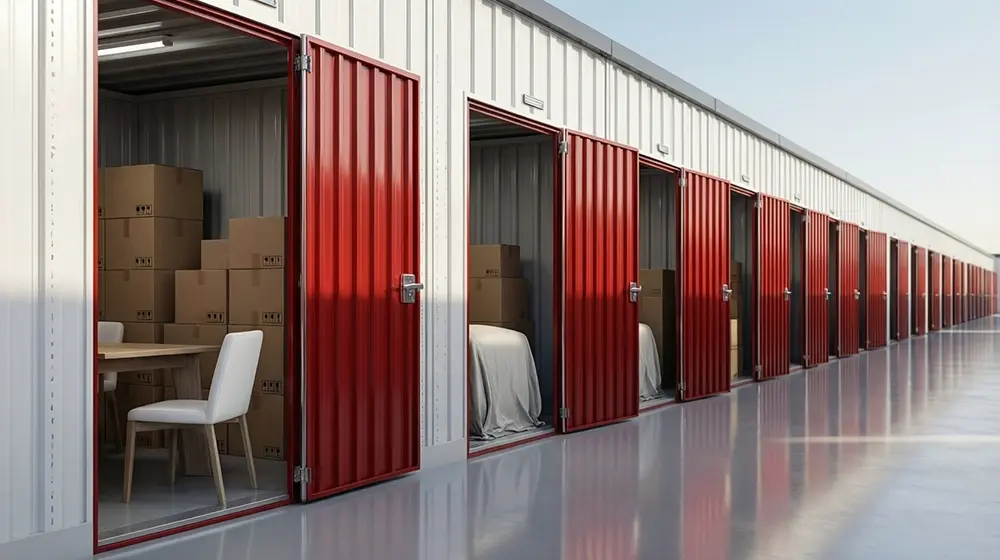
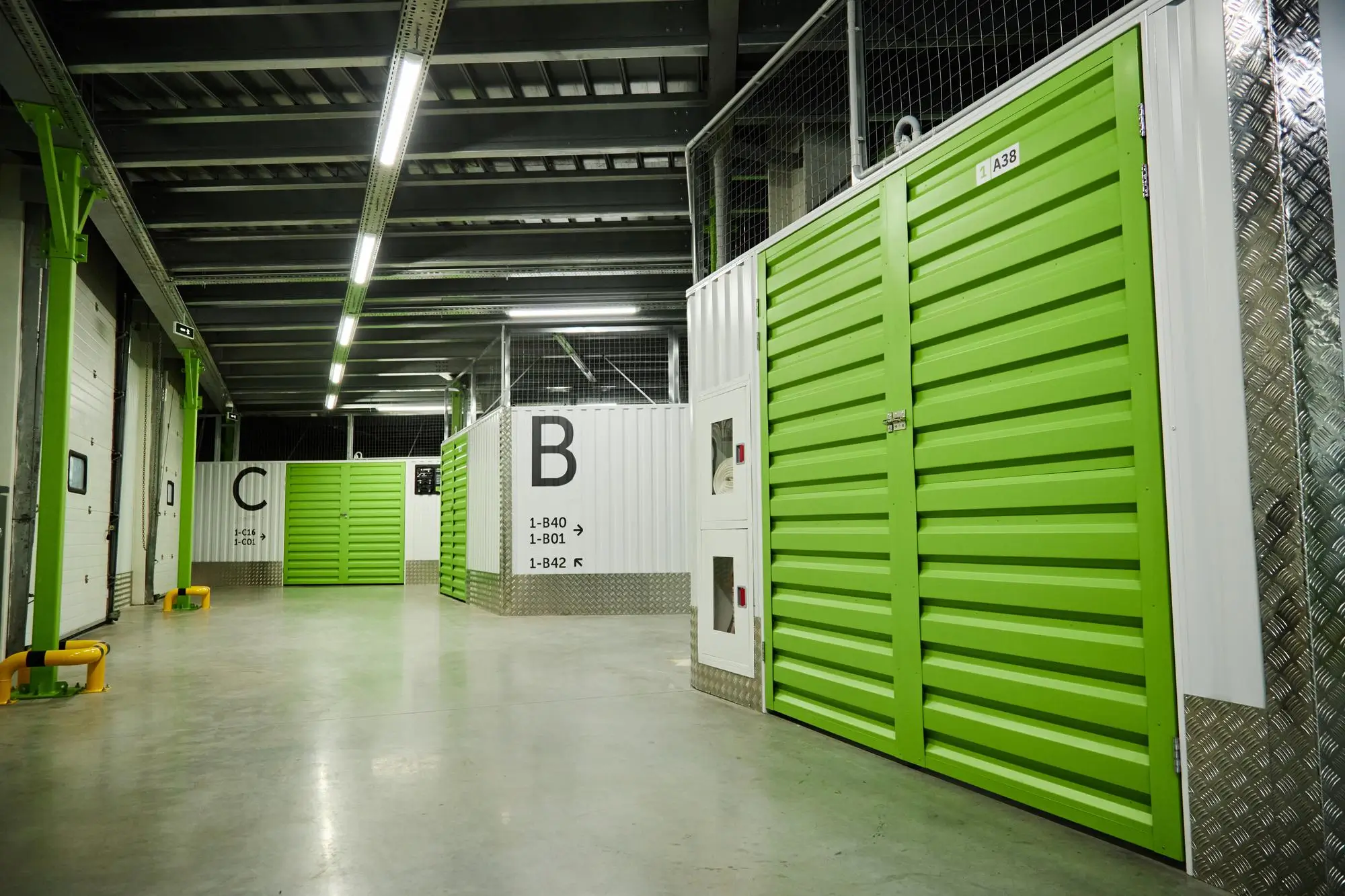
Peak summer in the UAE does not behave like an ordinary hot season. It acts as a stress test for everything you leave in storage. In August, Dubai’s average daily high sits around 106°F, while Abu Dhabi faces similar extremes. In 2025, the desert town of Sweihan reached 51.8°C, just below the national record, which shows how quickly heat loads build inside metal containers and warehouse units.
At the same time, the UAE self-storage industry already generates about USD 602.5 million in annual revenue, while the national furniture market alone is forecast at about USD 3.82 billion in 2025, and the consumer electronics market at roughly USD 68 billion in 2024. This means televisions, servers, gallery pieces, and solid wood dining sets are now routinely parked in rooms that can sit 15 to 20°C hotter than safe bands recommended by museums and data centre engineers.
This guide explains why, after just one peak summer, climate-controlled storage in the UAE moves from an optional extra to basic risk management for electronics, art, and furniture.
What makes one UAE peak summer so dangerous for electronics, art, and furniture in storage?
One UAE peak summer creates sustained heat and humidity that sit outside safe storage bands for electronics, art, and furniture, so climate-controlled storage in the UAE becomes non-negotiable if owners want predictable preservation.
Quick reality check for one peak summer in the UAE
- Dubai August daytime high: About 106°F to 110°F on most days.
- Dubai’s average sea temperature in August: About 32.8 to 33°C.
- Abu Dhabi August daytime high: The average high temperature hovers around a scorching 42°C.
- Abu Dhabi water temperature in August: Max: 35°C / 94°F, Avg: 33.8°C / 92.8°F, Min: 32.6°C / 91.6°F.
- National extreme recorded in August 2025: 51.8°C in Sweihan.
In parallel, Abu Dhabi International Airport shows August humidity comfort levels frequently in the muggy and oppressive bands, with many hours at relative humidity 50% to 80%.
These combined factors define the climate that surrounds non-climate-controlled units.
What climate do art collections require, and why is climate-controlled storage in the UAE non-negotiable for art?
Art collections require stable temperatures near 16 to 25°C and humidity roughly between 40 and 60 %, so UAE peak summer conditions without climate control cause cracking, warping, and mould on artworks.
Art storage guides describe ideal relative humidity between 40 and 55 %, which warns of cracking below about 35 % and mould risk at higher sustained values. Independent art conservation sources propose temperature bands near 20 to 22°C and relative humidity between 50 and 60 % for many artworks that include canvas, wood, paper, pigments, and metals.
In the UAE’s peak summer, external temperatures near 39°C and humid coastal air near 52 % relative humidity create the opposite environment. In a non-climate-controlled storage unit, these external conditions translate into:
- Canvas tension fluctuates as fibres expand and contract
- Oil and acrylic layers are expanding at different rates from the substrates
- Wooden frames absorb and release moisture
- Higher mould probability on paper, textiles, and untreated wood
Which art items in the UAE are most vulnerable during the peak summer?
- Original paintings on canvas or board with layered pigments
- Works on paper, including prints, drawings, and photography
- Mixed media pieces that combine wood, textiles, and metals
- Framed art with backing boards and trapped air
Climate-controlled storage in the UAE that keeps the temperature near the recommended art range and holds humidity close to 40 to 55 % reflects museum-style storage practices more than a basic container or warehouse.
How does this climate compare with recommended storage conditions for collections and electronics?
The recommended temperature for museum objects is 16 to 20°C, with mid-range humidity, which contrasts with 40°C external air and frequent humidity above 60 % in the UAE peak summer. An Australian museum conservation manual notes that traditional norms used 20°C and 50 % relative humidity as a reference point for museum collections.
For paper-based archives, a 2024 conservation article recommends temperatures between 35 and 65°F, and relative humidity between 30 and 50 %, with lower temperature targets for photographic materials. ASHRAE guidance on data centres, and other technical sources, gives a recommended temperature band between 18 and 27°C for many hardware classes.
Museum and electronics ranges versus the UAE peak summer
| Parameter | Conservation or IT guidance | Typical UAE August values |
| Temperature for collections | About 16 to 21°C. | Dubai and Abu Dhabi highs are near 40 to 43°C. |
| Relative humidity for collections | Around 45 to 55 %, with 40 to 60 % accepted. | Many August hours above 60 to 70 % in coastal cities. |
| Relative humidity for IT equipment | Often, 45 to 55 % recommended for computer rooms. | Humidity is frequently in muggy or oppressive ranges. |
| Water temperature near shore | Not a target, but indicates ambient heat load | The temperature is about 33°C around Dubai and Abu Dhabi in August. |
The gap is clear. External conditions are hotter by roughly 20°C and often more humid than many conservation or IT storage recommendations.
Climate-controlled storage in the UAE that keeps units close to indoor ranges, for example, 20 to 24°C and 45 to 55 % relative humidity, therefore aligns with these independent.
How large is the value of electronics art and furniture at risk in the UAE?
Market research on furniture and electronics in the UAE shows that households hold billions of dollars of value in exactly the categories that suffer most in uncontrolled heat and humidity.
The UAE furniture market size stands at about USD 3.82 billion in 2025 and is projected to reach about USD 4.70 billion by 2030, which equals a compound annual growth rate of 4.24 %. The UAE home furniture segment estimates a home furniture market of about USD 2.69 billion in 2025, expected to reach about USD 3.24 billion by 2030.
In consumer electronics, the UAE consumer electronics market reached about USD 68 billion in 2024 and could reach about USD 123.46 billion by 2033, with a forecast annual growth rate of 6.87 %. Another outlook projects a more focused consumer electronics revenue figure of about USD 25,793.8 million by 2030 for parts of the market, with growth of about 7.7 % per year from 2025.
Value at risk
1. Furniture and home furniture market 2025
- About USD 3.8 billion for furniture overall.
- About USD 2.69 billion for home furniture alone.
2. Consumer electronics market
- About USD 68 billion in 2024, with growth expected above 6 % annually.
- About USD 602.5 million in 2024, with a forecast of about USD 859.2 million by 2030 and a growth of about 6.3 %.
These figures show that households and small businesses in the UAE control tens of billions of dollars of electronics and several billions of dollars of furniture, while the self-storage industry has already grown into a large service sector that can house part of those assets in climate-controlled storage in the UAE.
How many hours in August exceed comfortable ranges for stored items in the UAE?
WeatherSpark time series for Dubai International Airport show that in August, the highest daily average high temperature reaches around 106°F, about 41°C, and the lowest daily high temperature still stays near 103°F, about 39°C.
For Abu Dhabi International Airport, WeatherSpark heat maps for August show that daytime conditions remain in the very hot band for almost the entire month, with water temperatures near 30 to 35°C.
Although WeatherSpark presents data visually, a typical August in Dubai and Abu Dhabi involves:
- Roughly 12 to 13 hours of daylight per day.
- Several hours each afternoon where the air temperature exceeds 40°C.
- Night temperatures often remain above 30°C.
Implication for non-climate-controlled units
- Walls and roofs absorb heat for many hours and radiate that heat into the interior through the night.
- Relative humidity fluctuates between high and very high levels, especially when humid air passes over warm surfaces.
- Any electronics, art, and furniture stored in such conditions experience repeated cycles of thermal and moisture stress that conflict with museum and IT ranges.
Climate-controlled storage in the UAE interrupts that cycle by stabilising both factors.
How do climate-controlled storage costs in the UAE compare with replacement costs for typical items?
Several UAE price guides for self-storage units present typical monthly cost bands that can be compared with realistic replacement values for electronics, art, and furniture.
Consumer advisory portals describe 25 square foot units in Dubai at around 300 to 400 AED per month, with 50 square foot units between about 900 and 1,400 AED per month, depending on location and provider. Some Dubai operators advertise climate-controlled units up to 50 square feet, around 900 to 1,700 AED per month, depending on access and configuration.
Abu Dhabi cost breakdowns for self-storage show small units between about 250 and 650 AED per month, medium units between about 1,250 and 1,600 AED per month, and large units above about 2,250 AED per month, with air conditioning treated as a key differentiator.
Comparative cost example
Assume one household stores:
- One 55-inch television valued at about 1,800 AED.
- One gaming console with accessories around 1,600 AED.
- One mid-range laptop costs around 2,500 AED.
- One solid wood dining table set costs around 3,000 AED.
- One original artwork valued at 2,000 AED.
If one peak summer in an uncontrolled unit causes failure in one television, one console, and visible damage to the artwork, replacement and restoration costs could easily exceed 5,000 AED.
By contrast, one 50 square foot climate-controlled storage unit in the UAE at about 1,100 AED per month generates approximately 13,200 AED per year in rent. If the household uses the unit for only four peak summer months, total rent is around 4,400 AED, which stays in the same range as replacing just a portion of the list above.
This simplified example illustrates why climate-controlled storage in the UAE often acts as a financial hedge.
What does UAE climate data show when compared with recommended storage ranges?
UAE peak summer climate data shows external temperatures and humidity levels that exceed recommended storage ranges for electronics, art, and furniture for many consecutive weeks.
| Parameter | Typical UAE peak summer value | Electronics storage guidance | Art storage guidance | Furniture and antiques guidance |
| Air temperature | Dubai’s August high is about 39 to 43°C | Room temperature, often near 20 to 25°C | Around 20 to 23°C | Similar to art and general indoor conditions |
| Relative humidity in coastal cities | About 50 to 80 % in Abu Dhabi in August | Often below 60 %, some guides prefer 30 to 50% | About 40 to 55% or 40 to 60% | Stable mid-range humidity with minimal fluctuation |
| Heat index in Dubai | The average August heat index is about 53°C | Not specified, but electronics are designed for lower heat | Not specified, but high heat accelerates ageing | High heat increases stress on joints and finishes |
| Sea temperature near Dubai in August | Around 33°C | Not relevant directly, but it indicates a warm environment | Not relevant directly | Indicates sustained environmental warmth |
Climate-controlled storage in the UAE that maintains a narrower band closer to 20 to 24°C and 40 to 55 % relative humidity, therefore narrows the gap between external climate and material tolerances.
How does the monthly cost of climate-controlled storage in the UAE compare with potential damage costs?
Monthly costs for climate-controlled storage in the UAE usually remain below the replacement value of even a small group of high-quality electronics, art, and furniture items after one peak summer event.
- 25 square foot units are often priced around 300 to 400 AED per month in both cities
- 50 square foot units are frequently priced around 900 to 1400 AED per month
- 75 square foot units for 1-bedroom furniture are often priced at 1000 to 1450 AED per month
Some climate-controlled operators in Dubai list 50 square feet of air-conditioned storage at around 900 AED per month for personal use.
Which electronics categories are most sensitive to UAE peak summer conditions?
Electronics that contain complex circuit boards, precision optics, and rechargeable batteries show a strong sensitivity to sustained heat and humidity.
- Many classes of data processing equipment are designed to operate between about 18 and 27°C.
- Computer room humidity between 45 and 55 % supports stable operation and minimises corrosion and electrostatic problems.
- High humidity, together with high temperature, increases corrosion rates on copper and silver components.
High-priority electronics for climate-controlled storage in the UAE
1. Home entertainment and audio
Televisions, soundbars, amplifiers, and home theatre receivers.
2. Computing equipment
Desktop towers, gaming PCs, laptops, and network-attached storage.
3. Networking and infrastructure
Routers, switches, and small servers for home offices and SMEs.
4. Imaging and production
Digital cameras, lenses, lighting gear, and studio electronics.
These devices contain soldered joints, hard drives or solid state storage, fans and vents, all of which react badly to high heat and moist air over a period of weeks. Climate-controlled storage in the UAE keeps them closer to their design environment.
Which art and furniture segments in the UAE hold the highest combined risk and value?
Art and furniture categories that combine organic materials with layered finishes or adhesives stand at the centre of humidity damage risk.
Conservation literature and museum guides state that:
- Many collections historically used a target of 20°C and 50 % relative humidity.
- Updated recommendations propose a range of 45 to 55 % relative humidity, with permissible limits between 40 and 60 %, but with a strong emphasis on stability.
- Sudden or repeated changes in humidity cause more stress to objects than a fixed point slightly outside the ideal band.
Art categories in the UAE that need climate-controlled storage
- Paintings on canvas or wood with multiple paint layers.
- Works on paper, such as drawings, prints, and photographic prints.
- Mixed media pieces that combine textile, leather, paper, and metals.
Furniture categories in the UAE that need climate-controlled storage
- Solid wood dining sets, beds, and wardrobes.
- Veneered cabinets and sideboards with inlays.
- Leather sofas and armchairs that develop mould and cracking in humid heat.
A large stock of wood, leather, and composite furniture now circulates through apartments and villas in high-heat coastal cities, where climate-controlled storage in the UAE protects a fraction of that stock during relocations and renovations.
Final Word: One UAE Summer Is All It Takes
One peak summer in the UAE does not simply warm a storage unit. It pushes temperature and humidity far beyond what electronics, art, and furniture are designed to tolerate. Afternoon air near 40 to 43°C, night readings that sit above 30°C, and coastal humidity frequently in the 60 to 80 % range sit in direct conflict with the 20 to 24°C and 40 to 55 % bands that museums, archives, and data centres aim for. One season in a non-temperature-controlled room is enough to crack varnish, warp wood, swell backing boards, and shorten the life of circuit boards and batteries.
At the same time, households and small businesses in the UAE now hold tens of billions of AED in televisions, laptops, cameras, gallery prints, solid wood sets, and leather seating. Self-storage companies already charge climate premiums that often equal only a fraction of the replacement value for even a small group of these items. The comparison is simple. You can either pay a predictable monthly amount to keep conditions close to indoor norms, or you can accept that one very hot summer may force you to buy the same furniture twice and replace electronics earlier than planned.
If your stored items cross the value thresholds in the checklist or include even one original artwork, quality dining set, or stack of sensitive electronics, a climate-controlled unit in the UAE is no longer a luxury. It is the default choice for anyone who wants their things to come out of storage looking and working as well as they went in.
FAQs
Is climate-controlled storage in the UAE really necessary or just a marketing term?
It is necessary because normal UAE summer conditions sit far outside safe temperature and humidity ranges for electronics, art, and furniture.
What temperature and humidity should I ask a UAE storage provider to maintain?
Look for target temperatures near 20 to 24°C and relative humidity around 40 to 55 % with clear written confirmation.
Can I store electronics in a non-climate-controlled unit for only one summer month?
Even a few weeks of repeated heat above 40°C and high humidity can shorten the life of circuit boards and batteries.
Is insulation and basic ventilation enough without full climate control?
Insulation slows heat gain, but without active cooling and humidity control, the unit will still follow outdoor extremes.
Which items should always go into climate-controlled storage in the UAE?
Original artworks, musical instruments, leather seating, solid wood sets, laptops, servers, and cameras should all be in climate control.
Does wrapping furniture in plastic protect it from UAE summer damage?
Plastic wrapping can trap moisture and often increases mould risk rather than preventing it in hot, humid air.
How can I tell if a storage unit is genuinely climate-controlled?
Ask to see temperature and humidity displays inside the building and request written operating ranges in the contract.
Is the extra monthly cost of climate-controlled storage worth it for most households?
In many cases, one season of damage to a television, console, or artwork can cost more than several months of climate-controlled rent.
Are dehumidifiers alone a good alternative to climate-controlled storage?
Dehumidifiers help, but without proper air conditioning, they do not keep temperatures near recommended ranges for sensitive items.
If I use climate-controlled storage, do I still need insurance?
Yes, climate control reduces risk, but insurance remains important for theft, fire, accidents, and other events outside temperature control.
Rakan Al-Juraid is a logistics specialist with a focus on commercial storage systems and high-security asset management. With extensive experience in industrial warehousing, he specializes in inventory tracking technology and transit safety. Rakan’s expertise lies in streamlining the storage process for both businesses and homeowners through strategic planning. His writing offers data-driven advice on insurance for stored goods, fire-safe environments, and heavy-duty logistics. He is committed to ensuring that every square foot of storage is utilized with maximum security and efficiency. Rakan aims to provide professional-grade storage standards to every reader navigating the moving process.
Layali Al-Samer is a seasoned storage and organization expert with over 12 years of experience in the logistics industry. She holds a degree in Spatial Design, specializing in high-density residential storage and climate-control solutions. Layali focuses on inventory management for luxury goods and long-term preservation techniques for sensitive heirlooms. Her articles provide expert guidance on maximizing unit efficiency and protecting valuables from environmental damage. She is dedicated to helping readers declutter their lives through strategic and organized spatial planning. Layali’s goal is to ensure every possession is stored with the highest level of care and precision.
- This author does not have any more posts