Warehouse Storage in Dubai vs Self Storage in Dubai: How to Choose the Right Fit for Business Inventory

Dubai businesses are under pressure to store smarter, not just cheaper. Rising industrial rents, tighter logistics capacity, and faster inventory cycles mean the wrong storage choice quietly drains time, money, and control. Many companies default to warehouse storage or self-storage based on habit or headline pricing, only to face access delays, stock disputes, or rising internal labor costs later.
This guide breaks that pattern. It explains when warehouse storage in Dubai creates operational leverage and when self-storage in Dubai is the more rational fit for business inventory.

Benefits of reading this article
- A decision framework that maps inventory velocity, SKU complexity, service levels, and evidence requirements to the right storage model.
- A vendor documentation pack that reduces disputes using audit trails, custody proof, and cost drivers.
The article also provides a practical decision framework and documentation checklist to reduce disputes, improve accountability, and align storage choices with Dubai’s fast-moving trade environment.
What is warehouse storage in Dubai for business inventory?
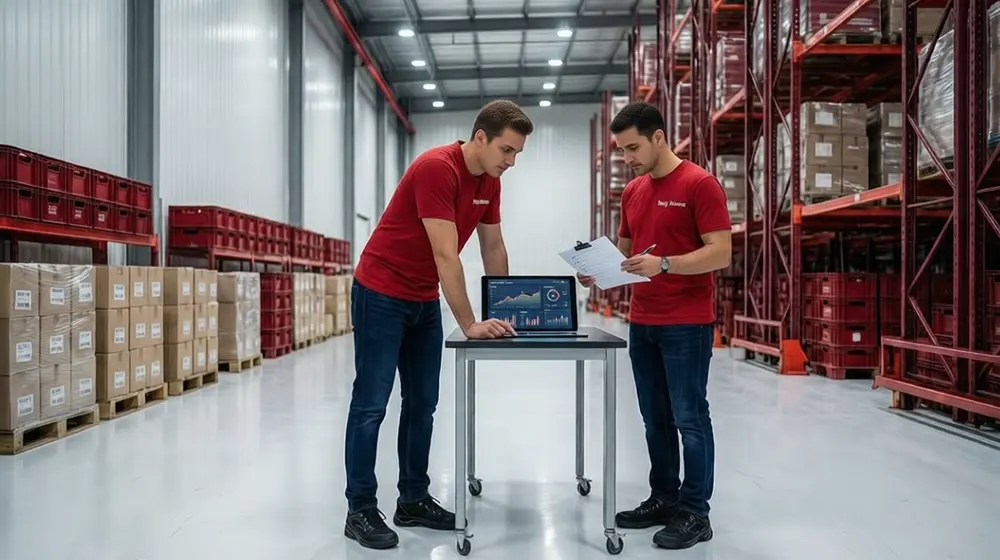
Warehouse storage in Dubai is a commercial storage model optimized for repeatable inbound, putaway, storage, picking, and dispatch. Warehouse operators commonly organize inventory using pallet positions, racking systems, staging zones, and inventory control processes.
Warehouse storage characteristics
- Storage unit: Pallet position, rack bay, bulk floor zone
- Handling layer: Forklift, reach truck, pallet jack, dock leveling
- Process layer: Receiving checks, GRN logging, bin location control, cycle counts
- Service layer: Pick and pack, kitting, labeling, returns handling
- Evidence layer: Receiving photos, count variance logs, movement history, and dispatch handover documents
Industrial space pricing creates pressure for efficiency. In Q3 2024, the average rental rate recorded stood at AED 40.3 per square foot, per annum. That is an emirate-wide average across all grades and locations; prime Grade A stock in areas such as Al Quoz rents for roughly double, as the figures below show.
What is self-storage in Dubai for business inventory?
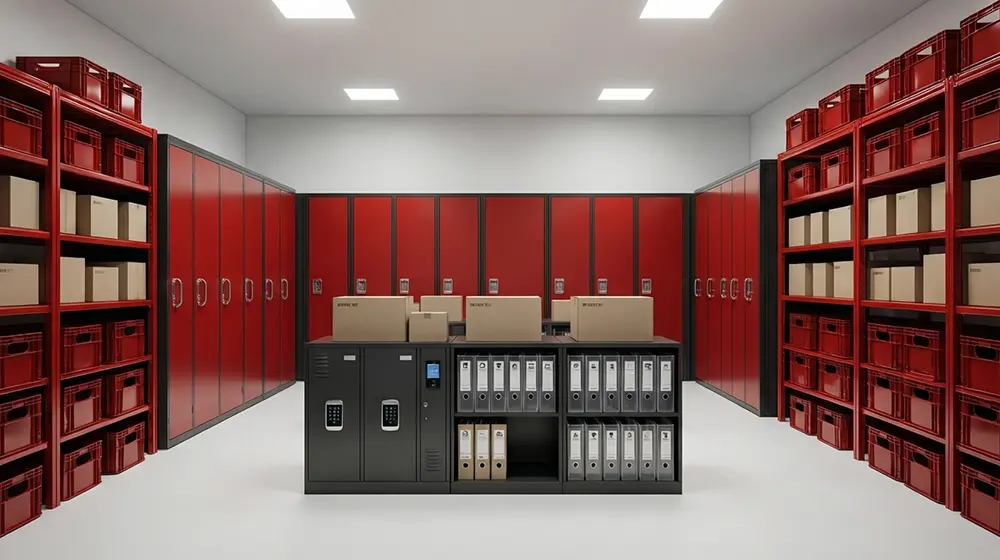
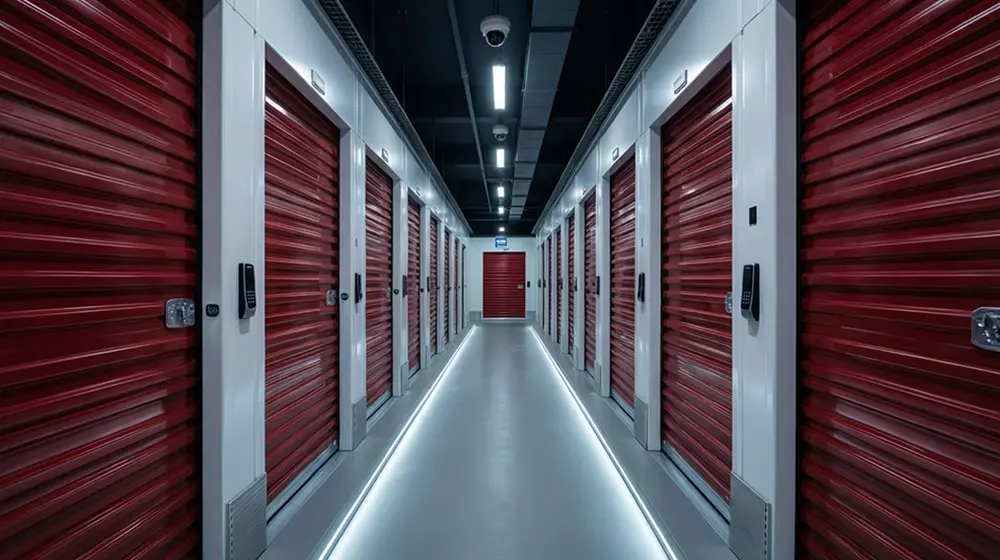
Self-storage in Dubai is a unit-based storage model where a business rents a defined space and controls access directly. Self-storage aligns with inventory cases that require flexible access without warehouse handling services.
Businesses use it for inventory when access flexibility and predictable unit pricing matter more than outsourced warehouse processes.
Key entity attributes
- Unit of storage: Lockers, small units, medium units, large units
- Handling: Business-managed, often manual, with trolleys and lift access
- Operations: Self-managed intake, self-managed retrieval, self-managed labeling
- Evidence: Unit access logs and contracts vary by operator and plan
The UAE self-storage market generated USD 602.5 million in revenue in 2024 and is projected to reach USD 859.2 million by 2030, with a 6.3% CAGR from 2025 to 2030.
What variables separate warehouse storage in Dubai from self-storage in Dubai?
Storage selection becomes accurate when based on measurable variables.
1) How often does inventory move?
Movement frequency predicts the value of warehouse workflows.
Movement cadence guide
- 0 to 2 retrievals per month: Self-storage fit rises
- 3 to 20 retrievals per month: Hybrid fit rises
- 21+ retrievals per month: Warehouse fit rises
This thresholding reflects labor and time economics. High retrieval frequency converts minutes into cost leakage when retrieval stays manual and unstructured.
2) What is the inventory format?
Inventory format controls handling physics and damage probability.
Formats and fit
- Palletized cartons: Warehouse fit rises due to racking and forklift handling
- High carton count, many SKUs: Warehouse fit rises due to bin logic and cycle counts
- Irregular shapes, low movement: Self-storage fit rises
3) How complex are SKUs and locations?
SKU complexity increases the value of structured storage.
SKU complexity indicators
- Active SKU count exceeds 200
- Multiple variants per SKU (size, color, batch, expiry)
- Multi-location storage (bulk plus pick face)
Warehouse storage supports repeatable bin control. Self-storage supports simpler SKU sets where the tenant controls labeling and retrieval discipline.
4) What service level exists for dispatch?
Service level translates into workflow requirements.
Service level attributes
- Dispatch cutoff time
- Pick accuracy expectations
- Returns handling requirements
- Packing standards and documentation standards
Warehouse operators commonly provide service layers. Self-storage relies on the tenant’s internal process maturity.
5) What evidence level supports disputes, audits, and claims?
Evidence is a measurable requirement, not an abstract preference.
Evidence attributes
- Receiving counts with timestamps
- Photo evidence at intake and dispatch
- Movement logs linked to SKU and location
- Access governance records
Evidence matters more as inventory value rises and dispute costs rise.
6) What is the rent and capacity environment?
Dubai’s industrial capacity tightness affects cost and availability. Industrial rents have risen across the emirates in January-June 2025 following a record-breaking 2024, during which industrial and logistics space requirements in Dubai rose by 225 % to reach 40.6 million sqft.
Sharp rental growth across key industrial areas in 2024:
- Al Quoz Grade A up 45% to AED 72 to 100 per sq ft
- Dubai Investments Park (DIP) up 48% to AED 50 to 70 per sq ft
High demand and rising rents change the math. Higher rent environments reward higher space utilization and lower waste per unit moved.
What Dubai macro indicators matter for inventory storage decisions?
Dubai’s logistics throughput supports both models, but it raises standards for speed, evidence, and reliability.
Dubai’s non-oil trade volume signals inventory flow
The UAE reached AED 3 trillion in non-oil trade in 2024, a 14.6 % increase year on year. Non-oil exports reached AED 561.2 billion in 2024, up 27.6 % from 2023, and the share of non-oil exports rose to 18.7 % of total foreign trade.
Trade expansion increases inbound inventory and distribution requirements, especially for traders, e-commerce, and spare parts businesses.
Air cargo throughput signals fast cycles and time sensitivity
Dubai International Airport handled 2.2 million tonnes of cargo in 2024, up 20.5% from 2023. Cargo growth increases the prevalence of time-sensitive inventory profiles, which often align with warehouse service models.
Seaport throughput signals containerized supply and pallet inventory
DP World’s flagship Jebel Ali port handled 15.5 million twenty-foot equivalent units (TEUs) in 2024, according to public reporting quoting DP World leadership statements. Containerized throughput often maps to palletized inventory flows, which tend to align with racked warehouses and formal receiving processes.
What do Dubai market rents indicate about warehouse cost pressure?
Dubai’s industrial rent environment shows a sustained upward trend.
According to the Knight Frank Industrial Market Review H1-2025, in Q2 2025, Al Quoz grade A rents reached AED 85 per sq ft (inside the AED 72 to 100 range quoted for 2024, and well above JLL’s all-grade average of AED 40.3), a 31 % year on year increase, and grade B stock in Al Quoz reached AED 58 per sq ft, up 21 % year on year.
Cushman and Wakefield reported a supply tightness indicator. Dubai industrial rents rose 18 % year on year, and occupancy for grade A assets averaged 95 %, indicating limited slack capacity in prime logistics stock.
These figures matter because higher industrial rents shift the cost advantage toward models that improve space utilization and reduce labor waste.
What inventory profiles match warehouse storage in Dubai?
Warehouse storage fits inventory that benefits from process control and throughput optimization.
E-commerce inventory
E-commerce inventory fits warehouse storage when order flow and SKU count remain high. E-commerce inventory commonly includes high SKU counts, high pick frequency, and high return rates.
Operational fit signals
- Daily order flow
- Multiple SKUs per order
- Packing standards and branded inserts
- Returns processing with condition grading
Market sizing varies widely by source, so use it as directional context, not as a single truth. IMARC’s estimate of the UAE e-commerce market size uses a much broader definition than Mordor Intelligence, which provides a far smaller market value and forecasts to 2031; both point to continued growth.
The key procurement point remains stable: e-commerce is SKU and flow-intensive, and flow-intensive inventory extracts more value from warehouse processes than from unit storage.
FMCG, cosmetics, and retail replenishment
FMCG and retail replenishment benefit from pallet handling, batch control, and expiry discipline.
Warehouse value drivers
- Pallet staging reduces handling touches
- Racking reduces crush damage
- Cycle counting improves stock accuracy
Spare parts and maintenance inventory
Spare parts require accurate location control and retrieval speed.
Warehouse value drivers
- Bin-level storage supports part retrieval
- Location discipline reduces mispicks
- Movement logging supports cost allocation
Trading inventory with frequent inbound and outbound
Trading inventory benefits from receiving checks and a documented dispatch handover.
Warehouse value drivers
- Reduced disputes through count evidence
- Standardized intake reduces variance
- Dispatch documentation supports receivables conversations
What inventory profiles match self-storage in Dubai?
Self-storage fits inventory that stays stable, moves less frequently, and remains manageable by a business team.
Low-velocity marketing collateral and event equipment
Marketing stock often includes irregular shapes and low-velocity access.
Self-storage value drivers
- Flexible access cadence
- Predictable unit rental
- Internal handling stays simple
Project stock and tools
Project stock moves in bursts. Self-storage supports storage between phases.
Self-storage value drivers
- Rapid access for teams
- Low dependency on operator services
Archived inventory and slow-moving spare parts
Slow movers rely on security and controlled packaging.
Self-storage value drivers
- Secure containment
- Low handling complexity
What does total cost mean in Dubai storage selection?
The total cost includes more than rent. Total cost includes rent, labor minutes, transport frequency, error cost, and claims friction.
Cost drivers for warehouse storage in Dubai
Warehouse pricing often includes multiple line items.
Common cost lines
- Storage fee: Per sq ft, per pallet position, or per cubic meter
- Inbound handling: Per receipt or per pallet
- Picking: Per line, per order, or per hour
- Packing materials: Cartons, bubble wrap, labels
- Value-added services: Kitting, labeling, assembly (operator-specific)
Cost drivers for self-storage in Dubai
Self storage pricing tends to appear simple, but operational costs sit outside the invoice.
Common cost lines
- Unit rent by size and location
- Shelving, pallets, and internal fit-out
- Staff time for retrieval and restocking
- Transport cost per run
- Packaging and labeling cost
Self storage aligns with businesses that prefer predictable unit rent and accept internal labor ownership.
Total cost comparison
| Cost driver | Unit | Warehouse storage in Dubai | Self-storage in Dubai |
|---|---|---|---|
| Space cost | AED per sq ft per year | Benchmark context from JLL: 40.3 avg in Q3 2024; Al Quoz Grade A up to 85 | About AED 138 to 192 at Ruby for 100 to 200 sq ft units (AED 1,350 to 2,800 a month) |
| Handling labor | Minutes per retrieval | Lower at high cadence due to the process | Higher at high cadence due to manual retrieval |
| Transport | Runs per month | Fewer runs if dispatch consolidated | More runs if staff access drives trips |
| Error cost | Percent of lines affected | Controlled by scan and location discipline | Controlled by tenant labeling discipline |
| Dispute cost | Hours per dispute | Lower if GRN, photos, and movement logs exist | Higher if evidence remains partial |
Per square foot, self storage costs more than leased warehouse space because the rent covers a finished, secured, month-to-month unit with no lease, fit-out or handling fees. Warehouse rent is quoted per year on longer leases and excludes handling, which is why the comparison only works on total cost per movement. Check current Dubai prices for the self-storage side.
What operational services differentiate warehouse storage in Dubai?
Warehouse storage becomes a managed operating layer, not a rented box.
Receiving and intake controls
Receiving controls reduce downstream disputes.
Receiving controls
- Count by SKU and carton
- Damage photos upon receipt
- GRN creation and timestamp
- Labeling and location assignment
Putaway and location control
Putaway discipline reduces misplacement.
Putaway controls
- Bin labels and barcode logic
- Zone mapping: bulk, pick face, returns
- Location scanning at move time
Picking and packing services
Picking and packing reduce dispatch errors when a workflow exists.
Picking controls
- Pick list logic
- Scan validation
- Pack verification and seal logs
Dispatch and delivery handover evidence
Dispatch evidence closes the chain of custody.
Dispatch evidence
- Delivery note with SKU counts
- Seal number where relevant
- Carton photos for fragile categories
What checklist fits the self-storage in Dubai selection?
Self-storage selection focuses on access physics and security.
Self-storage evaluation criteria
- Access hours and access method
- Loading bay availability and vehicle access rules
- Lift capacity and trolley availability
- CCTV coverage and the incident reporting process
- Contract clarity for business inventory use
UAE self-storage revenue growth provides a category maturity context.
What risks matter most for business inventory in Dubai storage decisions?
Risk and evidence are procurement-level decision variables.
Risk category 1: shrinkage and access governance
Shrinkage risk rises as access becomes uncontrolled.
Access governance controls
- Limited access list
- Access logs and timestamps
- CCTV and incident workflow
Warehouse operations tend to formalize access governance. Self storage governance varies by operator and by tenant discipline.
Risk category 2: damage during handling
Damage probability rises as handling touches rise.
Damage controls
- Palletization standards
- Racking and staging discipline
- Packaging compliance checks at intake
Warehouse models reduce random handling touches via staging and equipment use.
Risk category 3: disputes and claims friction
Claims friction correlates with missing evidence.
Evidence pack components
- Intake inventory list with timestamps
- Photos of the condition at intake
- Movement history or access record
- Dispatch handover document
- Exception log for damages or shortages
What decision framework fits a Dubai business choosing between the two models?
A practical framework uses measurable thresholds.

Step 1: Classify inventory by velocity
Velocity classification uses movements per month.
- A class: 21+ movements per month
- B class: 3 to 20 movements per month
- C class: 0 to 2 movements per month
A class inventory aligns with warehouse storage. C-class inventory aligns with self storage. B-class inventory often supports a hybrid split.
Step 2: Classify inventory by value and risk
Value and risk classification reduces dispute probability.
Risk attributes
- Fragile items
- High unit value items
- Regulated handling requirements
- Warranty return risk
High-value inventory aligns with stronger evidence systems.
Step 3: Map service level requirements
Service level classification uses dispatch cadence and accuracy targets.
Service level attributes
- Same-day dispatch requirement
- Order accuracy requirement
- Packing compliance requirement
Warehouse storage aligns with SLA-driven operations when the provider offers a defined service scope.
Decision matrix for business inventory storage in Dubai
| Decision variable | Measurement | Warehouse storage in Dubai | Self-storage in Dubai |
|---|---|---|---|
| Movement cadence | Picks per week | Optimized for high cadence | Optimized for low cadence |
| SKU count | Active SKUs | Supports high SKU count with bin logic | Supports low to moderate SKU count |
| Handling method | Pallets and equipment | racking, forklifts, staging | Manual handling |
| Service level | SLA and cutoff times | Supports SLA-based dispatch | Business executes processes |
| Evidence | Logs and records | GRN, movement logs, dispatch evidence | Contract plus access varies |
| Space efficiency | Vertical density | high, racking-driven | Moderate, unit geometry-driven |
| Security model | Controlled operations | Gated workflows and staff controls | Unit access control varies |
| Cost structure | Cost per unit moved | Reduces cost per movement at volume | Stable fixed unit fee, labor external |
Industrial rent growth adds weight to space efficiency.
How to evaluate warehouse storage providers in Dubai?
1. Receiving and intake controls
- Documented receiving checklist
- Variance log discipline
- Photo evidence workflow
2. Inventory control maturity
- Cycle count schedule
- Variance reconciliation method
- Location labeling system
3. Service level capability
- Dispatch cutoff times
- Pick and pack procedures
- Returns handling process
4. Evidence and reporting
- Weekly or monthly inventory reports
- Movement history availability
- Exception reporting clarity
5. Security and access control
- CCTV coverage
- Staff access segregation
- Visitor protocol
6. Commercial clarity
- Clear tariff schedule
- Clear handling charges
- Clear storage basis (sq ft vs pallet vs cubic)
How to evaluate self storage in Dubai for business inventory?
Self storage procurement focuses on access, security, and operational fit.
Self storage evaluation checklist
- Access hours and access control method
- Loading bay and lift access
- Parking access for vans and small trucks
- Trolley and handling equipment availability
- CCTV coverage and incident workflow
- Contract clarity for business use cases
What questions do procurement teams ask about warehouse storage in Dubai?

What contract terms define warehouse storage quality?
Warehouse quality correlates with contract terms that define process boundaries.
Contract terms
- Intake and receiving scope
- Cycle count frequency
- Damage responsibility boundary
- Dispatch cutoff time
- Access rules for client visits
- Reporting cadence
What KPIs show warehouse performance?
KPIs convert storage into measurable value.
Warehouse KPIs
- Inventory accuracy percent
- Order accuracy percent
- Average pick time per order
- Shrinkage rate per month
- Damages per 1,000 units handled
What questions do procurement teams ask about self-storage in Dubai?
What access model defines self-storage usability?
Access usability depends on operational access, not marketing claims.
Access attributes
- Access hours
- Lift capacity and loading bay availability
- Trolley and pallet jack access
- Vehicle access rules
What evidence exists for custody?
Custody evidence varies by operator plan and documentation.
Evidence attributes
- Contract terms and unit assignment
- Access logs and camera coverage
- Incident reporting process
The UAE self-storage market includes business usage as a defined application segment in market segmentation.
What documentation pack reduces disputes for both storage models?
Documentation quality reduces disputes and increases claim clarity.
Evidence pack components
- Intake inventory list with SKU counts and timestamps
- Intake condition photos
- Storage location mapping or unit layout diagram
- Movement log or access record
- Dispatch handover document with SKU counts
- Exception log for shortages and damage
Common mistakes businesses make in Dubai when selecting storage
Mistake 1: Pricing storage using rent only
Rent represents one cost line. Total cost includes labor, transport, errors, and dispute resolution time.
Mistake 2: Ignoring industrial capacity constraints
Supply tightness increases the importance of contract clarity and lead time.
Mistake 3: Mixing fast movers and slow movers
Mixed velocity increases misplacement and retrieval friction. Segmentation reduces error probability.
Mistake 4: Delaying documentation until a dispute occurs
Evidence created at intake and dispatch reduces disagreement later.
Final Takeaway: Pick the Storage Model That Protects Margin, Speed, and Proof
Choosing between warehouse storage in Dubai and self storage in Dubai is not a “space” decision. It is an operations and evidence decision. If your inventory moves frequently, carries many SKUs, or needs dispatch cutoffs and accuracy targets, warehouse workflows reduce hidden leakage through structured receiving, location control, and documented handovers. If your inventory is low-velocity, irregular, and better handled by your own team, self-storage can stay efficient, provided access, loading, and internal labeling discipline are strong. In Dubai’s higher-rent, higher-throughput environment, the best choice is the one that minimizes total cost per movement, not the one with the lowest headline rent. Use the velocity bands, service-level needs, and evidence pack in this guide, then choose the model that makes disputes harder, errors rarer, and scaling smoother.