Decluttering a Dubai home gets expensive when the wrong items stay and valuable ones leave too quickly. A sofa kept for another year adds storage costs. A working appliance sold too cheaply loses resale value. Usable furniture sent for disposal can miss a better donation route.
The scale matters too. Digital Dubai reported 4.580 million residents at the end of 2025, after Dubai added about 332,000 people in one year. In a city with constant household movement, knowing whether to sell, donate, store or bin can protect both space and money.
This declutter Dubai decision framework turns that choice into practical arithmetic. It compares replacement cost with 12-month storage cost, checks resale value in the Dubai second-hand market, separates sentimental items from ordinary clutter, and covers donation channels and Dubai Municipality bulk disposal rules. The result is a clearer way to decide what stays, what goes, and what still has value.
How do you decide what to keep?
Keep an item when its future use, replacement cost or irreplaceable value exceeds the cost and inconvenience of keeping it.
The decision starts with evidence, not the original purchase price. A costly sofa can become poor storage material after years of wear, while a small archive box can remain irreplaceable.
Use 4 questions for household decluttering in Dubai:
- What does an equivalent replacement cost today?
- What can the item realistically return in the Dubai second-hand market?
- Is the item sentimental, unique or legally important?
- When did you last use it, and what specific event creates the next use?
Record the answer beside each bulky or high-value item. This avoids treating every possession as only “keep” or “throw away.”
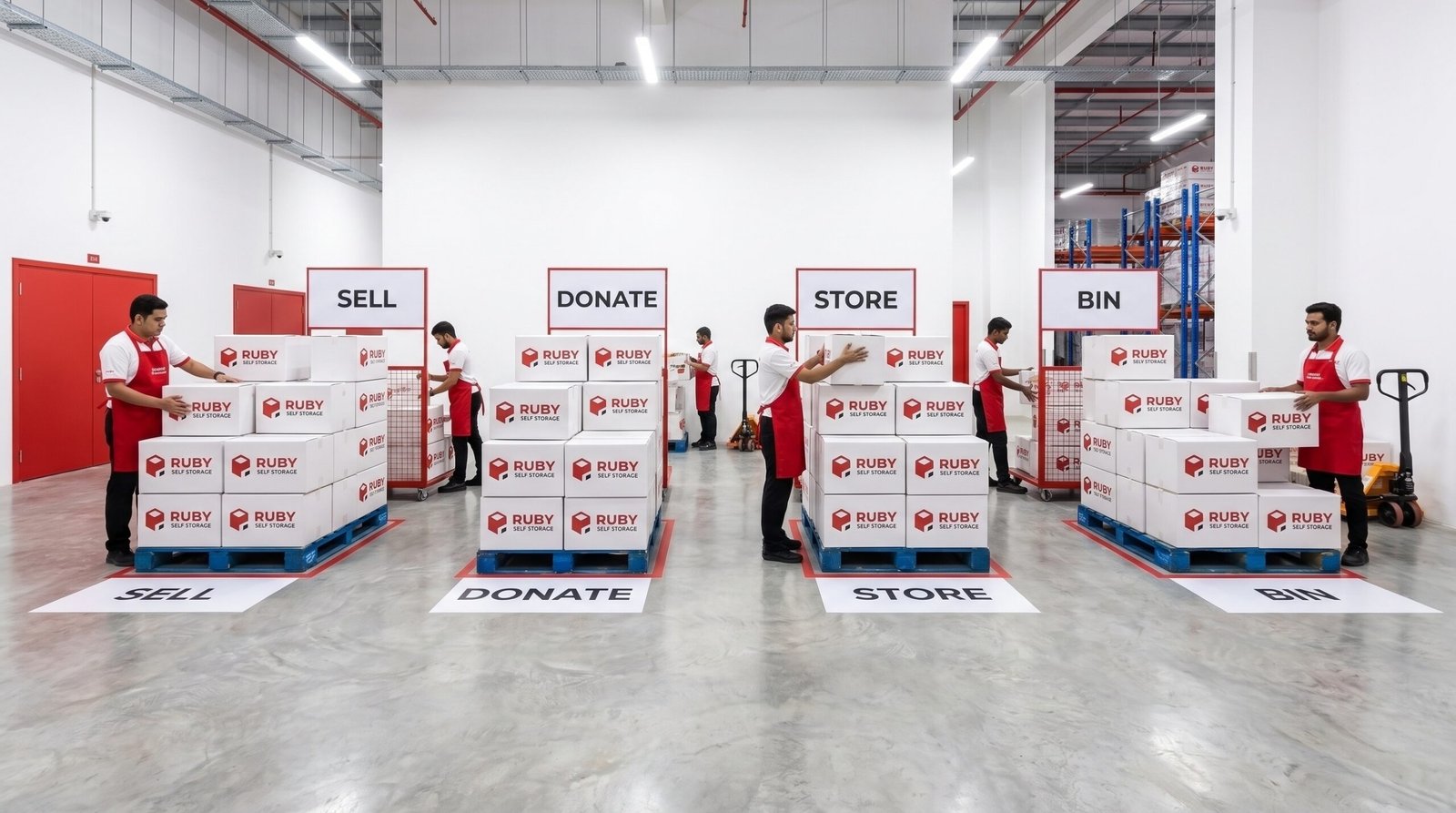
The four-way test
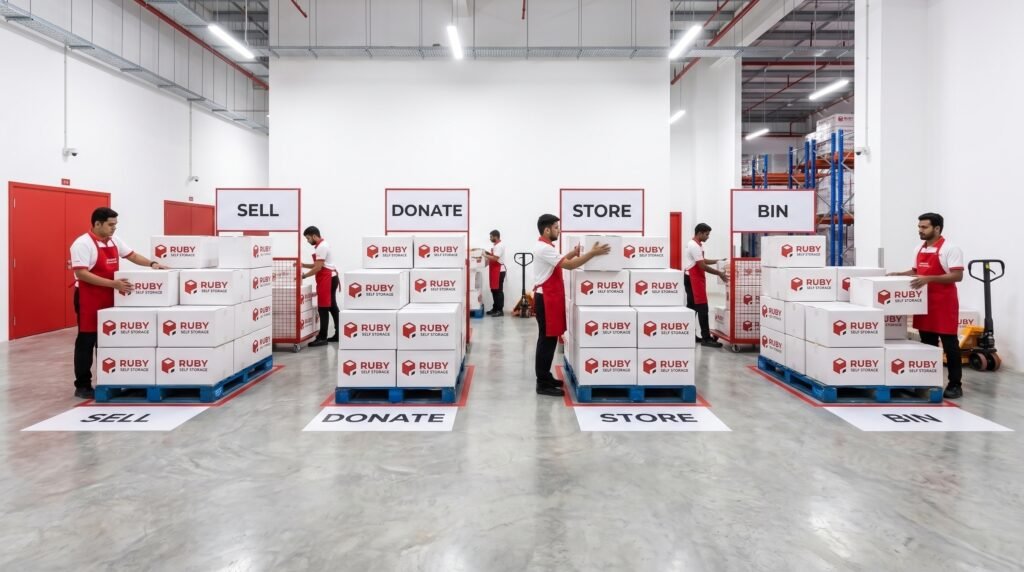
The four-way test assigns each item to sell, donate, store, or dispose of after comparing economic value, utility, and future use.
Use this table as the first filter. Then apply the detailed tests below to valuable, bulky or irreplaceable belongings.
| Route | Best fit | Numeric or factual test |
|---|---|---|
| Sell | Usable item with active demand | Net sale value justifies listing, negotiation and collection |
| Donate | Usable item with low cash recovery | Utility remains high while resale return stays low |
| Store | High replacement or personal value | 12-month storage cost stays below the value of keeping it |
| Bin or dispose | Broken, unsafe or unusable item | No realistic resale or donation route remains |
“Bin” means use the correct disposal channel. It does not mean leaving a wardrobe, mattress or refrigerator beside a communal waste container.
- Replacement cost versus 12-month storage cost
Replacement cost versus 12-month storage cost compares the money required to keep an item with the money required to buy an equivalent item later.
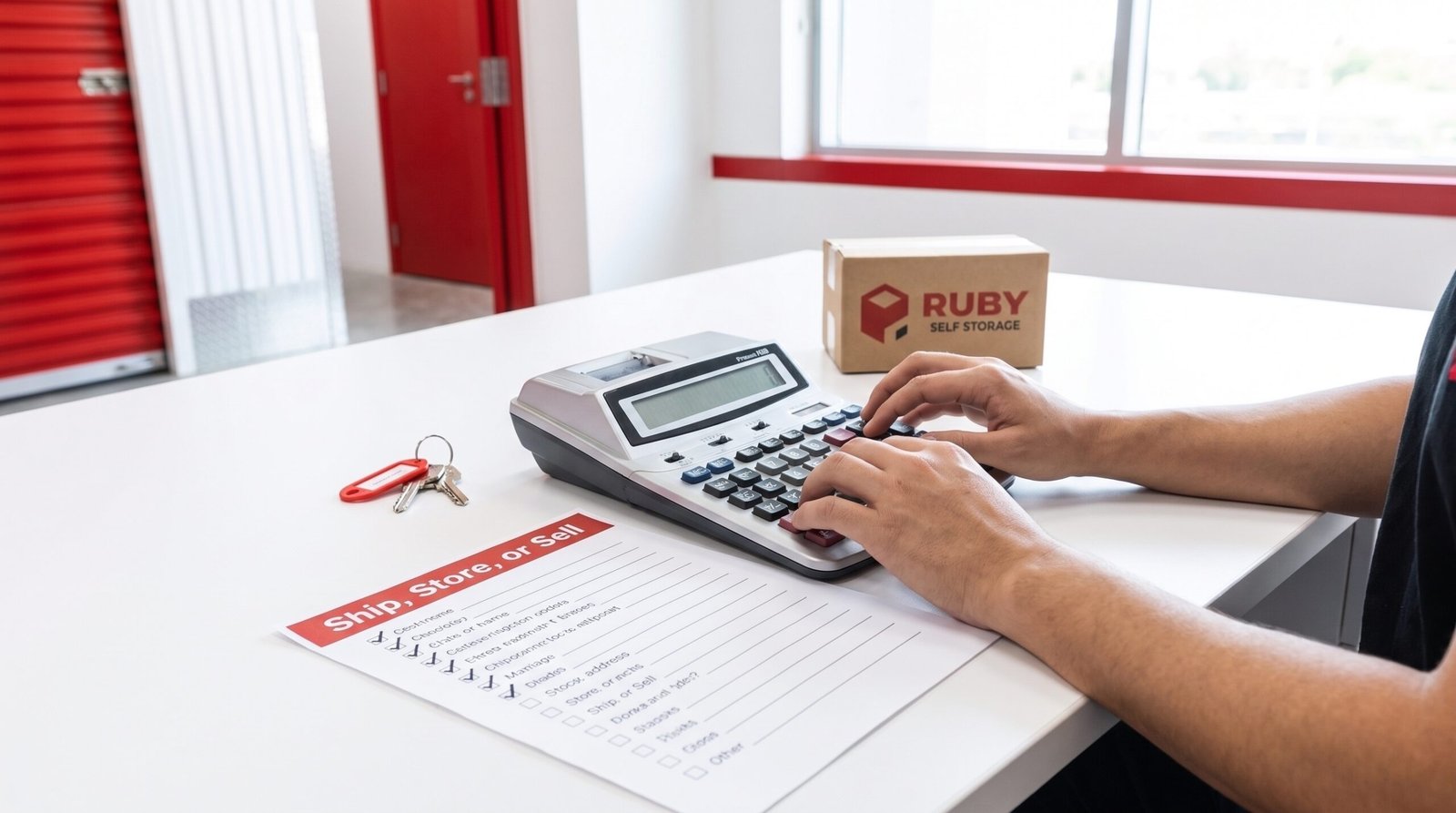
Use this test before placing furniture, appliances or boxes into long-term self storage in Dubai. Calculate the complete holding cost:
Annual storage cost = 12 months of unit rent + collection + packing + insurance + redelivery + other contracted charges
Current Dubai pricing also changes substantially by unit size. A Dubai self-storage pricing guide places a standard 150 sq ft storage unit at approximately AED 750 to AED 1,100 per month and describes this size as suitable for the contents of a larger one-bedroom or compact two-bedroom home.
That equals AED 9,000 to AED 13,200 for 12 months before separately charged services. The midpoint is approximately AED 11,100 a year.
If 12 months of storage costs less than replacing the item, storing is rational. For a compact 2BHK of furniture using about 150 sq ft, that threshold is around AED 11,100 a year at the midpoint of the published range.
Downsizing only creates a saving when the smaller home’s rent reduction remains greater than the storage bill created by the move. Do the calculation again for individual bulky pieces. Removing one wardrobe, spare bed and unused dining set can reduce the storage space required. That can change the economics of everything left.
- Resale value in the Dubai second-hand market
Sell when realistic net proceeds are high enough to beat the convenience value of donating or disposing of the item.
Dubai has no official citywide resale percentage for every household category. Users commonly discount second-hand goods 40% to 70% from the original retail price. Age, damage, brand, moving difficulty and urgency can change the result sharply.
Use this calculation:
- Recovery rate = net sale proceeds ÷ original retail price × 100
A AED 500 sale on an item originally bought for AED 2,000 produces a 25% recovery rate.
Compare similar Dubai listings and provide dimensions, condition details, accurate pricing, and clear photographs.
- Sentimental and irreplaceable items
Sentimental and irreplaceable items carry value that resale arithmetic cannot measure.
Use this category for original family records, one-off photographs, inherited objects, certificates and personal collections. Separate irreplaceable possessions from ordinary items that simply remind you of an earlier home.
Size changes the decision. Ten document folders occupy little storage capacity. A complete inherited bedroom suite consumes a much larger share of a storage unit.
Separate sentimental items into:
- Original documents and records
- Photographs and family archives
- Inherited objects
- Personal collections
- Replaceable objects linked only to a memory
Sentimental value can justify storage. Sentiment alone does not make unlimited storage spending rational.
- Frequency of use in the last 24 months
An item unused for 24 months becomes a strong sell or donate candidate unless a clear future use explains the gap.
The 24-month test is a decision rule, not proof that an item has no value. Seasonal gear, emergency equipment, specialist tools and sentimental objects can remain useful after long gaps.
For ordinary household items, two years covers repeated seasons and normal domestic routines. An untouched spare chair, duplicate kitchen appliance or unopened moving box deserves another look.
Ask one precise question: What event makes this item useful again?
“Maybe someday” does not identify an event. A confirmed move, planned renovation, family change or temporary overseas posting does.
Where to sell in Dubai
Sell household goods through peer-to-peer marketplaces, community channels or Dubai’s established second-hand furniture trade.
For ordinary furniture, appliances and homeware, online marketplaces give you direct access to end buyers. Local building and neighborhood groups can work better for bulky items because collection distances stay short.
Dubai Municipality also developed a 27,000 sq m Furniture Market in Nad Al Sheba 3 for buying and selling used furniture, kitchen equipment and related goods. The market was completed in 2018.
For anyone trying to sell used furniture in Dubai, compare three routes before accepting an offer:
- Direct marketplace sale
- Local community sale
- Dealer or consignment route
Price and speed move in opposite directions. Direct selling can recover more cash. Dealer selling normally exchanges part of that value for faster collection and less work.
Marketplaces and typical recovery rates by category
A recovery rate is the final sale proceeds divided by original retail cost, multiplied by 100.
No official Dubai dataset publishes completed household resale rates by product category. A defensible Dubai second-hand market estimate therefore combines documented benchmarks with current comparable listings.
| Category or example | Price evidence | Asking for recovery |
|---|---|---|
| General used goods, historical benchmark | 40% to 70% discount from retail | About 30% to 60% |
| Used clothing, historical benchmark | About one-fifth of retail | About 20% |
| 2026 sideboard listing | AED 2,000 vs AED 2,500 original | 80% |
| 2026 refrigerator listing | AED 1,900 vs AED 3,500 original | 54% |
| 2026 five-seat sofa listing | AED 2,500 vs AED 5,400 original | 46% |
| 2026 five-year sofa listing | AED 1,950 vs AED 8,000 original | 24% |
| 2026 outdoor table listing | AED 250 vs about AED 2,500 original | 10% |
The table shows how age, condition, and bulk move the asking value. It does not predict a final selling price. Compare at least 5 close matches before listing an expensive household item.
Bulky pieces face another cost. Buyer collection affects demand. Measurements, lift access and collection deadlines therefore belong in every serious furniture listing.
Consignment and second-hand dealers
Use consignment or a second-hand dealer when speed and removal matter more than maximizing the final sale price.
A second-hand dealer normally buys outright. The dealer carries resale risk, so the offer leaves room for transport, handling, stock time and resale margin.
Consignment works differently. The seller keeps an economic interest in the item until another buyer completes the purchase. The operator then deducts the agreed commission or fee.
Send dealers:
- Clear photographs
- Original brand or manufacturer
- Approximate age
- Measurements
- Visible damage
- Collection location
- Lift or loading information
Ask for the net amount you receive, not only the expected selling price.
Skipping this comparison can cost money during a rushed move. A weak dealer offer may still beat paying another month of storage for an item already marked for sale.
Where to donate in Dubai
Donate clean, usable household goods through an approved charity that accepts the item category and collection area.
Dubai Charity Association currently lists furniture, clothing, electronic devices, kitchenware, carpets, curtains, toys, sports equipment, books, bags and other household categories in its in-kind donation system. Its form also requests the pickup area, building information, and a preferred collection date.
Dubai’s charitable sector operates within a regulated system. The Islamic Affairs and Charitable Activities Department (IACAD) recorded more than AED 530 million through licensed digital donation channels during the first half of 2026, across more than 30,000 transactions.
For household decluttering, donation fits when:
- Confirm the item remains clean and functional.
- Check that resale proceeds stay small.
- Verify that the charity accepts the category.
- Arrange collection before the move-out deadline.
Confirm acceptance before moving bulky furniture downstairs. A charity gains little from an item that immediately creates repair or disposal costs.
Dubai Municipality bulk disposal rules
Dubai Municipality’s current service directory lists free disposal for bulky household furniture and electronics, with a stated completion period of three working days. The current listing excludes investment zones.
Check the property zone before booking. Dubai Municipality’s earlier service guidance excluded residents of real estate development zones and free zones from that municipal collection route, where local waste arrangements can differ.
The service handles measurable demand. Dubai Municipality recorded 4,000 bulky-waste requests in the first half of 2022. The municipality had recorded 13,002 requests by mid-December 2020, which was 35% above the comparable 2019 period.
Dubai Municipality also reported that recycling companies screen and collect bulky waste and recycle the most suitable items for reuse.
That disposal route now sits inside a larger waste target. Dubai Municipality’s Circle Dubai initiative says the Dubai Integrated Waste Management Strategy 2041 targets 100% diversion of all waste types from landfill by 2041, with recycled waste accounting for at least 56% of that target.
Use Dubai Municipality furniture disposal after sale and donation routes fail. Do not leave unwanted bulky furniture beside a building bin unless the property’s authorized waste process directs that action.
Category-by-category recommendations
The table applies the four-way test to common household categories. Condition and replacement value can move an individual item into a different decision.
| Household category | First choice | Change the decision when |
|---|---|---|
| Quality sofa or dining furniture | Sell | Store when the replacement value clearly exceeds the annual storage cost |
| Low-value usable furniture | Donate | Sell when live listings show meaningful demand |
| Broken or unsafe furniture | Dispose | Do not donate unusable pieces |
| Recent working appliances | Sell | Store during a short housing gap |
| Unwanted working household goods | Donate | Sell higher-value branded items |
| Everyday clothing | Donate | Sell higher-value pieces with a realistic resale market |
| Books, toys and kitchenware | Donate | Keep items in active use |
| Family photographs and original archives | Store | Digitize supporting copies where practical |
| Duplicate decor and unused accessories | Sell or donate | Keep only where a defined future use exists |
| Household electronics at the end of their usable life | Approved disposal | Sell or donate only when safe and functional |
Sell usable value first. Donate usable utility next. Store items whose future or personal value beats the cost. Dispose of what no longer has a safe reuse path.
For each large item, record these facts:
- Replacement price
- Expected sale price
- 12-month holding cost
- Last-use date
That creates a simple household decluttering audit trail.
Make every item earn its place
A successful Dubai declutter ends with a decision, not another pile waiting for later. Sell items with real resale value. Donate usable goods with weak resale potential. Store only what costs more to replace than to keep. Dispose of broken or unsafe items through the correct channel.
The numbers make that choice clearer. A compact 2BHK storage setup can cost about AED 11,100 a year at the midpoint of the cited 150 sq ft storage range. Paying that amount for furniture worth far less makes little financial sense.
Before the next move, downsizing project or home clear-out, give every large item 4 figures:
- Replacement price
- Expected resale value
- 12-month storage cost
- Last-use date
Then assign one destination and set a deadline.
Do not move clutter into paid storage because the decision feels difficult. Price it. List it. Donate it. Book disposal where reuse no longer makes sense.
Start with the five largest items in your home today. Those decisions usually release the most space and expose the biggest avoidable costs first.
FAQs
Is it better to sell or store furniture in Dubai?
Sell furniture when expected resale proceeds plus avoided storage costs exceed the value of keeping and later replacing the item.
Use the 12-month storage figure and include collection, packing and redelivery charges.
How much can a 2BHK storage decision cost over 12 months?
Current Dubai rate cards vary substantially, with one 100 sq ft annual tariff at AED 12,000 and another provider pricing two-bedroom-sized units at AED 1,295 to AED 1,395 monthly plus VAT.
Where can you sell used furniture in Dubai?
You can use classified marketplaces, local buy-and-sell groups, consignment channels and Dubai’s 27,000 sq m used-furniture market in Nad Al Sheba 3.
Where can you donate furniture in Dubai?
Dubai Charity Association lists furniture in its current in-kind donation system and provides a pickup-request process.
Does Dubai Municipality collect unwanted furniture?
Dubai Municipality currently lists free bulky-waste disposal for household furniture and electronics within three working days, subject to service-area exclusions.
What is the fastest way to declutter a Dubai home?
Sort every item into sell, donate, store or dispose, then attach a deadline and a number to each decision.
Rakan Al-Juraid is a logistics specialist with a focus on commercial storage systems and high-security asset management. With extensive experience in industrial warehousing, he specializes in inventory tracking technology and transit safety. Rakan’s expertise lies in streamlining the storage process for both businesses and homeowners through strategic planning. His writing offers data-driven advice on insurance for stored goods, fire-safe environments, and heavy-duty logistics. He is committed to ensuring that every square foot of storage is utilized with maximum security and efficiency. Rakan aims to provide professional-grade storage standards to every reader navigating the moving process.
- Rakan Al-Juraid
- Rakan Al-Juraid
- Rakan Al-Juraid