Keeping a few product cartons beside your desk may seem simple. In Dubai, the bigger question is whether your licence, tenancy terms, and approved property use allow that stock to stay there.
The issue is becoming more relevant as Dubai’s small-business base expands. Dubai Chambers recorded 71,830 new member companies in 2025, up 20% year on year. The Dubai Department of Economy and Tourism also reported more than 2,400 new e-commerce sellers through Dubai Traders within 12 months.
For freelancers and home businesses, storage can quickly become a licensing, tenancy, insurance, and cost decision.
This guide explains storage for Dubai freelancers and home businesses:
- What freelance and home-business licences allow?
- When stock has to move out?
- How storage compares with a small office in AED?
- Whether a storage unit can serve as a business address?
- Which access requirements matter for a one-person operation?
Can you hold stock at home on a Dubai freelance licence?
You can keep items connected with your approved activity, but a Dubai freelance licence does not grant unrestricted home-stock or retail trading rights. Your exact activity and premises rules control what you can store.
Start with the licence because Dubai separates professional work, home-business activity, and commercial trading.
What freelance permits allow
A Dubai freelance permit covers approved independent professional activity, not unrestricted product trading.
The Dubai Development Authority describes its Freelancer License as a Sole Professional License. The licence identifies you as a sole practitioner operating under your birth name. The published permit fee is AED 7,500, plus AED 10 Knowledge Dirham and AED 10 Innovation Dirham per transaction.
The related GoFreelance programme concentrates on four professional groups: technology, media, education, and design. Listed activities include software development, photography, writing, training, graphic design, and fashion design.
This matters when you keep stock.
A photographer’s cameras relate directly to photography. Printed design samples can support design work. Merchandise bought mainly for repeated resale creates a different commercial activity.
The UAE Ministry of Economy and Tourism lists more than 2,000 economic activities across six main licence categories. The selected economic activity determines the licence type.
Check the activity printed on your licence before using your home as inventory space. An activity mismatch remains a licensing issue even when the stock occupies only a few boxes.
What home-business licences allow
A home-business licence specifically links an approved business activity with residential premises.
According to Dubai SME, the Intelaq licence allows Dubai residents who qualify for the scheme to run approved businesses from home. The business must remain 100% owned and managed by UAE or Gulf Cooperation Council nationals residing in the UAE.
Dubai SME lists several other limits. Your enterprise must operate in Dubai. Your residence must also be in Dubai. An applicant cannot hold more than five trade licences that the applicant owns or manages. The published Intelaq fee is AED 1,050, excluding federal fees.
Home-based does not mean activity-free.
Dubai expanded Intelaq in 2020 to include 19 food trading activities and seven food preparation activities. The Government of Dubai Media Office also reported that eligible Intelaq holders could obtain establishment cards connected with visas for up to three employees.
Current activity rules still control each application. Food, cosmetics, health products, chemicals, and other regulated goods can involve additional authority approvals.
Dubai also maintains E-Trader licences. The current Invest in Dubai activity database lists E-Trader and Intelaq among available licence types for eligible activities and legal forms. Both depend on the selected business activity, not a blanket right to trade every product category.
For home business storage, the licence therefore answers only one part of the question. Your property rights answer another.
Tenancy restrictions that override both
Your tenancy can restrict commercial use even when your licence allows home-based activity.
The Dubai Land Department states that a residential apartment cannot operate as a commercial office. The Dubai Land Department also lists use outside the leased purpose among grounds connected with tenancy enforcement.
Article 25 of Dubai’s tenancy law provides the legal basis. The Dubai Legislation Portal allows a landlord to seek eviction when a tenant uses property for another purpose. The rule also covers breaches of planning, construction, or land-use regulations.
Use this order when checking home stock:
- Check your economic activity. Confirm that your licence covers the goods or professional activity involved.
- Check residential use. Confirm that the approved activity can operate from your residence.
- Check the tenancy contract. Look for limits covering commercial use, deliveries, visitors, goods, or alterations.
- Check building rules. Apartment management can control loading access, courier movement, and common areas.
Skipping the property-use check creates a separate problem from licensing. A valid licence does not change a residential unit into unrestricted commercial premises.
When stock has to move out
Stock has to move out when the residence no longer meets the rules for your activity, tenancy, product conditions, or insurance. Dubai does not use one universal box-count rule for every freelancer or home business.
Volume threshold
Dubai’s published freelance and home-business rules do not state one general stock threshold in boxes, square feet, or cubic meters.
That distinction matters. The legal trigger can depend on the product rather than its physical volume.
Food trading under Intelaq provides a clear example. The Government of Dubai Media Office published specific conditions for 19 food-trading activities and seven food-preparation activities. For food trading, the residence could function as a management office only. Home storage and repacking were not permitted.
For that published food-trading condition, the permitted quantity of home-stored trading stock is therefore zero. Dubai SME requires any required storage or repacking through a licensed and accredited institution, subject to food-safety approval.
Other goods can create storage-condition limits before space becomes the main problem. The 2024 Dubai Municipality consumer-product storage guidelines specify 21°C to 25°C for consumer products without labelled storage conditions. Products marked for moisture protection require no more than 60% relative humidity under normal storage conditions.
Dubai Municipality also gives 2°C to 8°C as the refrigeration range for products carrying that storage instruction.
Consider these 4 triggers rather than an invented carton limit:
- Move regulated stock when the activity requires licensed or specialist storage.
- Move temperature-sensitive stock when your residence cannot maintain the required conditions.
- Move growing inventory when deliveries and dispatch activity change the residential use of the property.
- Move insured business stock when your household policy does not cover commercial inventory.
The practical volume threshold therefore differs by activity. Five cartons can create a compliance problem while 20 boxes of ordinary business records may not.
Insurance implications of home-held stock
Home insurance can exclude business inventory even when the goods physically fit inside your apartment or villa.
Liva Insurance states that its home policy covers items for personal use. Liva asks customers to contact the insurer when home activity includes clients, staff, business cash, or business-related stock.
Another UAE home policy specifically excludes items used for business or professional purposes. The related consumer guidance also states that business-use items may fall outside normal home contents cover.
Confirm four points before storing commercial stock at home:
- Confirm whether the policy definition includes business inventory.
- Confirm the insured value assigned to commercial goods.
- Confirm theft and fire cover for stock.
- Confirm whether customer or courier activity changes the risk declaration.
The number of cartons does not determine the insurance exposure. AED 40,000 of compact electronics presents a different financial risk from bulky, low-value packaging materials.
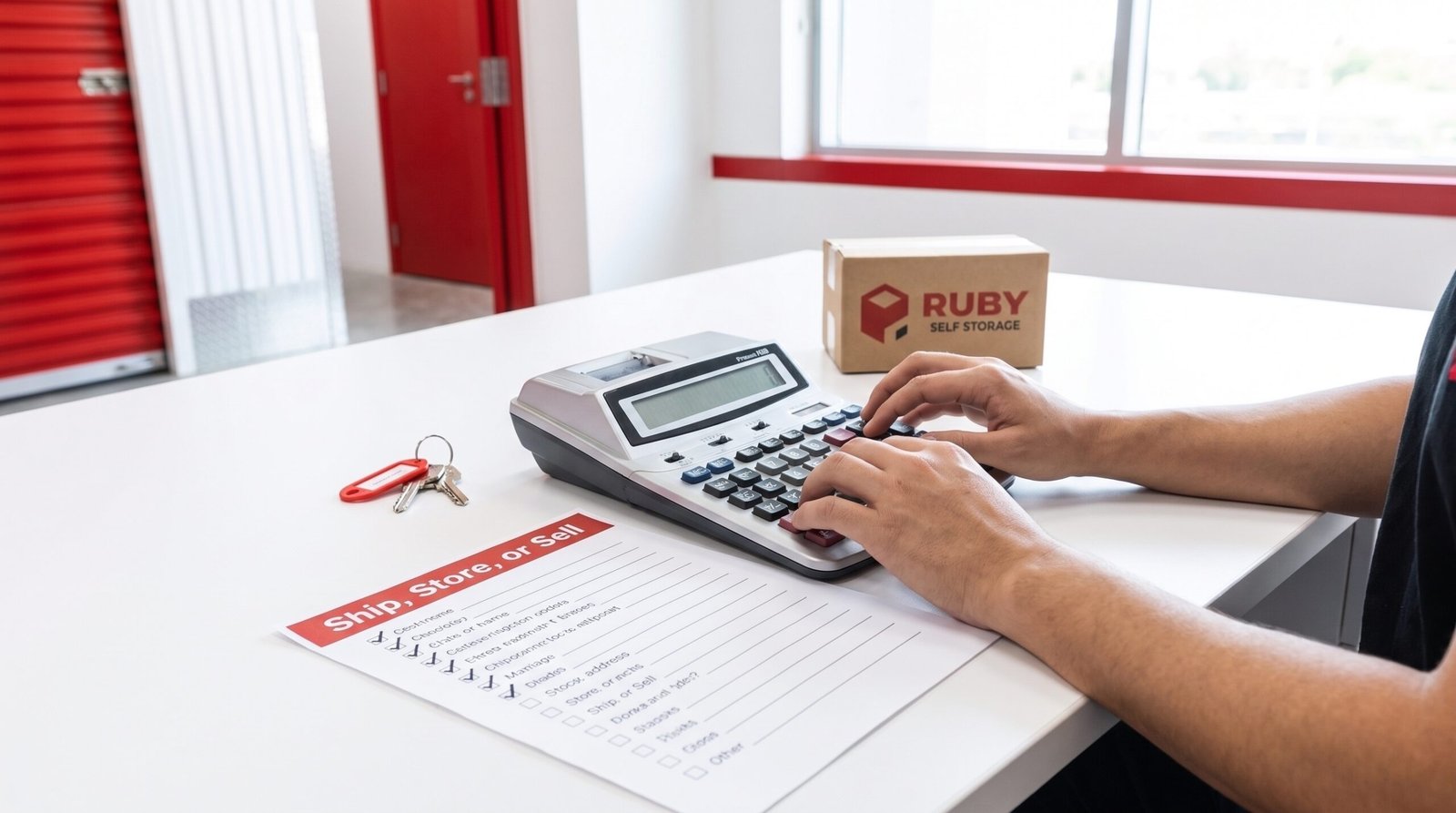
What a storage unit costs against a small office
A small storage unit usually costs less than a physical office when you require inventory space rather than licensed workspace.
Current Dubai business-storage rate cards checked in September 2026 show how strongly size and contract length affect cost. One public rate card includes 5% VAT, climate control, baseline insurance, security, and facility access in its published figures.
The table compares those rates with two current 100-square-foot physical office listings.
| Space | Monthly or equivalent cost | 12-month base cost |
|---|---|---|
| 25 sq ft business storage, monthly rolling | AED 300 | AED 3,600 |
| 25 sq ft business storage, 12-month rate | AED 234 | AED 2,808 |
| 50 sq ft business storage, 12-month rate | AED 663 | AED 7,956 |
| 100 sq ft business storage, monthly rolling | AED 1,750 | AED 21,000 |
| 100 sq ft business storage, 12-month rate | AED 1,365 | AED 16,380 |
| 100 sq ft furnished office, Deira | About AED 2,333 | AED 28,000 |
| 100 sq ft fitted office, Al Qusais | About AED 2,667 | AED 32,000 |
The storage figures come from a current commercial storage rate card. The physical office examples come from live Dubai listings at AED 28,000 and AED 32,000 per year.
In these examples, 100 square feet of annual-contract storage costs AED 11,620 less than the AED 28,000 office. The gap reaches AED 15,620 against the AED 32,000 office.
Tax treatment can widen the final office cost. The Federal Tax Authority states that commercial-building rent attracts 5% VAT, while residential rent generally remains exempt.
Price still does not make the two spaces interchangeable. Storage holds inventory. An approved office provides workspace and can support business-premises requirements.
Can you use a storage unit as a business address?
A normal self-storage agreement does not automatically qualify as a registered Dubai business address.
The UAE Ministry of Economy and Tourism requires UAE companies to maintain a physical address for their economic activity.
The location must satisfy economic-development requirements and applicable zoning rules.
For Dubai mainland operations, the Ministry states that office or warehouse leases require registration through Ejari.
That separates a storage contract from an approved business premises contract. A unit can serve as your registered premises only when the licensing authority accepts that location and the lease meets the required registration rules.
Free-zone arrangements can differ. The Ministry notes that free zones may offer offices or virtual-office arrangements for independent and professional licences.
Check the address on your licence separately from your inventory location. Your registered business address and physical stock address do not always perform the same legal function.
Access needs for a one-person operation
A one-person business benefits most from storage that reduces unnecessary collection trips, courier waiting, and manual stock handling.
Access frequency comes first. Daily e-commerce fulfillment creates a different requirement from quarterly archive retrieval.
Compare these 6 factors before choosing freelancer storage in Dubai:
- Check access hours. Some Dubai business storage facilities provide 24-hour access, while others restrict customer access.
- Check courier handling. Some facilities accept or hand over shipments without requiring you onsite.
- Check fulfilment support. Pick, pack, courier handover, and stock retrieval can reduce solo operating time.
- Check loading access. Confirm parking, lifts, trolleys, loading bays, and larger-item handling.
- Check climate conditions. Match temperature and humidity controls to the stored product.
- Check inventory records. Keep quantities, purchase records, photographs, and declared stock values aligned.
Workspace access may already come with the freelance structure. GoFreelance provides members with year-round, 24-hour access to its coworking facilities.
For a solo operator, that creates a useful separation. Use approved workspace for professional activity and suitable business storage for inventory when your licence permits the stock activity.
Choose storage that matches your licence and business model
Freelancer storage in Dubai works best when the storage choice follows the licence, not the other way around. A few cartons at home may be acceptable for one activity but unsuitable for another, especially when tenancy rules, product controls, or insurance conditions apply.
Before paying for extra space, check the activity on your licence, the permitted use of your residence, and the type of stock involved. Then compare the real operating cost. A small storage unit can be far cheaper than an office, while larger units can narrow that gap. Access hours, courier handling, climate conditions, and inventory value also change the decision.
For freelancers and home businesses, the right setup is the one that keeps stock practical without creating a licensing or premises problem. When inventory starts changing how the home functions, external business storage is usually the point where operations become easier to manage and easier to scale.
FAQs
Can a Dubai freelancer keep stock at home?
A Dubai freelancer can keep items related to the approved professional activity, but the freelance licence does not create unrestricted retail-stock rights. Check the licensed activity and residential-use rules.
What is the stock-volume limit for a Dubai home business?
Dubai’s cited public rules do not set one universal box, square-foot, or cubic-meter limit. Product rules and premises use determine the applicable restriction.
Can an Intelaq food trader store food stock at home?
No. Dubai SME’s published food-trading conditions treat the residence as a management office and prohibit home storage or repacking for those food-trading activities.
How much does business storage cost in Dubai?
Current published rates start around AED 300 monthly for 25 square feet. The cited 12-month rates reach AED 663 monthly for 50 square feet and AED 1,365 for 100 square feet.
Is storage cheaper than a small Dubai office?
It can be. A cited 100-square-foot storage unit costs AED 16,380 across 12 months, while current 100-square-foot office examples list at AED 28,000 and AED 32,000 annually.
Can you register a self-storage unit as your business address?
Not automatically. Dubai mainland business premises must satisfy activity, zoning, lease, and Ejari requirements. A normal self-storage contract does not establish those approvals by itself.
Does home insurance cover business stock?
Do not assume it does. UAE home insurance wording can limit cover to personal belongings or exclude business-use items and commercial stock.
Rakan Al-Juraid is a logistics specialist with a focus on commercial storage systems and high-security asset management. With extensive experience in industrial warehousing, he specializes in inventory tracking technology and transit safety. Rakan’s expertise lies in streamlining the storage process for both businesses and homeowners through strategic planning. His writing offers data-driven advice on insurance for stored goods, fire-safe environments, and heavy-duty logistics. He is committed to ensuring that every square foot of storage is utilized with maximum security and efficiency. Rakan aims to provide professional-grade storage standards to every reader navigating the moving process.
- Rakan Al-Juraid
- Rakan Al-Juraid
- Rakan Al-Juraid