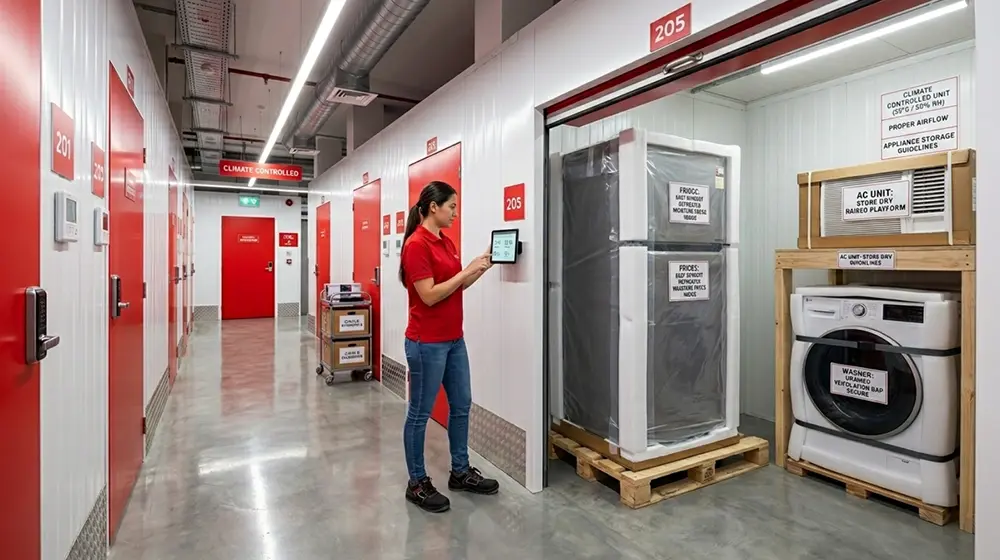
Appliance Storage in Dubai: How to Store Fridges, ACs, and Washing Machines Safely
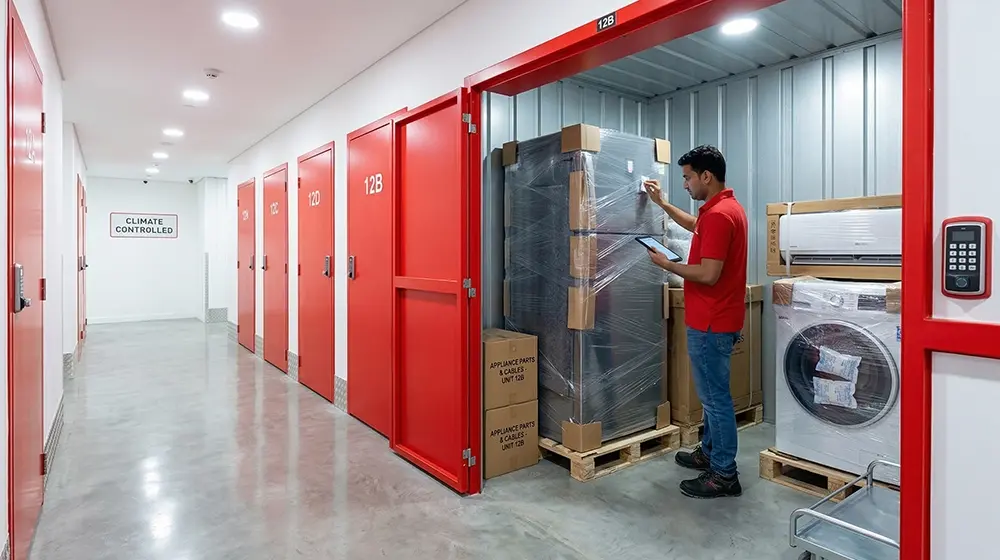
Appliance storage in Dubai is safest in a clean, indoor, humidity-controlled unit after complete draining, cleaning, drying, upright placement, and model-specific shutdown steps. That is the short answer. Dubai Government Media Office reports an annual average humidity of 59%, a highest monthly average of 65%, and an average summer high of 41.8°C, while humid coastal nights in summer can push RH towards 90%, so appliance storage in Dubai operates with a narrow moisture and heat margin from the start. EPA guidance places indoor humidity below 60%, ideally 30% to 50%.
This guide does two things. First, it reduces the probability of mold, corrosion, odor, gasket damage, trapped-water damage, and restart faults. Second, it gives a usable operating framework for appliance self-storage in Dubai during relocation, renovation, fit-out, landlord handover, inventory holding, and staged move schedules.
The storage logic becomes clearer once Dubai’s climate profile and each appliance’s failure points sit side by side.
Why is appliance storage in Dubai more demanding than generic storage?
Appliance storage in Dubai is more demanding because climate conditions sit close to, or above, accepted indoor moisture limits while appliances retain water internally. According to the EPA, indoor RH stays safest below 60%, ideally 30% to 50%. According to NIOSH and Health Canada, 30% to 50% also reduces mold risk. According to the Canadian Conservation Institute, mixed-material storage becomes riskier once RH exceeds 55% because corrosion concerns rise.
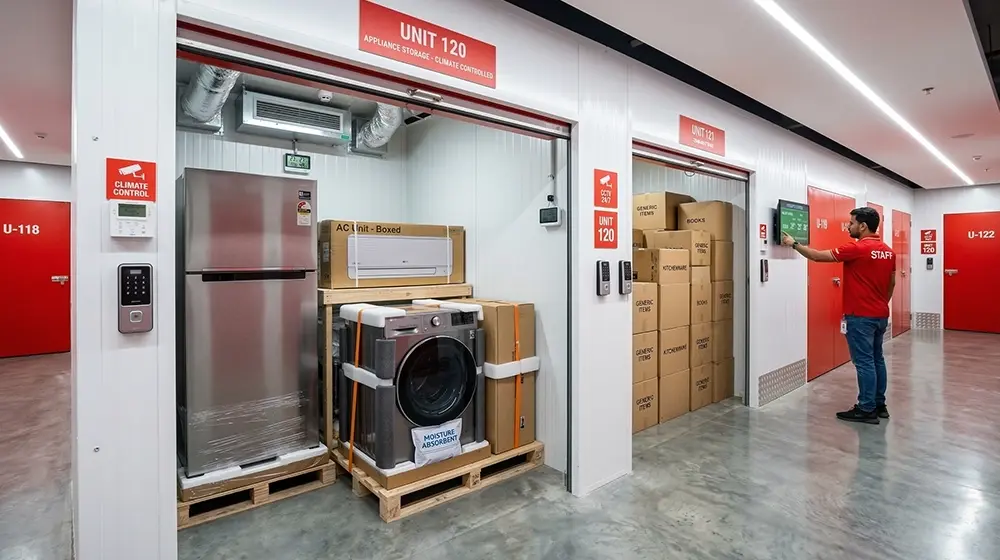
Climate and storage thresholds that matter
| Metric | Quantified figure | What it means for storage |
|---|---|---|
| Dubai’s annual average humidity | 59% | 1 point below the EPA ceiling |
| Dubai’s highest monthly average humidity | 65% | 5 points above the EPA ceiling, with nightly peaks far higher |
| EPA indoor humidity ceiling | below 60% | Upper moisture limit |
| EPA ideal indoor range | 30% to 50% | Best target range |
| NIOSH indoor range | 30% to 50% | Mold-reduction range |
| Health Canada indoor range | 30% to 50% | Moisture-control range |
| CCI mixed-material range | 35% to 55% | Corrosion-aware storage band |
| Dubai’s average summer high | 41.8°C | High heat stress for stored appliances |
The practical reading is simple. In appliance storage in Dubai, a room that feels “normal” can still be moisture-heavy by technical standards. An annual average of 59% relative humidity (RH) is already above the ideal 50% ceiling. The highest monthly average of 65% RH also crosses the EPA ceiling and sits 10 points above the corrosion-aware 55% threshold used by the Canadian Conservation Institute, and individual humid summer nights on the coast go well beyond these averages.
What storage conditions define safe appliance self-storage in Dubai?
Safe appliance self-storage in Dubai uses five measurable controls: indoor placement, humidity control, full drainage, full drying, and upright positioning. According to the EPA, a humidity meter often costs $10 to $50, which makes moisture tracking inexpensive compared with appliance repair or replacement. Indoor air stays more stable for mold control at 30% to 50% RH.
5 measurable controls
- Keep RH between 30% and 50% where possible. That aligns with EPA, NIOSH, and Health Canada guidance.
- Treat 55% RH as a warning line. Corrosion concerns increase above 55% RH for mixed-materials applications.
- Avoid persistent conditions above 60% RH. According to the EPA, it crosses the general indoor moisture ceiling.
- Keep every appliance upright. GE, Whirlpool, and portable AC manuals all reinforce upright handling or upright recovery before operation.
- Store only after the appliance is dry inside and out. GE, Whirlpool, Honeywell, and Midea all repeat the clean, dry, drain sequence.
Heat control also matters. According to Whirlpool, one refrigerator manual states a location range of 13°C to 43°C, with a preferred range of 15°C to 32°C. The United Arab Emirates (UAE) had its hottest April on record, with an average daily maximum temperature of 42.6°C. That is why unmanaged storage rooms, service yards, rooftop plant areas, and metal sheds are poor choices for appliance self-storage in Dubai.
| Control point | Safe figure or action | Risk if ignored |
|---|---|---|
| Relative humidity | 30% to 50% ideal | Mold and corrosion risk rise |
| Upper humidity line | Below 60% | Moisture threshold exceeded |
| Appliance position | Upright | Compressor, tub, and internal-component stress |
| Internal water | Zero standing water | Odor, mildew, and hidden damage |
| Filters and gaskets | Clean and dry | Mold growth and airflow restriction |
| Accessory storage | Bag parts with the unit | Missing hoses, remotes, and drain tubes |
How do you store a fridge safely in appliance storage in Dubai?
Store a fridge by emptying it, shutting down water functions, cleaning the liner, drying it fully, propping the doors open, and keeping the cabinet upright. According to GE, long-term refrigerator storage starts when the unit is out of use for more than one month. GE also recommends cleaning the interior with 1 tablespoon of baking soda per 1 quart of water, wiping the interior dry, adding 2 cups of dry coffee grounds or an open box of baking soda, and leaving the doors open to prevent odor, mold, and mildew.
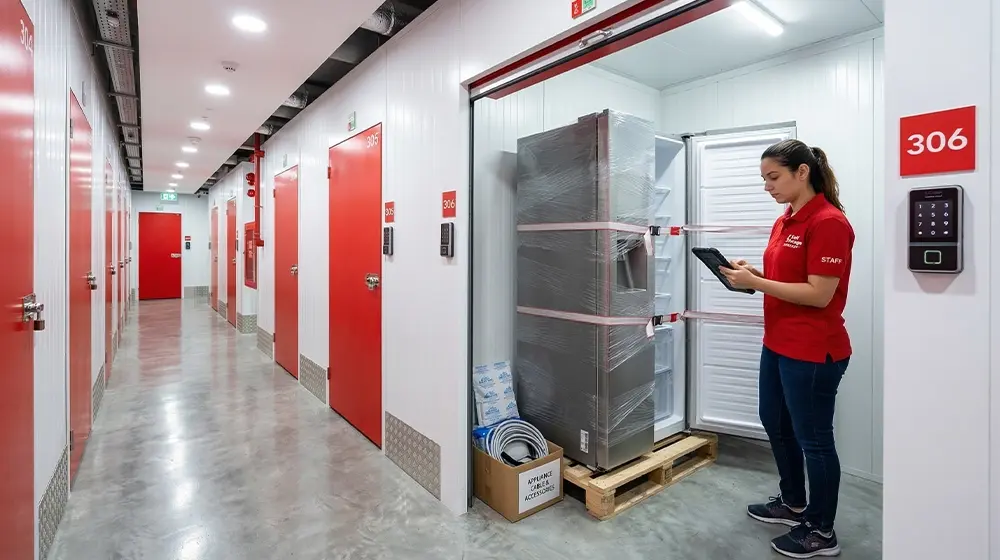
Fridge storage checklist
- Turn the temperature control off and unplug the unit. GE lists that for long-term storage.
- Turn the icemaker off and shut the water supply if fitted. GE includes both steps for long-term storage.
- Remove all food and ice. GE lists full removal before storage.
- Clean with the baking-soda mix of 1 tablespoon per 1 quart of water. GE provides that exact ratio.
- Wipe every surface dry.
- Leave the doors open. GE links open doors to odor, mold, and mildew prevention.
Fridge transport and settling figures
| Fridge control | Quantified figure |
|---|---|
| Preferred room range | 15°C to 32°C |
| Allowed location range | 13°C to 43°C |
| Side transport recovery | Up to 24 hours upright if on side for more than a day |
| Side and top ventilation clearance in one Whirlpool manual | 1/2 inch |
| Rear clearance in one Whirlpool manual | 1 inch |
| Fixed-wall side clearance in one Whirlpool manual | 2 inches minimum |
According to GE, if a refrigerator stays on its side for more than one day, it stays upright for 24 hours before restarting. That number is not cosmetic. It directly reduces restart risk after oil migration and transport disturbance. In practice, that makes upright movement and upright storage the better default in appliance storage in Dubai, especially during building move-ins, where appliances often remain boxed or staged before connection.
How do you store AC units safely in appliance storage in Dubai?
Store AC units by draining condensate, drying the filter and internal moisture path, packing the accessories with the unit, and keeping the unit upright in a cool, dry indoor space. According to Honeywell, the unit needs full drainage, 30 minutes in Fan Only mode before storage, dry filters, dry window-kit parts, and storage away from direct sunlight. According to Midea, portable ACs occasionally require drainage in humid environments, and extended storage starts with complete drainage and moisture removal.
AC storage checklist
- Drain all leftover condensation. Honeywell and Midea both specify drainage before storage.
- Run Fan Only mode for 30 minutes. Honeywell provides that exact drying interval.
- Remove and dry the dust filter. Honeywell says the filter stays dry before reinstalling.
- Keep accessory parts together. Honeywell recommends storing the window kit, remote control, and drain tube in one bag with the unit.
- Store in a cool, dry place away from direct sunlight, as Honeywell advises.
- Keep the unit upright. Honeywell specifies an upright period of 1 hour before use to stabilize refrigerant, which supports upright handling discipline during storage as well.
AC figures that matter
| AC control | Quantified figure | Source relevance |
|---|---|---|
| Pre-storage drying cycle | 30 minutes | Honeywell |
| Dust-filter cleaning interval during use | Every 2 weeks | Honeywell |
| Upright stabilization before use | 1 hour | Honeywell |
The key Dubai issue is condensate. A portable AC may require drainage in humid environments because water collects in the internal drain pan. Dubai’s official annual average humidity of 59%, a highest monthly average of 65% and much higher humid nights explain why a portable AC that “looked dry” after seasonal use can still hold internal moisture. In appliance storage in Dubai, condensate left inside the unit becomes a mold and odor risk during idle storage.
What about split AC systems?
This storage framework fits portable ACs, window ACs, and detached AC components best. Fixed split systems depend on model-specific HVAC service instructions. Midea’s manual states that service personnel handle the equipment with reference to the installation manual, which makes model-specific professional handling the safer route for refrigerant-related work.
How do you store a washing machine safely in appliance storage in Dubai?
Store a washing machine by disconnecting and draining the inlet hoses, draining the waste line, drying the drum and gasket, reinstalling transport bolts where applicable, and keeping the unit upright. According to Whirlpool, transport starts with shutting off both water faucets, disconnecting and draining inlet hoses, disconnecting the drain hose, placing the hoses inside the drum, and moving the washer upright. According to Samsung, front-load transport without shipping bolts can damage the suspension, tub, and other internal parts.
Washing machine storage checklist
- Shut off both water faucets. Whirlpool lists that as step one.
- Disconnect and drain the inlet hoses.
- Disconnect the drain hose from the drain system and washer back.
- Place the inlet and drain hoses inside the drum.
- Dry the gasket and interior. Whirlpool states that a closed front-load washer door prevents the tub from drying properly and supports mildew growth.
- Leave the door ajar until the interior dries. Whirlpool recommends that directly.
- Reinstall shipping bolts for transport on front-load models. Samsung says transporting without them can damage the suspension and other major internal parts.
- Keep the washer upright. Whirlpool states that the washer must be transported upright.
Washer figures that matter
| Washer control | Quantified figure |
|---|---|
| Transport bolts on one Whirlpool front-load installation guide | 4 |
| Hose replacement interval in one Whirlpool guide | Every 5 years |
The value of those figures is procedural. They show that washer storage is a water-management task, not just a moving task: Whirlpool’s installation guide specifies the drain path in detail because water path errors create operational faults. In appliance self-storage in Dubai, any washer that enters storage with water still trapped in the hoses, drain loop, dispenser, or gasket enters with a known avoidable risk.
What packaging and placement controls reduce appliance-storage failures?
The most effective placement controls are upright positioning, moisture separation, accessory containment, and restart-ready packing. Those controls sound simple, but they directly match the failure points identified by manufacturers: trapped water, loose parts, blocked airflow, and transport-related internal movement.
Use this placement framework inside the storage unit:
- Keep each appliance upright. GE, Whirlpool, and AC manuals all reinforce upright handling or storage.
- Store hoses, window kits, remotes, and drain tubes with the same appliance. Honeywell recommends storing the window-kit parts, the remote control, and the drain tube together with the portable AC unit. Whirlpool places hoses inside the washer.
- Protect from moisture, not just dust. AC manuals warn against water exposure and require dry filters and dry parts before storage.
- Maintain an open-air path where the manufacturer requires it. For fridges, propped doors matter. For portable ACs, the core principle is dry airflow and no trapped condensate before storage.
For multi-appliance moves, an intake sheet adds practical control. Record appliance type, shutdown date, whether the water path was drained, whether transport bolts were installed, and whether the unit entered storage upright and fully dry.
Which mistakes cause most post-storage appliance damage?
The most common mistakes are trapped water, sealed doors, side transport without recovery time, missing shipping bolts, and uncontrolled humidity. Those five errors account for a large share of the avoidable odor, mildew, suspension, and restart problems that appear after storage.
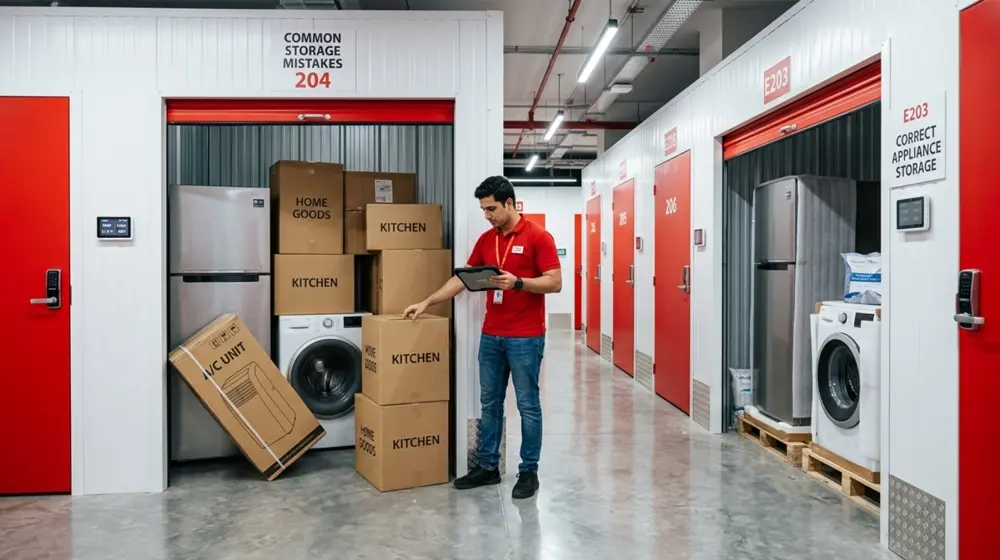
The highest-risk mistakes
- Closing a stored fridge completely. GE and Whirlpool both say open or propped doors stop odor, mold, and mildew buildup.
- Leaving washer moisture in the gasket or drum. Whirlpool states that front-load gaskets trap moisture and support mold and mildew growth if not cleaned and dried.
- Storing a portable AC with condensate still inside. Midea and Honeywell both require drainage before extended storage. One AC manual says an undried evaporator risks component damage and mold.
- Moving a front-load washer without shipping bolts. Samsung says that practice can damage the suspension and other major internal parts.
- Running a refrigerator immediately after side transport. GE says a unit that stayed on its side for more than a day stands upright for 24 hours before operation.
- Treating Dubai’s ambient air as “good enough” moisture control. Dubai’s annual average humidity of 59% sits right below EPA’s 60% ceiling, and the 65% highest monthly average exceeds it.
What is the best short-term and long-term framework for appliance self-storage in Dubai?
The best framework is not based on rent duration alone. It is based on the appliance’s moisture status on entry. According to GE, refrigerator storage beyond one month counts as long-term storage. According to the EPA, NIOSH, and Health Canada, humidity control remains the central variable across longer hold periods.
Decision framework
| Storage case | Recommended setup | Risk level |
|---|---|---|
| Dry appliance, upright, RH 30% to 50% | Indoor humidity-controlled unit | Lower |
| Dry appliance, RH 50% to 55% | Indoor unit with monitoring | Moderate |
| Any appliance above 55% RH exposure for long periods | Humidity control and inspection | Elevated |
| Any wet appliance entering storage | Delay storage until dry | High |
| The fridge was moved to the side and restarted immediately | Recovery time missing | High |
| The washer moved without shipping bolts | Mechanical transport risk | High |
For Dubai users, the dividing line is straightforward. Climate-controlled appliance storage in Dubai is not a luxury feature for moisture-sensitive appliances. It is a damage-control feature. That applies most strongly to fridges with water lines, front-load washers with gaskets and residual detergent, and portable ACs with condensate paths.
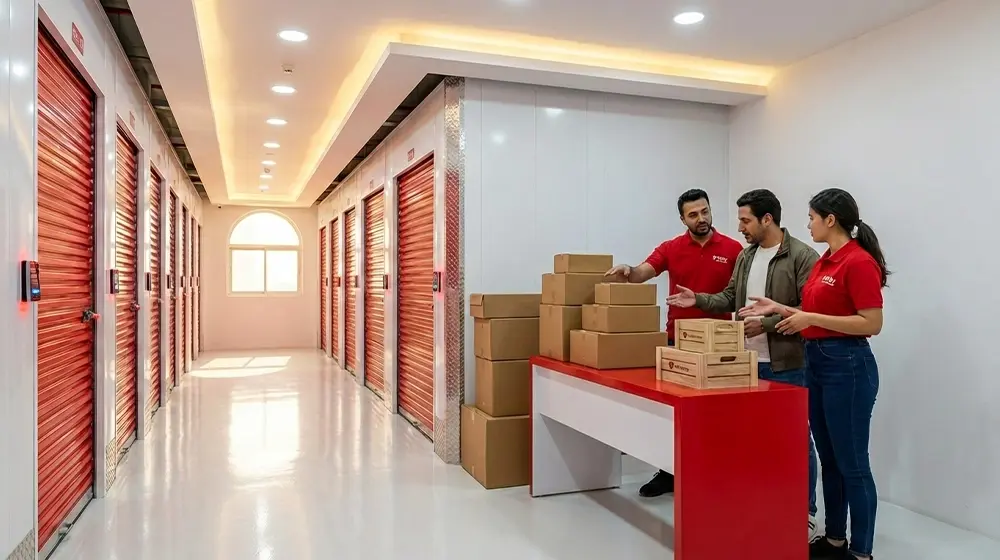
Unit size and cost per appliance
As a guide, a single fridge or washing machine stored upright needs about a 25 sq ft unit, which costs AED 400 to 550 a month at Ruby. A fridge, washer and portable AC together fit a 35 sq ft unit at AED 500 to 700 a month, and a full kitchen-and-laundry set with boxes suits 50 sq ft at AED 650 to 850. Use the size guide to check fit and current Dubai prices before you book; every unit is 8 ft high, so tall fridges stand upright without trouble.
What is the best restart procedure after appliance storage in Dubai?
The correct restart process is inspect, reconnect, stabilize, then energize. Restart faults often come from rushing the final stage. According to GE, a refrigerator restarted after side transport may require 24 hours upright. According to Whirlpool, washer reactivation starts with reconnecting hoses, turning on both water faucets, and running a cleaning cycle.
Fridge restart
- Confirm upright position and transport history.
- If the unit stayed on its side for more than one day, keep it upright for 24 hours before powering it.
- Reconnect the water line if fitted and confirm the interior is clean and dry.
Portable AC
- Remove the cover and confirm the filter is dry.
- Reattach the hose, window kit, remote, and drain tube if applicable.
- Confirm no water remains in the condensate path.
Washing machine
- Reconnect the inlet hoses and the drain path.
- Remove transport bolts before operation. Samsung states that a locked tub can damage internal parts.
- Run a cleaning or heavy-duty cycle after reconnection. Whirlpool recommends a cleaning run after non-use, vacation, winter storage, or moving.
Quick myth vs reality
Is a dry-looking appliance safe for storage?
Not necessarily. Midea states that portable ACs may still hold water in humid environments, and Whirlpool notes that front-load washer doors restrict drying when closed.
Is regular storage space enough for appliance storage in Dubai?
Only when humidity is controlled. Dubai’s annual average humidity is 59%, while the EPA, NIOSH, and Health Canada all frame 30% to 50% as the safer indoor range.
Does dust cover alone solve the problem?
No. Honeywell and Midea both pair dust protection with drainage and drying. The cover is the final step, not the first control.
5 question storage readiness check
A unit is storage-ready only when all five answers are yes.
- Is the measured RH below 60%, and preferably between 30% and 50%?
- Is every water path drained? Fridge water line, AC drain path, washer hoses, and drain line?
- Is every moisture-trap dry? Fridge liner, AC filter, washer gasket, dispenser, and drum?
- Is the appliance upright? GE, Whirlpool, Honeywell, and Samsung all point to position control.
- Are all loose parts packed with the appliance? Hoses, remotes, drain tubes, and kit parts
What Matters Most in Appliance Storage in Dubai?
Appliance storage in Dubai works best when moisture control drives every decision. Heat, humidity, trapped water, sealed doors, and poor positioning create most storage failures in fridges, ACs, and washing machines. The safer approach is clear: clean the appliance, drain every water path, dry every internal surface, keep the unit upright, and place it in an indoor, humidity-controlled space. That process reduces mold risk, odor buildup, corrosion, gasket deterioration, and restart faults. It also makes appliance self-storage in Dubai more predictable during relocation, renovation, landlord handover, and delayed move-in periods. In practical terms, safe storage is not about finding empty space. It is about controlling humidity, airflow, drainage, and transport conditions before the appliance enters storage and before it returns to service.