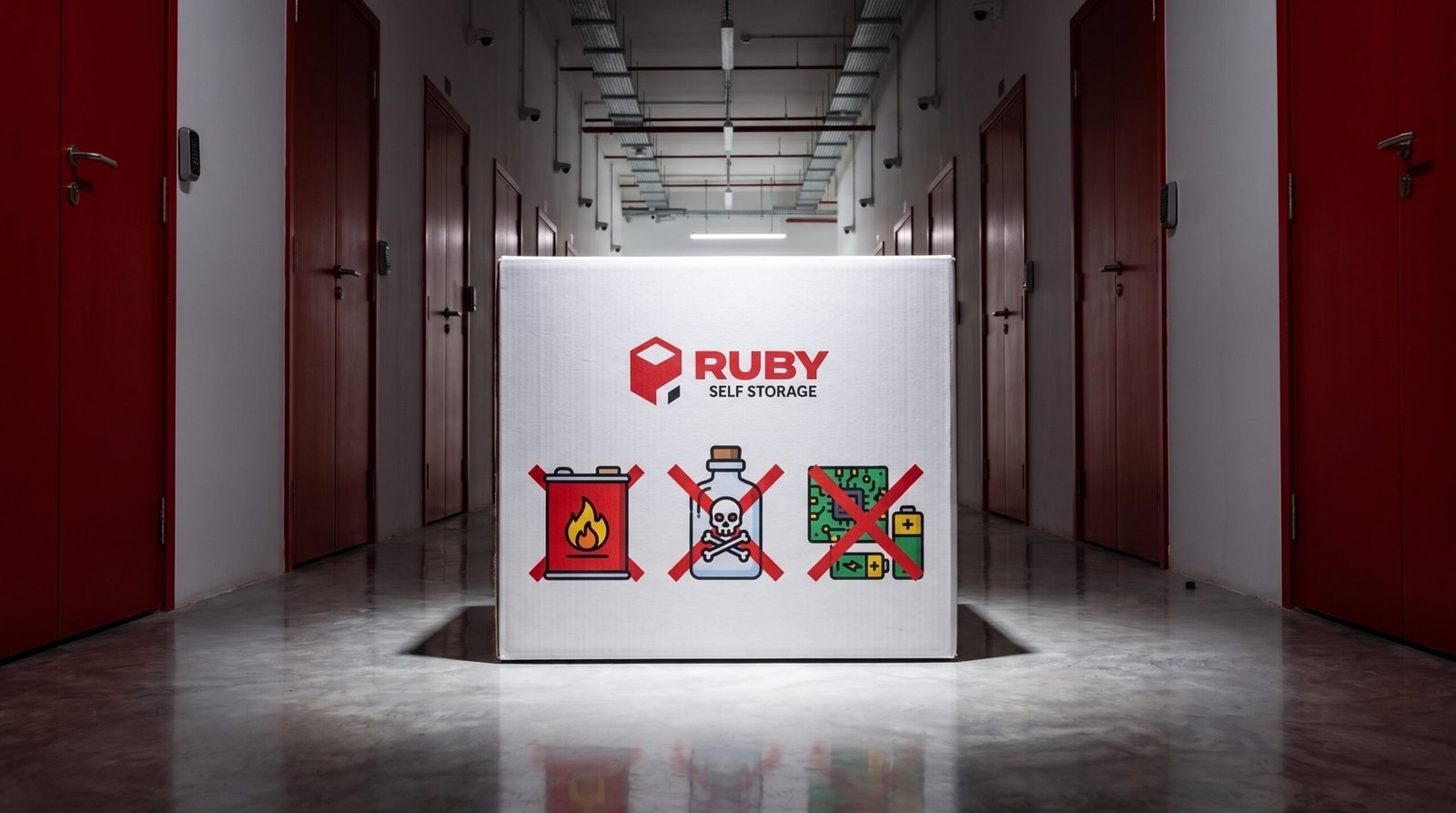
A box that looks harmless at home can become a customs, fire-safety, or hazardous-waste problem once it enters storage or shipping in the UAE. Petrol cans, aerosols, power banks, prescription medicines, household chemicals, perishables, and even some everyday consumer products can face different restrictions depending on how they are stored, transported, or imported.
That is where most confusion starts. Prohibited items in UAE storage rules do not come from one authority. UAE Customs controls border movement, Dubai Municipality regulates waste and selected products, while Civil Defence sets fire and life-safety requirements for storage premises.
This guide separates what is prohibited, restricted, conditionally accepted, or unsuitable for standard self storage in Dubai. It covers:
- Flammables
- Compressed gases
- Perishables
- Hazardous chemicals,
- Batteries
- Power banks
- Medicines
- Controlled goods
It also explains what happens when prohibited items are found, how legal disposal works in Dubai, and where grey areas require written confirmation before storage or shipping.
Who sets the rules?
Three regulatory layers determine whether you can import, ship, store, move or dispose of an item in Dubai. Customs deals with border movement. Dubai Municipality deals with local product and waste controls. Civil Defence deals with fire risks inside buildings.
- UAE Federal Customs
UAE customs law distinguishes prohibited goods from restricted goods. Prohibited goods cannot enter or leave under the applicable legislation. Restricted goods require approval from the competent authority before customs releases them. Dubai Customs explains this distinction in its current prohibited and restricted goods guidance.
Dubai Customs currently identifies categories including narcotic drugs, gambling equipment, used or reconditioned tyres, radiation-contaminated substances, paan, and betel leaves as prohibited. Restricted categories include pharmaceuticals, weapons, fireworks, foodstuffs, cosmetics, plants, pesticides, radio equipment, and rough diamonds.
Classification matters before shipping. The Dubai Customs Integrated Customs Tariff covers more than 5,000 commodity groups. The GCC tariff uses a 12-digit customs structure. The Al Munasiq system also identifies commodity descriptions, duty rates, and prohibition or restriction status.
If an item is restricted, obtain the approval linked to that commodity before clearance. Dubai Customs policy says restricted goods without the required approval are detained and the applicable legal process follows.
- Dubai Municipality
Dubai Municipality controls several local rules that affect food, consumer products, waste, and hazardous materials. Dubai Customs identifies Dubai Municipality as the controlling authority for foodstuffs, personal care products, and cosmetics.
Waste creates another regulatory layer. Law No. 18 of 2024, Regulating Waste Management in Dubai, covers waste storage, transport, treatment, recycling, import, export, and final disposal. The law applies across Dubai, including special development zones and free zones.
The 2026 implementing bylaw makes hazardous waste storage more specific. Containers require leak-proof sealed covers, chemical resistance, corrosion resistance, sturdy walls, and suitable color coding. Labels require the waste type, composition, warning codes, and disposal instructions. Dubai’s 2026 Waste Management Implementing Bylaw sets those requirements in Articles 9 and 10.
The same bylaw defines storage as a regulated waste-related activity. A normal self-storage unit therefore does not become a hazardous waste facility simply because space is available.
- Civil Defence
Dubai Civil Defence controls the fire and life safety conditions of storage buildings. The Dubai Civil Defence UAE Fire and Life Safety Code of Practice is the principal reference listed for building and facility fire safety.
The fire code distinguishes low-hazard storage from premises containing larger quantities or higher-risk combustible materials. Dubai Civil Defence guidance also identifies aerosols, flammable liquids, and flammable gases as fire hazards requiring careful storage.
That distinction matters for warehouses. A facility approved for furniture, documents, or boxed inventory does not automatically cover petrol, liquefied petroleum gas cylinders, solvents, or comparable hazardous materials.
For business inventory, confirm the approved use of the premises with the facility operator. Check the product safety data and written storage terms before moving regulated stock.
Prohibited categories and why
“Prohibited” can describe four different situations: customs prohibition, restricted import, hazardous storage, or exclusion under a private storage contract. Treating those labels as identical creates compliance errors.
The table shows how the main categories differ.
| Category | Common examples | Main authority or rule | Practical position |
|---|---|---|---|
| Flammables and gases | Petrol, LPG, solvents, some aerosols | Civil Defence, transport rules | Specialist controls apply |
| Perishables and biologics | Homemade food, meat, cell cultures, disease agents | Customs, Dubai Municipality | Declaration or product controls can apply |
| Corrosives and toxics | Acids, toxic cleaners, pesticide waste | Dubai Municipality | Hazardous storage and disposal rules apply |
| Controlled goods | Narcotics, weapons, fireworks, some medicines | Customs plus competent authority | Prohibited or approval-based |
| Lithium batteries | Power banks, spare lithium batteries | GCAA for air transport | Quantity and watt-hour limits apply |
The exact product, quantity, packaging, transport mode, and intended use determine the final treatment. Legal ownership alone does not establish storage or shipping acceptance.
- Flammables and compressed gases
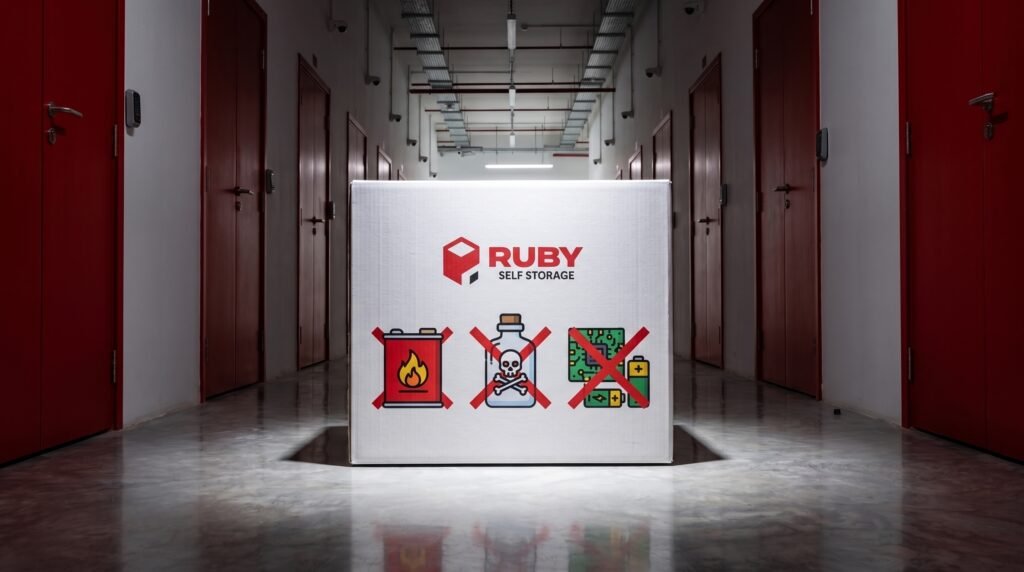
Flammables and compressed gases fall outside ordinary household storage because they add ignition, pressure, and fire-load risks. Petrol, LPG cylinders, fuel canisters, thinners, and solvent products are common examples.
Dubai Civil Defence says careful use and storage of flammable liquids and aerosols are necessary for workplace safety. Its guidance also directs premises operators to secure flammable liquids and gases.
Air transport adds another control. The UAE General Civil Aviation Authority (GCAA) maintains UAE regulations for transporting dangerous goods by air under Civil Aviation Regulation Part VI.
A product can therefore be legal to own but unsuitable for an ordinary moving carton, passenger bag, or self-storage unit. Check its hazard classification and the premises’ approved use first.
- Perishables and biologics
Perishable food and biological materials face hygiene, customs and temperature control issues rather than one universal prohibition.
Dubai Customs asks arriving passengers to declare meats, animals, animal products, disease agents and cell cultures. Dubai Customs also lists cooked and homemade food among banned passenger items. Foodstuffs generally fall under Dubai Municipality control.
Standard self storage adds a separate contractual layer. Perishable food can attract pests, leak or deteriorate. Ruby Self Storage lists perishables among categories excluded from ordinary self storage.
Packaged commercial food is different from homemade food or biological material. Check the exact product rather than applying one rule to every food item.
- Corrosives, toxics and hazardous waste
Corrosive or toxic products include acids, certain pesticides, industrial cleaners, contaminated fluids and chemical waste. The regulatory issue depends on whether you hold a usable product or discard it as waste.
Dubai’s 2026 waste rules require hazardous waste containers to resist chemicals, corrosion and leakage. Containers also require secure covers and labels identifying the waste, composition, warning codes and disposal instructions.
Dubai Municipality classifies hazardous waste by properties including toxicity, reactivity, ignitability, corrosiveness, infection risk and radioactivity. Improper storage can contaminate soil, surface water or groundwater.
Once a chemical becomes hazardous waste, use the permitted waste route rather than leaving it inside general business storage.
- Controlled and restricted goods
Controlled and restricted goods require category-specific approval. Dubai Customs links each restricted goods category to the competent regulator.
Examples include:
- Pharmaceuticals and medical equipment: Health authorities.
- Weapons, ammunition, explosives, and fireworks: Defence or interior authorities.
- Live animals, plants, fertilizers, and pesticides: Environmental authorities.
- Food, cosmetics, and personal care products: Dubai Municipality.
The enforcement scale is measurable. In August 2025, Dubai Customs reported seizing more than 35 tonnes of counterfeit, smuggled, and non-compliant goods during an air-cargo campaign.
That operation included 12 million smuggled cigarettes, 6.7 million counterfeit cigarettes, 37,110 non-compliant cosmetic products, and 3,632 unauthorized electronic parts.
Storage does not cancel an import restriction. Moving restricted goods into a warehouse does not change the product’s legal status.
The grey areas most people get wrong
Grey areas usually involve ordinary products containing a regulated component. A deodorant may be pressurized. A laptop contains a lithium battery. A prescription medicine may contain a controlled substance.
Aerosols and power banks can fall outside standard storage cover. Confirm each in writing. Ruby Self Storage’s accepted-items guidance excludes flammable materials, perishables, illegal substances, and hazardous materials from ordinary personal storage.
- Household chemicals and aerosols
Household chemicals are not automatically prohibited. Their composition, pressure, flammability, toxicity, quantity, and transport method determine the applicable restriction.
For air passengers, GCAA dangerous goods guidance permits qualifying non-flammable, non-toxic aerosols for toiletry, sporting, or household use within exact limits. The combined quantity cannot exceed 2 kilograms or 2 liters. Each item cannot exceed 0.5 kilograms or 0.5 liters.
That passenger allowance does not prove a self-storage facility accepts the product. It also does not cover every aerosol formulation.
Disposal creates another classification. Dubai Municipality’s hazardous waste technical guidance lists pressurized gas cylinders and aerosols within its special waste categories.
- Batteries and power banks
Power banks are regulated differently from ordinary electronics during air travel.
The 2026 GCAA dangerous goods list treats power banks as spare lithium batteries. Spare batteries travel in carry-on baggage only, not checked baggage. Standard lithium-ion batteries in that category cannot exceed 100 watt-hours, and the general passenger limit is 20 spare batteries, unless the operator approves more.
Air cargo follows a different system. GCAA requires UAE-originating dangerous goods shipments, including specified lithium battery consignments, to enter through a GCAA Dangerous Goods Certified entity.
Do not use passenger baggage rules as permission for courier shipping. Ask the carrier how it classifies the exact battery, watt-hour rating, packaging and transport mode.
- Medicines and supplements
Medicines are not automatically prohibited, but controlled medicines receive tighter treatment. Personal carriage, commercial import, and warehouse storage are different activities.
The Ministry of Health and Prevention (MOHAP) allows travellers to carry narcotic and controlled medicines for a maximum three-month treatment supply with the required documentation. Prescription-only medicines can reach a six-month personal supply.
MOHAP also says travelers without prior electronic approval declare narcotic and controlled medicines on arrival with their prescription and medical report. Residents importing controlled medicines through shipping companies use the electronic approval process.
Supplements may fall under product registration rules rather than personal medicine rules. For commercial stock, check product status, expiry controls, temperature conditions, and warehouse acceptance before storage.
What happens if prohibited items are found
The result depends on the breach. Customs detention, regulatory enforcement, dangerous-goods rejection, and a storage contract violation are different outcomes.
Dubai Customs policy says prohibited or restricted goods without the required approvals can be detained and subjected to the applicable legal process.
The scale of enforcement is visible in current figures. Dubai Customs recorded 502 narcotics seizures, 406 kilograms of controlled substances, and more than 2.3 million tablets during January through May 2026.
Dubai waste law has separate penalties. Law No. 18 of 2024 permits fines of up to AED 500,000 for violations of the law, its implementing bylaw, or related resolutions.
A repeated violation within one year can double the applicable fine, subject to the AED 500,000 ceiling. Dubai Municipality can also remedy a violation at the violator’s expense and add a 25% administrative charge to those costs.
A contractual storage exclusion is not automatically an AED 500,000 offence. The material, conduct, permit status, quantity, and applicable legislation determine the regulatory consequence.
Legal disposal routes in Dubai
Legal disposal starts by identifying what the unwanted item has become. Furniture, spent batteries, expired chemicals, aerosols, electronics, and hazardous liquids do not share one disposal route.
Use this sequence:
- Identify the material and quantity: Record the product name, components, condition, hazard information, and amount.
- Classify the waste: Dubai Municipality separates general, green, construction and demolition, liquid, and hazardous waste.
- Use the correct disposal process: Dubai Municipality’s Waste Disposal Service guidance covers hazardous waste, trade waste, and unwanted materials.
- Choose an approved carrier: Dubai Municipality’s Waste Department publishes approved hazardous waste transporters and permitted processing or recycling facilities.
- Keep the waste record. The 2026 bylaw requires covered producers to record waste type, daily quantity, approved carriers, and disposal sites.
Dubai’s 2026 bylaw makes hazardous storage requirements concrete. Containers must have tightly sealed covers and be chemical-resistant, corrosion-resistant, weather-resistant, color-coded, and labeled with prescribed information.
Law No. 18 of 2024 also requires Dubai Municipality authorization before importing or exporting waste or recyclable materials. The law prohibits importing waste for final disposal except for the limited authorized purposes specified in Article 18.
For ordinary bulky household waste, Dubai Municipality operates a separate collection service. The municipality reported handling 4,000 bulky-waste requests during the first half of 2022. That route covers items such as furniture and appliances, not hazardous chemicals.
Check before you pack, store or ship
The safest approach to prohibited items in UAE storage is simple: verify the item before it enters a box, vehicle, warehouse, or shipping network. A product that is legal to own can still face customs restrictions, dangerous-goods controls, municipal disposal rules, or a storage provider exclusion.
Start with the exact product. Check its customs classification, identify the competent regulator, review the transport rules, and get written confirmation from the storage provider. That sequence resolves most grey areas before they become delays, rejected shipments, or compliance problems.
Do not place flammables, compressed gases, hazardous chemicals, damaged batteries, controlled medicines, or restricted goods into general storage without checking the applicable rules. The same applies to disposal. Hazardous waste follows approved Dubai Municipality routes, not ordinary rubbish collection.
Before booking storage or arranging transport, send the provider a written list of any uncertain items. Get a clear acceptance or refusal for each one. That single step gives you a documented answer before packing starts.
FAQs
What items are prohibited in UAE storage?
Illegal goods, hazardous materials, flammables, compressed gases, and perishables are commonly excluded from general storage. Customs and municipal rules separately regulate restricted products and hazardous waste.
What is the difference between prohibited and restricted goods in the UAE?
Prohibited goods cannot normally enter or leave under applicable law. Restricted goods require approval from the competent authority before customs releases them.
Can you store aerosol cans in Dubai?
Aerosol acceptance depends on composition and facility rules. GCAA permits qualifying non-flammable, non-toxic aerosols within 2-kilogram or 2-litre combined passenger limits.
Can you ship a power bank in the UAE?
Air transport is regulated. GCAA treats power banks as spare lithium batteries, with standard lithium-ion units limited to 100 watt-hours for the cited passenger category.
Can you store prescription medicine in a self-storage unit?
Legal possession does not guarantee storage acceptance. Check controlled-drug status, expiry, temperature requirements, and the provider’s written terms before storing medicine.
Can you ship food into Dubai?
The rule depends on the food and transport context. Dubai Customs lists cooked and homemade food as banned passenger items, while commercial foodstuffs fall under Dubai Municipality controls.
How do you check an uncertain item before storage or shipping?
Identify the exact product, check its customs classification, confirm the competent regulator, review transport rules, and obtain written storage acceptance. That process resolves most prohibited-item UAE storage questions before packing begins.
Rakan Al-Juraid is a logistics specialist with a focus on commercial storage systems and high-security asset management. With extensive experience in industrial warehousing, he specializes in inventory tracking technology and transit safety. Rakan’s expertise lies in streamlining the storage process for both businesses and homeowners through strategic planning. His writing offers data-driven advice on insurance for stored goods, fire-safe environments, and heavy-duty logistics. He is committed to ensuring that every square foot of storage is utilized with maximum security and efficiency. Rakan aims to provide professional-grade storage standards to every reader navigating the moving process.
- Rakan Al-Juraid
- Rakan Al-Juraid
- Rakan Al-Juraid